// The money read, in writing
The $100 Billion Panic: Why YouTube is Paying Millions for Your Silence
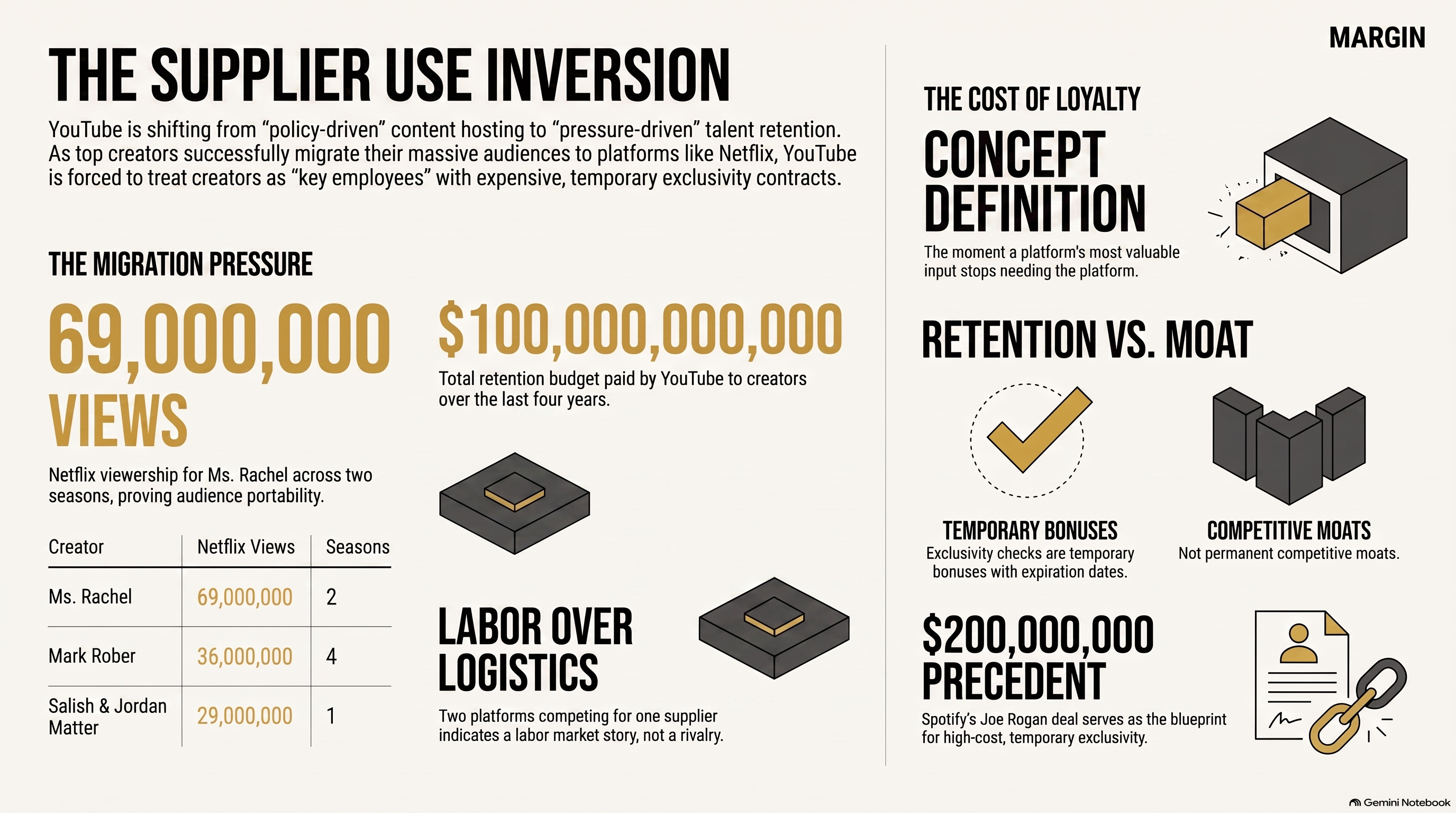 Download the one-page infographic
Why is the world’s largest video platform suddenly terrified of its own stars leaving? For over a decade, YouTube sat comfortably as the undisputed king of digital video, operating under the assumption that the platform was the destination and the creators were simply the guests. But that hierarchy is collapsing. YouTube is no longer just buying content; it is buying silence around a single word: exclusivity. Bloomberg sourcing reveals that YouTube is reportedly offering top-tier creators seven-figure checks to stay put. This isn't for a specific viral hit or a new channel launch. Instead, the money arrives via direct financing for a creator’s slate or a significant cut of brand deal revenue that would traditionally go elsewhere. This is "pressure, not policy"—informal talks and high-stakes maneuvering rather than filed contracts, signaling a platform in a defensive crouch. We are witnessing a fundamental shift in the power balance between platforms and creators. This is the moment the mask falls off. YouTube has realized that its grip on the "creator economy" is a phantom, and they are now desperately trying to buy the loyalty they once took for granted.
The Numbers That Keep YouTube Awake at Night
The anxiety in San Bruno isn't based on vibes; it’s based on a brutal set of data points from Netflix’s 2026 first-half report. This wasn't a leak, but a formal filing that confirmed YouTube’s worst nightmare: their top talent is portable. Creators who built their empires on Google’s infrastructure are migrating their audiences to the " Big Red N" with startling efficiency. Ms. Rachel logged 69 million views across just two seasons on Netflix. Mark Rober’s Crunch Labs brought in 36 million views over four seasons, and the duo of Salish and Jordan Matter accounted for 29 million views. These aren't just statistics; they are proof of a " YouTube-to-Netflix" pipeline that works. Creators who built their audience on YouTube travel intact into a 325 million subscriber platform and the audience follows them there. This migration shatters the illusion that the platform provides the value. When a creator leaves, the audience doesn't look for a replacement on YouTube; they change the input on their remote.
It’s Not a Content Deal—It’s a Retention Bonus
YouTube has paid over $100 billion to creators and media companies over the last four years. While that sounds like an investment in a thriving ecosystem, the new seven-figure exclusivity checks represent a different financial logic entirely. These are not payments for services rendered. They are key employee retention bonuses. Think of it like a major tech acquisition. Before a deal closes, the buyer writes massive "stay-put" checks to the target company’s best engineers to prevent a talent drain. YouTube is running this exact same math under extreme pressure. Whether the check goes to a software architect or a YouTuber, it’s the same balance sheet line—it’s just wearing a ring light.
The Illusion of the "Moat"
For years, platforms have tried to build "moats" to protect their dominance, but paid exclusivity is a fragile defense. Unlike a technological advantage or a network effect, an exclusivity check is a temporary fix with a ticking clock. The strategy doesn't actually create a lasting advantage because the incentive resets the moment the contract ends. It’s a bidding contest wearing a renewal clause, not a sustainable business model. Moats hold because the terrain won't drain. And this is a check with an expiration date. The second Netflix or another bidder writes a larger check, the "moat" evaporates. YouTube is effectively renting the silence of its creators, but the lease is up for renewal every single year.
The Supplier Use Inversion: A New Economic Reality
We are entering the era of the " Supplier Use Inversion. " This is the revelation that the most valuable input—the creator—no longer needs the platform more than the platform needs them. For decades, a philosophical battle raged between industry titans. Reed Hastings built Netflix on the bet that content could be commoditized and personalization algorithms would win. Former YouTube CEO Susan Wojcicki argued the opposite: that content was king. This current panic is that argument finally being priced onto the balance sheet. YouTube is admitting that the algorithm cannot replace the individual. This shift mirrors the " Aviation Parallel" in the airline industry. Major carriers don’t lose their pilots to a single raid; they lose them slowly to whoever removes friction first. In this market, signing bonuses buy time, but they don’t buy loyalty. Like a pilot who knows their market rate, a creator will eventually move toward whichever platform makes their life easiest and their wallet heaviest.
The Spotify Lesson: When the Math Stops Working
YouTube should look to the podcasting wars as a cautionary tale. Spotify famously spent $200 million for 3.5 years of Joe Rogan’s exclusivity. It was a massive statement of intent, but eventually, the "retention math" stopped paying for itself. When the contract ended, Spotify chose not to renew the exclusivity clause. This highlights the inherent ceiling of this model: there is a limit to how much a platform can pay to keep talent away from competitors before the revenue generated can no longer justify the "silence" being purchased.
A Labor Market in a Platform Costume
While the media frames this as a " YouTube vs. Netflix" rivalry, that’s the wrong subject. This is a labor market story. For the first time, two global giants are competing for the same limited pool of elite suppliers. The platforms are no longer just hosts; they are employers in a high-stakes talent war. Creators are finally being paid what they were always worth because there is finally genuine competition for their services. The "platform" is just the costume; the reality is a standard market where the value of specialized labor is skyrocketing.
Conclusion: The End of Quiet Budgets
The era of the " Quiet Budget" is dead. Within the next 12 months, the first seven-figure exclusivity number will leak or be publicly disclosed. Once that figure hits the trades, the market will change forever. Every creator on every platform will suddenly know their "number. "The "retention budget" will no longer be a secret executive tool; it will be the baseline for every negotiation in the industry. As platforms continue to battle for the same suppliers, they must reckon with the fact that they no longer control the terrain. The platforms aren't fighting each other for dominance; they are simply paying the market rate for talent that they've undervalued for years. Can loyalty ever truly be bought in an era of supplier use inversion, or are platforms simply renting the silence of creators until the next bidder arrives?