// The money read, in writing
The Hidden Cost of Attention: What Unilever’s Radical Brand Purge Teaches Us About Growth
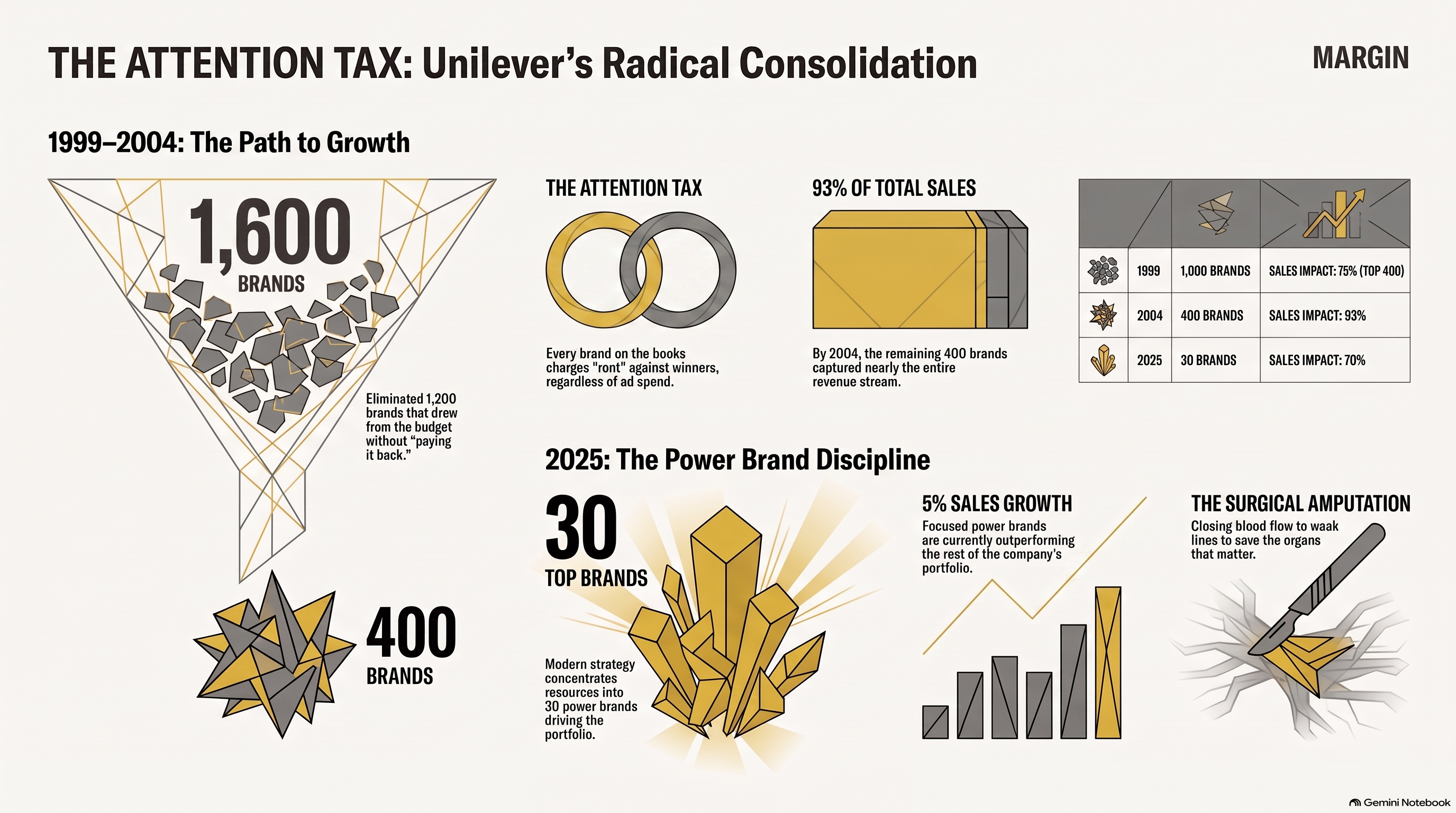 Download the one-page infographic
In the calculus of corporate expansion, there is a pervasive and dangerous temptation to equate "coverage" with "dominance. " Business leaders frequently hoard products, services, or regional sub-brands, fearing that any contraction of their portfolio is a surrender of hard-won territory. Yet, this sprawl creates a silent, internal drain that even the most meticulous P&L statements often fail to capture. In 1999, under the leadership of CEO Nile Fitzgerald, Unilever executed what many observers initially characterized as a corporate massacre. The company erased 1,200 of its own brands, slashing its portfolio from 1,600 down to 400. To the outside world, this looked like a "fire sale" or a desperate rescue mission for a failing giant. In reality, it was a sophisticated exercise in resource reallocation. Fitzgerald wasn't cutting to survive; he was choosing to stop "paying rent" on invisible brands that were starving the winners of the oxygen they needed to compound share.
The Attention Tax: Why Your Portfolio is Subsidizing Mediocrity
The primary driver behind the 1999 " Path to Growth" strategy was the identification of the " Attention Tax. " While 1,600 brands might superficially suggest total market coverage, the structural reality was 1,600 small claims on a single, finite marketing budget. By the late nineties, the vast majority of these lines were drawing from that pool without paying it back in growth or relevance. Every brand on the books—regardless of its active advertising spend—imposes a structural cost. It demands management bandwidth, logistical support, and a slice of the organizational focus. "Every brand on the books charges rent against the ones that could win whether or not it gets ad spend. "When a budget is diluted 1,600 ways, the high performers are essentially subsidizing the mediocre survivors. By concentrating spend where it could actually move the needle, Unilever transitioned to a model of efficiency: same buyers, fewer shelves, more spend where it could compound.
Strategic Amputation: Resource Reallocation as Survival
Public perception often misinterprets radical consolidation as emergency surgery—a last-ditch effort to stop the bleeding. However, the Unilever case study represents "purposeful amputation. "Think of the growth analyst as a surgeon closing off blood flow to non-essential vessels to save the organ that matters. To grow the core, you must decide which vessels the patient actually needs and let the rest go. This process carries heavy, visible costs; for Unilever, this meant 55,000 jobs and 145 factories. Yet, the "invisible cost" of inaction was significantly higher: every dollar consumed by a struggling or invisible brand was a dollar denied to a brand capable of market dominance.
The CFO’s Delusion: Dismantling the "Profitable" Long Tail
The most common defense for a sprawling portfolio is the existence of the "profitable" long tail. Chief Financial Officers often defend small, regional favorite brands that appear profitable in their narrow silos, arguing they aren't "dead weight. "This "bull case" for small brands is a structural lie. The question isn't whether a brand is profitable in a vacuum, but whether it is profitable only because the organization has failed to measure the "rent" it charges the rest of the portfolio. The results of Fitzgerald’s discipline were undeniable: as the brand count dropped from 1,600 to 400, those survivors went from representing 75% of sales to a staggering 93% of sales . Market dominance isn't found in the number of lines on a spreadsheet; it is found in the concentration of reach. Small and profitable rarely outlasts small and invisible once the parent company stops feeding it oxygen.
Compounding Share: Why Discipline is a Process, Not an Event
Portfolio discipline is not a one-time event; it is a continuous process of re-evaluating which brands earn attention and which merely collect rent. In January 2025, CEO Fernando Fernandez proved the 26-year continuity of this discipline by running the same math again. Today, the focus has narrowed even further to 30 " Power Brands" which now account for roughly 70% of total sales. The strategy continues to yield results: by the April 2025 update, those 30 brands grew sales by 5%, significantly outperforming the rest of the portfolio. For investors and analysts, the "tell" for whether this discipline is active lies in the reporting. As long as earnings calls separate " Power Brand" performance as its own distinct line, the discipline is alive. The moment that split disappears from the filings, the focus is dying. Within the next 12 months, watch the filings closely; the transparency of the split is the only metric that confirms the board is still reallocating reach toward compounding share.
The Path to Growth: A Final Provocation
The philosophy of the " Path to Growth" is simple to state but difficult to execute: identify the brands that compound share and let the weak claims starve. The real metric of success was never the brand count—whether 1,600, 400, or 30. The metric that moved the needle was the volume of attention each survivor kept. Most organizations currently maintain their own version of the "1,600 brands"—a services roster or product line where something is drawing a budget it never earned back, persisting only because no one has dared to measure its true cost. As you evaluate your own operations, look past the visible line items and ask the foundational question of growth: What is the expense you don’t see that you are still paying for?