// The money read, in writing
The Jordan Tax: Why Nike Traded Simple Marketing for the Brutal Accountability of a Spin-off
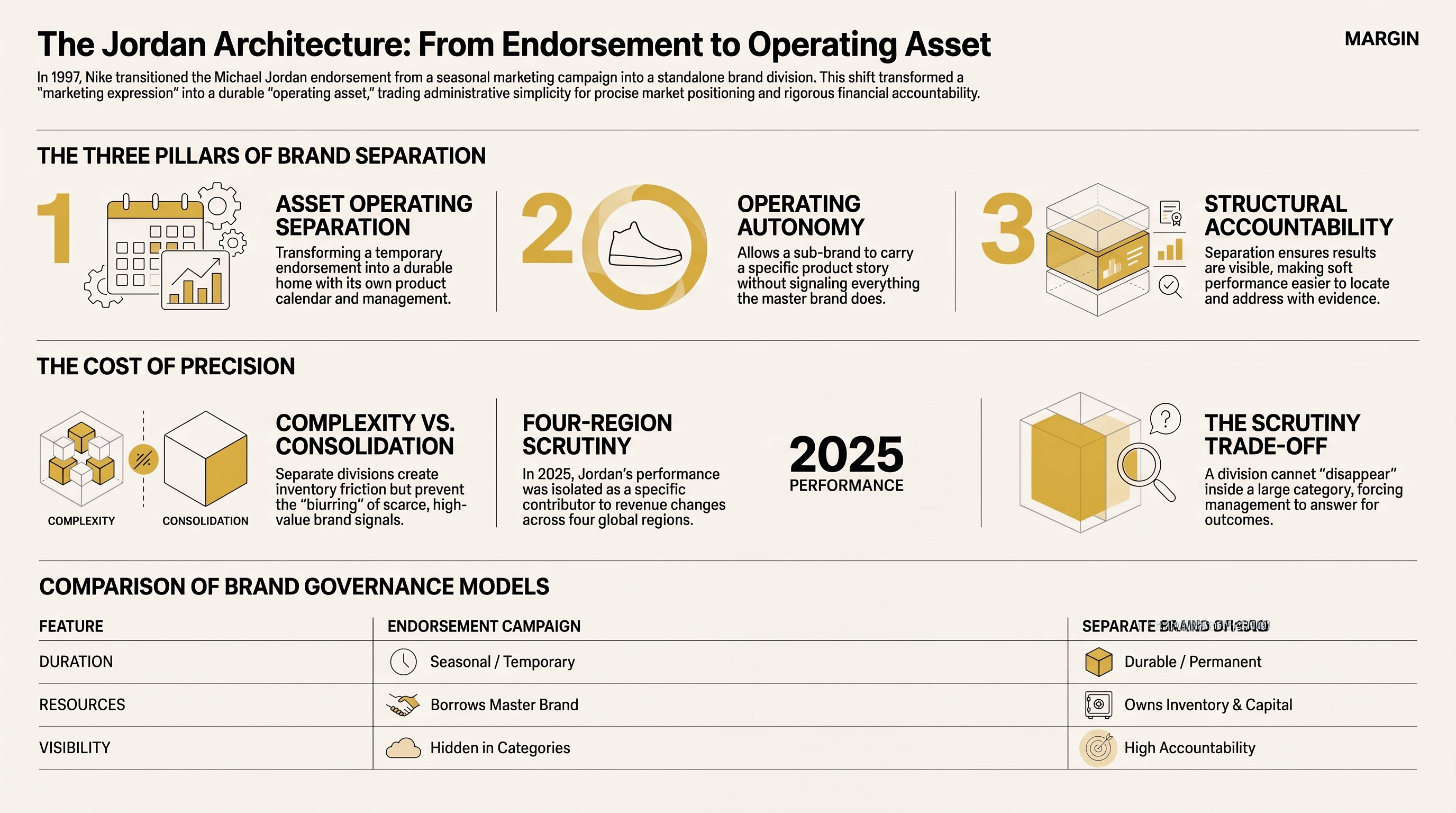 Download the one-page infographic
In the theater of global commerce, most celebrity partnerships are treated as ephemeral performances—high-energy, short-term campaigns designed to spike quarterly revenue before the spotlight inevitably shifts. But in 1997, Nike made a move that defied the standard endorsement playbook. In a pivot that took only four minutes to finalize, the company transitioned Michael Jordan from a seasonal spokesperson into his own dedicated division. This was not a mere tribute to a basketball icon; it was a fundamental reorganization of how corporate value is governed. By spinning the Jordan relationship into a distinct brand architecture, Nike addressed a challenge every successful enterprise eventually faces: what happens when a premium asset becomes too vital to remain buried inside a general marketing budget? The move revealed the "hidden costs" and "strategic logic" of a structure designed to trade the ease of administration for the precision of exposure.
From Seasonal Campaign to Durable Asset
The primary difference between a "marketing expression" and a durable brand is the timeline of the customer relationship. An endorsement is a sprint—it makes a product desirable in the immediate term by borrowing the athlete's glow. A distinct brand, however, is a marathon designed to protect that relationship over decades. By granting Jordan a "durable home," Nike moved the partnership out of the cycle of seasonal commercials and into the realm of long-term equity. While a campaign relies on a master brand’s momentum, a separate brand must sustain its own relevance. This distinction is the bedrock of long-term value: it ensures the connection with the consumer isn't diluted by the broader company's generalist goals or a "one-size-fits-all" marketing strategy.
Brand Architecture is About Resource Allocation, Not Logos
It is a common mistake to view brand architecture as a cosmetic exercise in logo placement. In reality, it is a rigorous mechanism for capital allocation. Nike’s financial filings do not merely list product lines; they report sales under a multi-brand strategy: Nike, Jordan, and Converse. This is an "allocation choice," not decoration. Each of these brands must compete for its own share of management attention, retail footprints, and inventory priority. This is the "initial cost" of separation. A standard campaign "borrows" the master brand’s existing resources, but a separate division like Jordan or Converse must justify why its specific inventory deserves priority over the rest of the portfolio. "Brand architecture is not just a way to organize logos. It determines where decisions live and who owns the outcome. "
The Precision of Operating Separation
Operating separation creates a level of "legibility" that is often lost in massive corporate portfolios. Because Jordan is defined as its own entity, it is liberated from the need to "signal everything Nike signals. " It can maintain a specific product story and engage its audience through specialized channels without worrying about universal brand consistency. This structure allows leadership to see the business with high resolution. Inside a sprawling organization, product lines often disappear into vague categories, making it impossible to tell if choices are reinforcing each other or merely "creating activity. " When product creation, digital platforms, and retail distribution are housed within a specific brand unit, the relationship between a decision and its result becomes visible.
The Double-Edged Sword of Accountability
The most significant advantage of this architecture is the "line of sight" it provides when performance falters. This isn't just about celebrating growth; it’s about the brutal scrutiny of the dip. The Fiscal 2025 Snapshot In its fiscal 2025 filing, Nike reported a decline in overall company revenue. Because of its architecture, the company could pinpoint a specific contributor: Lower Jordan brand revenue across all four regional reporting segments. While a revenue dip is a challenge, the separate structure makes the problem "easier to locate. " Instead of the issue being masked by the general performance of a "vague category," it has a clear owner. Management can use "evidence" rather than "enthusiasm" to diagnose the failure. They can determine if the pressure stems from the product mix, the specific sales channels, or a shift in regional consumer demand, and then adjust the operating plan with surgical precision.
The Hidden Cost of Simplicity
The most frequent argument for consolidation is the reduction of complexity. Managing separate calendars, independent inventory, and internal competition for capital is administratively taxing. However, there is a dangerous trap in prioritizing "ease of administration" over strategic judgment. Folding every distinctive relationship into a single master brand provides simplicity, but it risks "blurring the signal" that made those relationships scarce and premium in the first place. If a sub-brand like Jordan is forced to behave exactly like the master brand, the very scarcity that allows for premium pricing begins to evaporate. "Fold every distinctive relationship into one master brand and the organization gains simplicity. It may blur the signal that made the relationship scarce. "
Conclusion: The Mechanism of Precision
The Nike-Jordan structure was never a guarantee of perpetual growth; it was a mechanism for governance. By treating the Jordan relationship as a separate operating asset, Nike ensured the brand would be subject to the discipline of capital allocation and the scrutiny of the open market. Ultimately, the effectiveness of any brand architecture hinges on a single, ongoing stress test: Does the brand keep earning different capital decisions? If a separate structure allows for better governance and protects the asset's scarcity, the complexity is a strategic investment. If it does not, the organization is merely carrying overhead without the return. Every CEO must eventually ask: Is your organization's structure protecting your most valuable assets, or is it just making your administration easier?