// The systems read, in writing
Why the IBM-OpenAI Partnership Isn’t Actually About AI: The Rise of the "Process Layer"
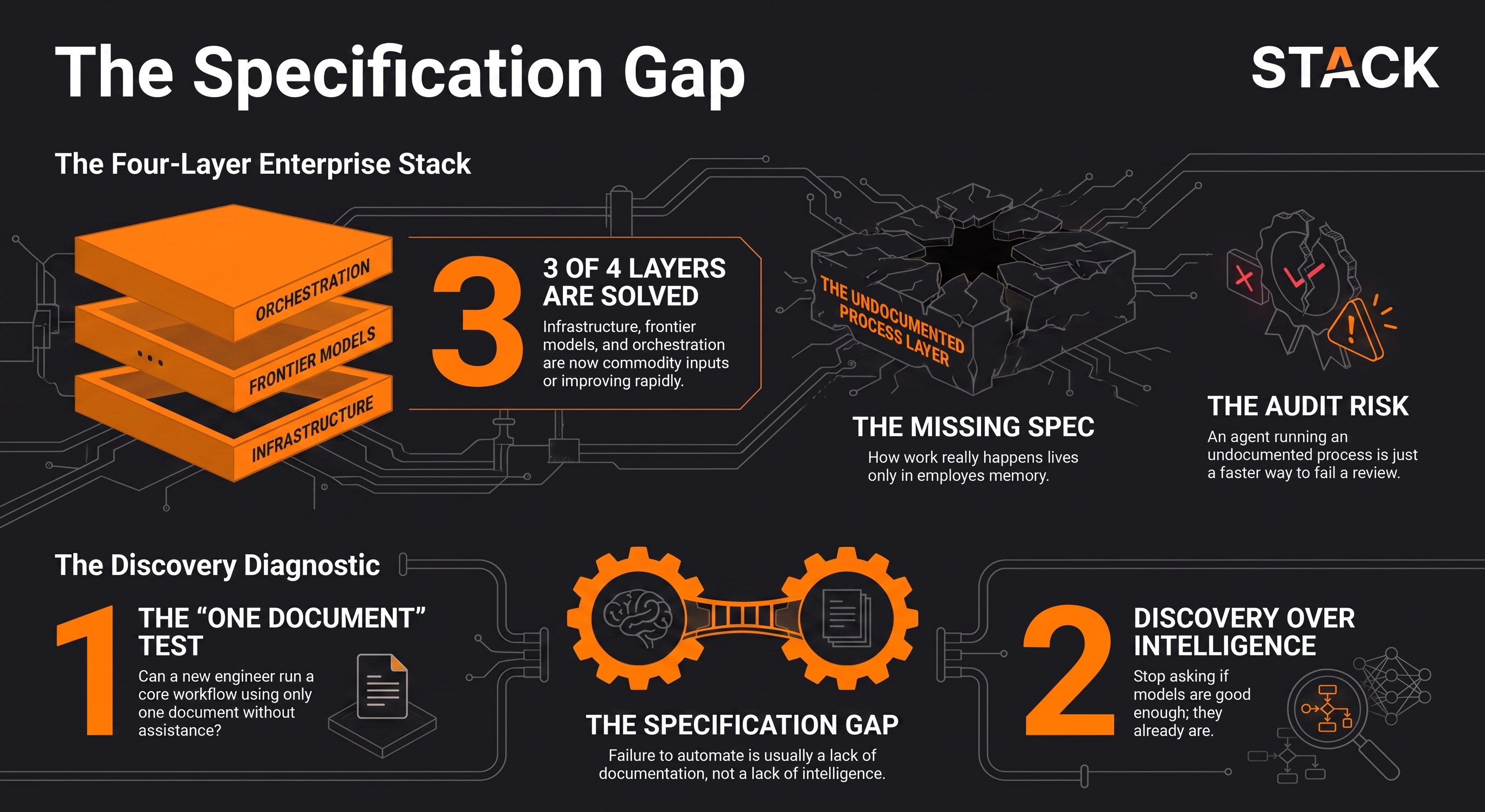 Download the one-page infographic
1. Introduction: The Ghost in the Machine
In the current enterprise landscape, we are witnessing a peculiar paradox. Organizations are deploying the most sophisticated large language models in history, yet implementation friction remains at an all-time high. Digital transformation projects continue to stall, not because the technology is deficient, but because the underlying business logic is invisible. The "intelligence" is ready, but the architecture it’s supposed to inhabit is a ghost. The IBM-OpenAI partnership, announced on August 13th, is often framed as a simple integration of frontier models into a consulting ecosystem. However, a strategic analysis reveals a deeper, more disruptive thesis. The real value of this deal isn't found in the models; it is found in the discovery of how companies actually function. IBM isn't just selling AI; they are addressing the fundamental "specification gap" that prevents automation from scaling.
2. Takeaway 1: Intelligence is Now a Commodity
From an architectural perspective, the enterprise stack is stabilizing. We can now view the bottom three layers—Infrastructure, Models, and Orchestration—as essentially "solved" or rapidly improving commodities. OpenAI’s frontier models, including the newest generation, Codex, and ChatGPT, now function as commodity inputs. When high-level reasoning can be procured via a corporate credit card, it offers zero competitive moat. As orchestration layers stabilize across vendors, the volatility—and therefore the value—has migrated up the stack. If your strategic advantage is predicated on having access to a better model, you have already lost. The true moat is no longer the intelligence you buy; it is the proprietary process logic you own.
3. Takeaway 2: The "Layer with No Name"
Above the solved layers of the stack lies the " Process Layer"—a nebulous, undocumented, and informal territory where the majority of enterprise work actually happens. This is the layer of tribal knowledge, the "exception routes" that bypass standard operating procedures, and the critical handoffs that exist only in a specific employee’s memory. This "missing spec" is the ultimate bottleneck for automation. As IBM’s managing partner for Gen AI and Consulting observed:" Before you can create a workflow, you need to understand how it works. And in many enterprises, that isn't clear because of technical debt and human handoffs. "In an architectural sense, you cannot automate a process that remains a mystery. Without a rigorous specification, any attempt to deploy agents is a shot in the dark.
4. Takeaway 3: IBM as a "Read-Write Head" for Corporate Memory
IBM’s strategy focuses on "forward deployed engineers" utilizing specialized discovery tools: Process Studio and Contact Studio . While they may look like AI features, they are actually forensic tools designed to codify enterprise knowledge. Contact Studio captures industry-specific logic, while Process Studio analyzes standard operating procedures to identify exactly where the human-to-human handoffs break down. By deploying these tools, IBM acts as a "read-write head" for the organization. They are not merely observing (reading) the messy reality of daily operations; they are standardizing and codifying (writing) that reality into a functional specification. IBM is effectively selling the documentation of a layer that currently exists only in the collective memory of the workforce. They aren't reselling model access; they are selling the blueprint of the company itself.
5. Takeaway 4: The High Stakes of Undocumented Handoffs
This emphasis on the " Process Layer" is non-negotiable in regulated verticals like Finance, Government, and Telecom. In these environments, an undocumented process isn't just inefficient; it is a liability. IBM’s strategic buildup reflects this: they joined OpenAI’s Daybreak Cyber Program in June, months before the August partnership was formalized. This timeline highlights that the " Process Layer" is also a security layer. A control that cannot be described is a control that cannot be audited. An agent running an undocumented process is just a faster way to fail. If an AI agent accelerates a workflow that lacks a clear audit trail, it is simply accelerating an organization’s path to a regulatory finding or a security breach.
6. Takeaway 5: The Political Reality of Documentation
The "honest limit" of AI adoption is rarely technical; it is social and political. Documenting a previously informal process is a political act because it explicitly defines ownership, accountability, and the loss of individual leverage. When a process is codified, the "handoff that lives in one person's head" is exposed. This changes the power dynamics of the organization. Many AI programs stall here because the organization is fundamentally resistant to the transparency required for automation. While tools like Process Studio can find where work breaks, the decision to fix the "specification gap" requires a level of organizational will that no model can provide.
7. The Litmus Test & Conclusion
To move forward, leaders must stop asking if their models are smart enough and start asking if their documentation is accurate enough. We are moving from a model-centric era to a documentation-centric era. To diagnose your own organization's readiness, apply this architectural litmus test:Could you hand a new engineer one single document that fully describes a core workflow—including every exception, every handoff, and every override—and have them run it perfectly without asking a single colleague for help? If the answer is no, you do not have an "intelligence gap. " You have a specification gap . As you approach your next planning cycle, remember: the era of better models has been superseded by the era of better documentation. The question isn't whether you have the AI to run your business, but whether you finally have the courage to write down how your business actually runs.