// The systems read, in writing
Why the Best Algorithm is a Promise You Keep: Lessons from Spotify’s Discover Weekly
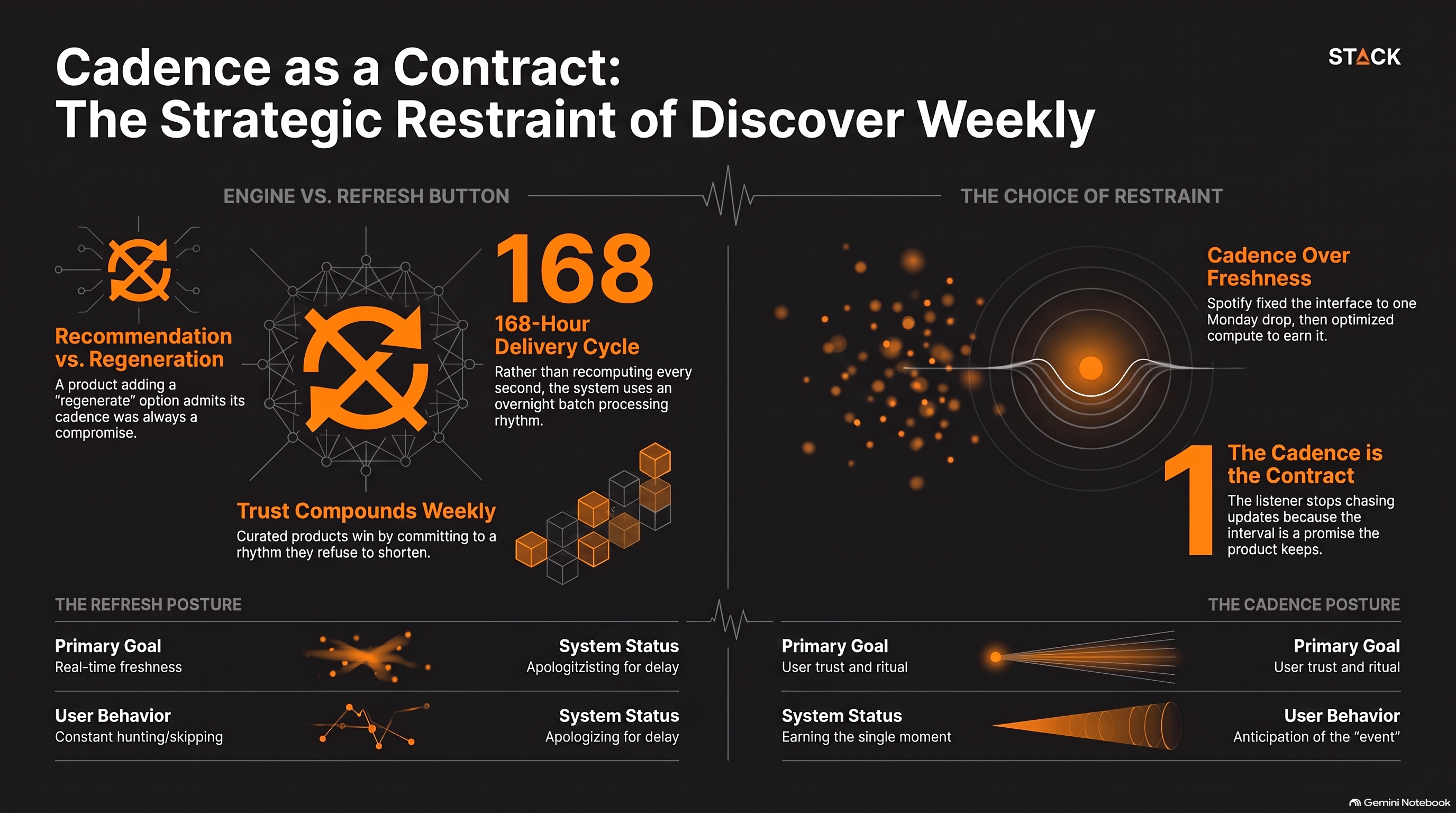 Download the one-page infographic
The Cult of Instant Gratification
In 2015, the tech industry was intoxicated by the myth of the " Live Feed. " The prevailing logic dictated that a recommendation engine was only as valuable as its speed. Success was measured by real-time responsiveness—the ability to chase every skip, every session, and every signal to update a user’s world instantly. Most platforms were designed to optimize for this immediate gratification, resulting in a system that was constantly apologizing for not being instant. Spotify’s Discover Weekly, launched in July 2015, succeeded by doing the unthinkable: they made the user wait. While Spotify possessed the technology to refresh feeds every second, they made a counter-intuitive product decision to forgo the live-updating model. This reveal is the ultimate lesson in product strategy. Spotify’s greatest innovation wasn't the underlying algorithm; it was the discipline to turn the algorithm into a promise.
The Power of the "Batch" over the "Live Feed"
Technically, Spotify was fully capable of delivering a live-updating model at launch. They had already built the necessary components—collaborative filtering applied across millions of listening histories—but they made the active decision to shut down the real-time capability. Instead, they chose to process the data as an overnight batch job on a cluster. This restraint was not a technical limitation; it was a display of organizational guts—a confidence play. By choosing an overnight batch process over a continuous one, Spotify prioritized a cohesive, finished product over a constantly shifting one. They realized that by fixing the delivery schedule, they could stop the system from chasing the user and start making the user rely on the system. "The cadence became the contract. The model may improve, the interval may not. "
Turning a Feature into an Event
By restricting the delivery of new music to a single Monday morning "drop," Spotify fundamentally altered user behavior. Before Discover Weekly, the posture of the user was one of "hunting"—checking feeds repeatedly in the hopes of finding a better version of a recommendation. The fixed schedule transformed the recommendation from a mere feature into a weekly event: a two-hour long playlist delivered once every Monday. Users shifted from a state of constant hunting to a state of waiting for a curated moment. This shift built a unique form of trust; users understood that the Monday version was the only version worth having. It moved the product from a "for you feed" that one refreshes out of habit to a "rhythm" that one relies on by choice. "A recommendation you can't refresh isn't a limitation. It's a promise you chose to keep. "
The "Refresh Button" vs. The "Recommendation Engine"
The presence of a "refresh" or "regenerate" button is a quieter tell than any keynote. It is a signal of a weak product strategy, suggesting that the cadence of delivery is a compromise rather than a core value. When a product allows a user to shortcut the interval, it admits that the current recommendation is a failure and that the system is merely guessing. Contrast the two distinct product postures:
The Refresh-Button Product: Optimizes for freshness and instant updates; encourages a user posture of constant hunting; behaves as if it is constantly apologizing for not being fast enough; includes a "regenerate" or "refresh" option because the cadence is a compromise.
The Cadence-Based Product: Optimizes for a fixed, trusted interval; encourages a user posture of patient waiting and trust in the "drop"; commits to a rhythm and earns the moment; lacks a refresh button because the cadence is the point.
The Hidden Cost of Patience
Maintaining a batch-driven cadence involves a structural trade-off. There is a real cost to running massive batch jobs and intentionally withholding new content that could be surfaced immediately. While this cost never shows up as a specific line item in a report, it builds long-term brand equity by cementing the "contract" with the user. It is an investment in trust that pays out on both sides: the listener stops chasing, and the system stops apologizing. Looking toward 2026, the default for most companies will likely be a "pre-Discover Weekly posture"—continuous, always-on feeds that treat fixed intervals as legacy compromises. By defaulting to "continuous," these products lose the curated feel that defines a premium experience. The product that wins is the one that commits to a rhythm it refuses to shorten, spending its computational power to earn a specific moment of the user's attention.
Conclusion: What is Your Rhythm?
Nearly a decade after its launch, Discover Weekly remains one of Spotify’s most durable features. It has succeeded because Spotify fixed the interface first—one drop, one day—and allowed the technology to serve that schedule. The playlist still arrives every Monday, honoring a rhythm that has survived years of technical pressure. The trust earned by this consistency is an interest-bearing asset that compounds every Monday. The ultimate test for any product strategist is the commitment to their own schedule. Name the rhythm you refuse to break. Can't name one? You don't have a recommendation engine. You have a refresh button.