// The systems read, in writing
The Migration Illusion: Why Oracle’s August 2025 Strategy is a Bet on Continuity, Not Capacity
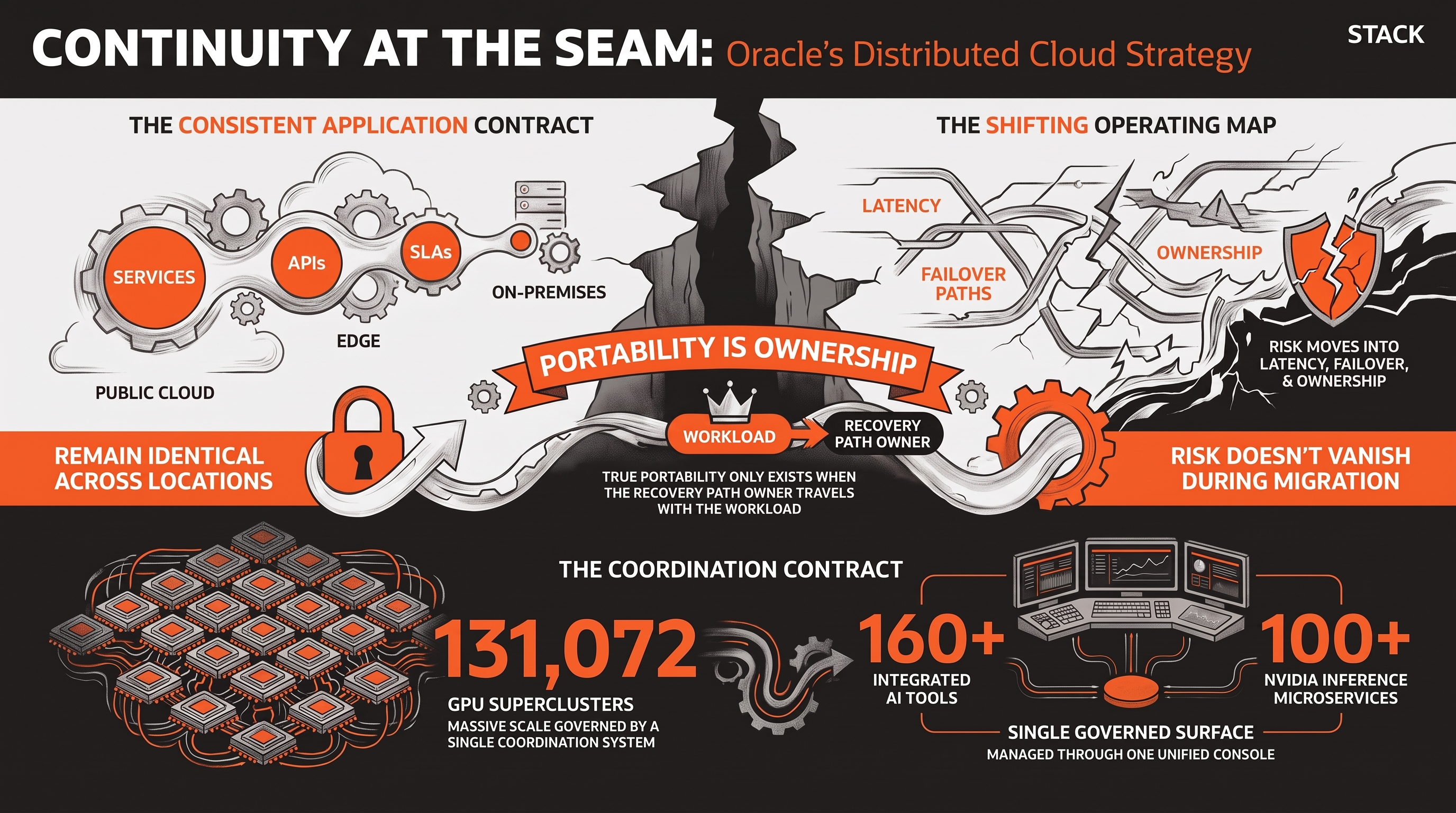 Download the one-page infographic
For most enterprises, the "migration deck" is a work of fiction. It presents cloud adoption as a simple matter of renting enough compute in a new zip code and declaring victory. But for those of us who have lived through the fallout of a failed failover, we know that capacity is rarely the bottleneck—continuity is. Oracle’s August 2025 strategic pivot makes this explicit. While the headline figures are staggering—Oracle Cloud Infrastructure (OCI) now delivers more than 200 AI and cloud services across public regions, dedicated data centers, and the edge—the real story isn't "reach. " It is a calculated bet on the "seam. " Oracle isn't just trying to win a race for more compute; they are betting that the enterprise cares more about keeping its data rules intact than where the processors actually hum.
Takeaway 1: It’s Not a Capacity Story, It’s a Continuity Play
The industry often forgets that Oracle didn't enter the cloud as a commodity hardware provider; it entered from the perspective of the enterprise database—the place where data and recovery already meet. This is Oracle’s structural advantage. By maintaining the database control plane across locations, they are targeting "the seam" where compute changes but governance remains. The useful reading of this strategy is not that Oracle has more servers; it’s that they are trying to keep the database control plane meaningful even when the underlying hardware shifts. "The real bet is continuity. Can an enterprise move compute without moving the rules that keep its data safe? "
Takeaway 2: The "Same" Interface vs. The "Different" Reality
Oracle leans heavily on the word "same"—same APIs, same SLAs, same pricing. In theory, a stable interface reduces the friction of migration by eliminating the need for code rewrites. However, as any strategist will tell you, a uniform programming interface does not make failure modes uniform. Here is the part a launch plan usually hides: when you move a workload, the incident paths remain materially different. Latency shifts, failure domains change, and the on-call path for your engineers is altered. The goal of Oracle's consistent interface isn't to pretend these differences don't exist, but to expose those differences early enough to operate them. Before you sign off on the next migration deck, you must draw two distinct maps:
The Application and Database Contract Map: Tracking identity, data integrity, and recovery protocols.
The System and Ownership Map: Tracking physical latency, failover mechanisms, and the actual humans responsible when a node goes dark.
Takeaway 3: Multicloud is a Boundary, Not an Identity
Oracle’s partnerships with AWS, Azure, and Google Cloud suggest a fundamental shift in how we define a "cloud. " In this model, multicloud is a boundary, not a locked identity. By allowing Oracle database workloads to run on competing platforms without rearchitecting, Oracle is shifting the "migration review" away from the code level and toward the strategic placement of compute. The "accountable boundary" remains with the Oracle control plane, even if the data is being crunched by a competitor’s AI or analytics tools. This allows technical teams to stop worrying about "replatforming" and start focusing on where the compute actually belongs for the business.
Takeaway 4: AI Superclusters are Coordination Systems, Not Just Hardware
In March 2025, Oracle and NVIDIA revealed that the OCI Console would offer more than 160 AI tools and 100 NVIDIA inference microservices. While the 131,712 GPU superclusters grab the headlines, the catalog is the real "governed operating surface. "A supercluster is not merely a room full of accelerators; it is a coordination system where the interconnect is loadbearing. If the system cannot coordinate compute scheduling, data movement, and failure recovery, the raw capacity is a liability. In AI workloads, one weak dependency compounds into a recovery problem that can sink an entire migration. The capacity claim is only as good as the coordination contract that supports it.
Takeaway 5: The Ultimate Test—Who Owns the Fix?
Portability is a vanity metric if the responsibility for recovery stays behind. Oracle’s "continuity at the seam" model assumes that while operating maps will change, the accountable boundary must be portable. I challenge every platform architect to apply the "six-month test" to their current strategy: Within six months of moving a workload, can your team name exactly which changed condition broke the recovery path, and can they identify who owns the fix? If you can’t name the owner, you haven't migrated a workload—you've just orphaned it in a new environment. "Portability is real only when ownership travels with it. "
Conclusion: Beyond the Migration Deck
Oracle is betting that the future of the enterprise cloud isn't about finding the biggest data center, but about finding the most resilient "seam. " Their strategy prioritizes an interface that travels over an infrastructure that stays put. As you evaluate your next move, ask yourself: is your strategy built for the aesthetic of a smooth migration deck, or the reality of a predictable recovery? If your "incident path" is an afterthought to your "interface," you aren't building for continuity—you're just renting space.