The Governance Paradox: Why Technology Committees Fail to Prevent Breaches—and How Boards Can Build True Oversight
Introduction: The Governance Illusion
Establishing a dedicated technology committee, adopting a broad charter, and filling board calendars with quarterly briefings creates a comfortable illusion of control. Yet this administrative momentum frequently obscures a fundamental paradox: organizations add formal structure, titles, and reporting lines without altering a single operational outcome. Too often, management buries choices beneath dense slide decks and technical status updates, allowing directors to ask familiar, high-level questions while executives leave with the exact same freedom to defer difficult calls.A charter establishes visibility, but visibility is not governance. When a governance structure functions merely as an information conduit, board meetings become passive briefings rather than decision engines. This disconnect frames the ultimate reality check for corporate leadership: When technology risk reaches the board, does anything actually change, or are directors just watching the news in real time?Moving beyond administrative theater requires confronting counter-intuitive empirical research on technology oversight. Board oversight cannot be measured by published committee charters or meeting frequency—it depends entirely on whether the governance process creates a capable, enforceable decision path in the room.
Counter-Intuitive Research: Why New Tech Committees See More Security Breaches
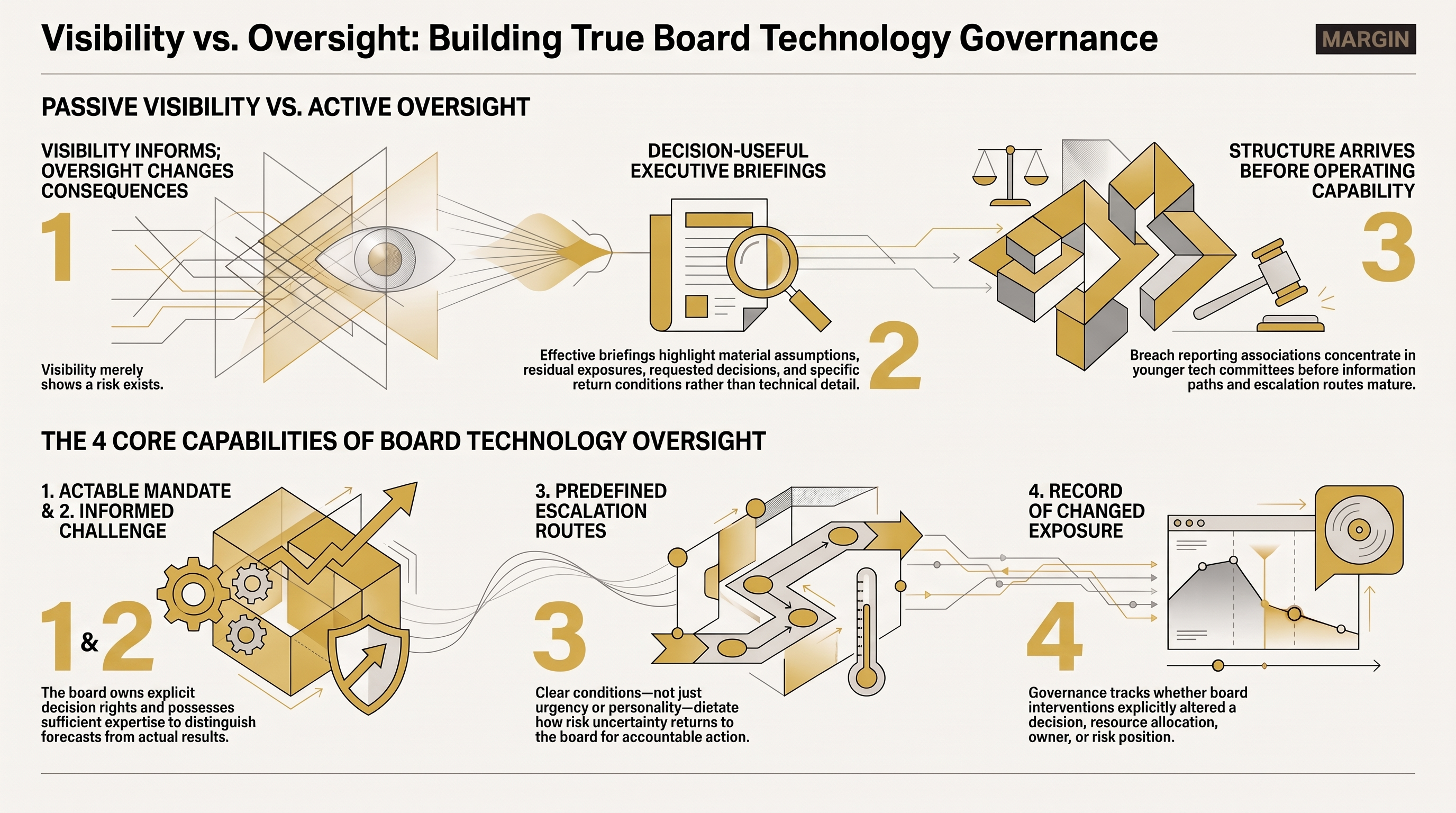
Empirical research on corporate governance yields a striking finding: firms with board-level technology committees are statistically more likely to report a security breach in a given year.This statistic is not evidence of failure, nor does it imply causation. Specialized committees do not cause breaches. Instead, high-risk enterprises are inherently more motivated to establish dedicated committees, instrument better detection, and disclose material incidents. The critical strategic takeaway is subtle but profound: formal structure routinely arrives before operational capability.The empirical data reveals a vital distinction: this heightened breach association is concentrated almost entirely in young committees. Established committees show no such pattern. This divergence proves that treating the creation of a committee as a completed milestone is a dangerous executive error. A new charter signals organizational intent, but it does not guarantee that critical risk signals travel differently, that director challenge alters executive recommendations, or that an escalation yields a concrete decision."A reported breach is not a verdict on any board. It is a reason to separate what a structure signals from what the organization can already do."The committee structure itself is merely a shell. The proper unit of governance analysis is operating capability.
Visibility vs. Oversight: The Critical Distinction
To construct an effective governance framework, boards and executives must enforce a clear distinction between visibility and oversight:
Visibility: Informs directors that a risk exists. It delivers dashboards and updates without giving directors a structural mechanism to alter the risk's consequence.
Oversight: Changes who must answer, what evidence is required, and when the matter must return. It establishes an explicit mechanism to alter the operational outcome.The SEC Cybersecurity Rule offers a clear real-world reality check of this boundary. By mandating that public companies disclose their processes for assessing, identifying, and managing material cyber risk—alongside the board's oversight role and specific subcommittees involved—the rule creates a standardized disclosure architecture. It forces companies to make the oversight path public and visible.However, disclosing a path does not make that path capable. A corporate governance page can list every required committee actor, report line, and meeting cadence while leaving actual decision-making completely diffuse. Without explicit decision rights, defined escalation thresholds, and required evidence, visibility remains administrative window dressing.
The Audit Committee Lesson: What Expertise Really Brings
Empirical studies of audit committees offer critical guidance for designing technology governance. Researchers found that the presence of IT expertise on an audit committee is negatively associated with breach likelihood.This finding does not mean board-level expertise acts as a silver bullet or a substitute for management controls. A technically fluent director cannot engineer systems or run operational teams. Instead, expertise elevates the quality of the board process itself. Directors who understand technology can read presented evidence critically, spot incomplete operational claims, and demand a higher-quality decision record that changes the executive task.Broad research reinforces that capabilities matter far more than organizational labels. A systematic review of 203 empirical studies across multiple disciplines confirms that cybersecurity risk has complex, highly distributed drivers. No single governance design, committee structure, or charter template provides a universal defense. Directors must judge board design strictly by the decision path it enables, not by the label on its committee charter.
The 4 Capabilities That Turn a Charter into Real Governance
Converting a paper charter into functional governance requires four core operating capabilities:
An Actable Mandate: Generic phrases like "oversee technology risk" serve merely as invitations to talk. An actable mandate explicitly defines the choices the board owns—granting authority to challenge risk appetite tolerances, mandate formal remediation plans, escalate threshold breaches, or require independent third-party assessments.
Informed Challenge: True oversight requires sufficient technical context within the board process to separate corporate assurances from verified evidence, forward-looking forecasts from actual operational results, and high-level status metrics from actionable decision thresholds.
A Pre-Defined Escalation Route: Directors and executives must agree in advance on how uncertainty becomes accountable work. Rather than relying on crisis urgency or individual personalities, governance relies on a continuous operational loop: Management presents a defined condition $\rightarrow$ The committee requires evidence or action $\rightarrow$ The decision returns on a known timeline.
A Record of What Changed: Real governance records the specific decision condition, the missing evidence, the accountable executive, and the explicit return terms. Management and directors must link return conditions to concrete operational triggers: a threshold is crossed, a control is incomplete, an underlying assumption no longer holds, or a resource trade-off requires board resolution."A return date without a condition is only a calendar entry. A return condition tells management what must be brought back."
The Executive's Playbook: How to Brief the Board
Executives drafting materials for technology committees must enforce strict boundaries between management execution and board oversight. Management must never ask directors to approve granular technical implementations they cannot reasonably own or validate.The primary directive for executive reporting is simple: Bring the decision above the implementation.A decision-useful briefing strips away tactical noise to focus on risk choices. Every board presentation should explicitly state:
What changed: The shift in the operational, threat, or regulatory landscape.
The core exposure: The specific underlying assumption that carries risk.
What management tested: The empirical evidence gathered to validate controls.
What remains uncertain: The residual risk and unknown variables the organization accepts.
The requested decision: The specific resource trade-off, policy shift, or escalation required from the board.By framing briefings around residual risk, critical assumptions, and resource trade-offs, management retains full operational control over execution while equipping directors to govern the conditions under which that execution occurs.
Conclusion: The Ultimate Test for Your Next Board Meeting
Forming a board-level technology committee is often a prudent starting move, particularly when cyber exposures require elevated organizational visibility. However, establishing a structural entity is merely an administrative prerequisite—it is never a completed outcome. Effective governance requires leadership to explicitly engineer the information path, the challenge mechanism, the escalation routes, and the return conditions.Before stepping into your next board meeting, test the practical design of your governance process against one definitive litmus test:When this risk reaches the board, what new information, challenge, escalation, or decision becomes possible that did not exist before?A crisp, unambiguous answer proves your organization has built genuine governance capability. A vague answer signals that leadership must stop polishing committee charters and start building the decision path those charters were meant to govern.