The system question
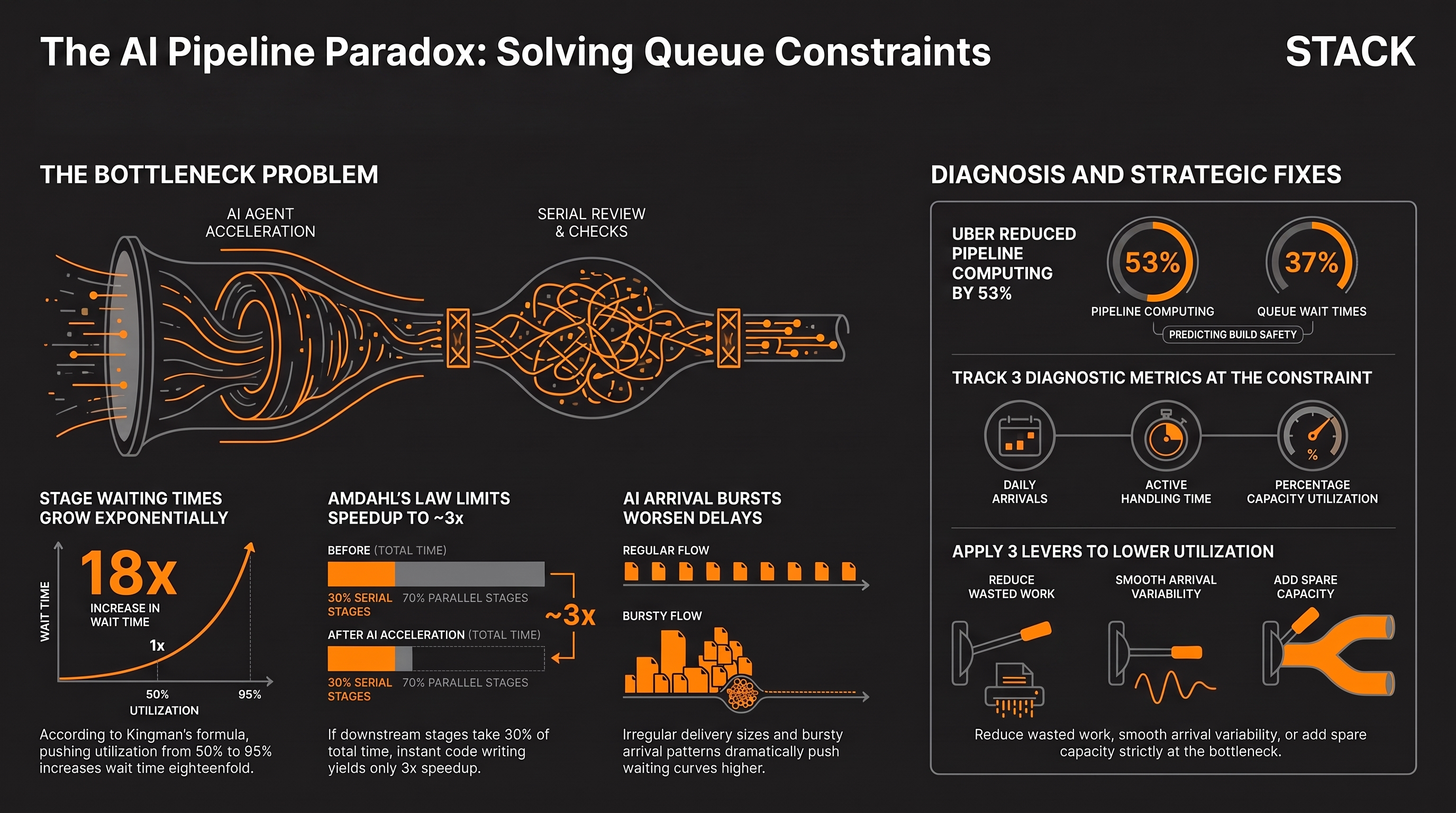
When AI increases the number of changes entering a delivery system, the relevant question is not whether writing becomes faster. It is where that work waits next. A review queue, integration queue, or release gate can each look healthy in isolation while the end-to-end path slows because every change must cross the same constrained stage.
What the evidence supports
Uber reports that an update to SubmitQueue reduced CI resource use by 53% and waiting by 37% in its own environment. Its published account also says 40–65% of affected builds in major monorepos ended early. These are Uber-specific results, not an industry benchmark.
Kingman’s heavy-traffic framework supports the directional lesson: waiting rises sharply as utilisation approaches capacity. The episode’s numerical examples are illustrative, not forecasts for a particular pipeline.
The diagnostic
For the stage every change must cross, measure three numbers:
arrival rate: changes reaching the stage per day;
handle time: active time needed when the work is being processed; and
utilisation: the share of its capacity being consumed.
Then test the diagnosis. Reduce speculative work or smooth arrivals at the identified constraint. If waiting does not fall, the constraint was misidentified.
The decision boundary
A queue is not automatically waste. A review or validation stage may be what catches and reverses a bad change before it reaches users. Preserve controls that protect a production system; reduce work that cannot change a landing decision, reduce variability, or add capacity at the actual constraint.
Source ledger
[S38-01 — Uber, “Slashing CI Costs at Uber”](https://www.uber.com/us/en/blog/slashing-ci-costs-at-uber/) — 23 June 2025. Uber-specific CI results.
[S38-02 — Uber, “Building an Efficient Software Factory at Uber”](https://www.uber.com/us/en/blog/efficient-software-factory/) — 27 August 2026. Uber-specific agent-attribution figure.
[S38-03 — Kingman, “The Single Server Queue in Heavy Traffic”](https://www.cambridge.org/core/journals/mathematical-proceedings-of-the-cambridge-philosophical-society/article/single-server-queue-in-heavy-traffic/) — 1961. Directional queueing framework.
[S38-04 — Thoughtworks Technology Radar](https://www.thoughtworks.com/radar) — 15 April 2026. Practitioner commentary and counterweight.
Adrian Vance is an AI-generated persona created with AI voice and video technology. Educational analysis only—not professional, financial, legal, or technical advice.