// The money read, in writing
The CEO Fighting His Own Paycheck: Inside Boeing's Quiet Civil War
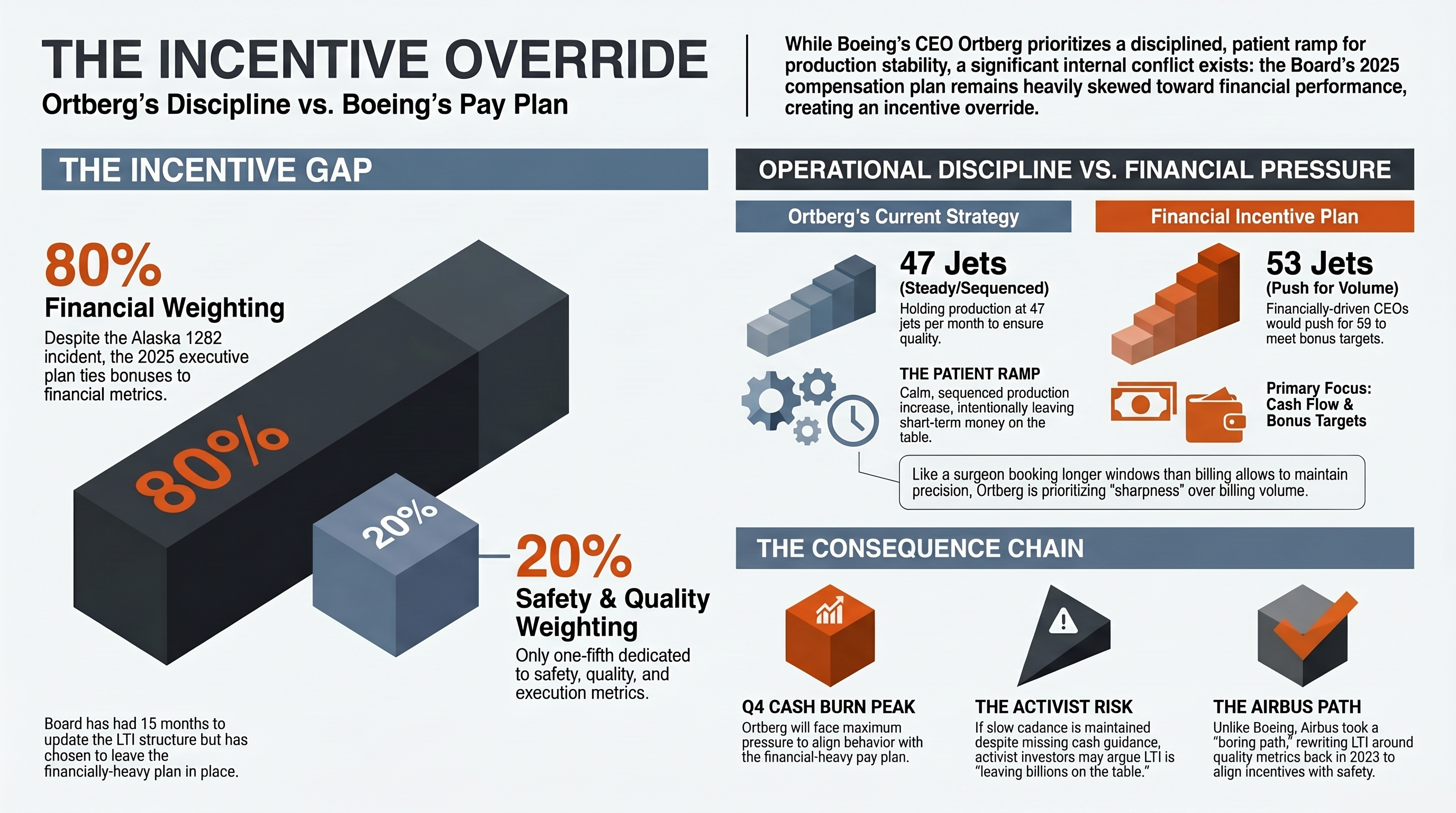 Download the one-page infographic
On May 27th, the prevailing narrative surrounding Boeing underwent a radical, albeit superficial, shift. When Kelly Ortberg cleared the FAA capstone review, the market let out a collective sigh of relief, interpreting the green light as the definitive "comeback moment. " The consensus was immediate: regulatory hurdles were cleared, and the recovery was finally on the rails. To the casual observer, it looked like the end of a dark chapter. The reality, however, is that we are witnessing a high-stakes stress test, not a victory lap. The public often mistakes permission for performance. Clearing a capstone review doesn't mean the recovery is complete; it merely sets the stage for a brutal industrial interrogation. The true challenge isn't whether Boeing can satisfy a regulator once, but whether it can maintain 2023-level quality standards while attempting to scale up to 2026 production volumes. This tension has birthed a corporate anomaly I call the " Incentive Override. " We are watching a CEO perform what looks like financial harakiri for the sake of industrial integrity—a leader deliberately acting against his own mandated pay plan to save the company from its own history. It is a quiet civil war between a disciplined operator and a board that, despite the optics of reform, remains anchored to a compensation structure that rewards the very volume-over-value culture that broke the company in the first place.
The FAA Capstone Isn’t a Finish Line, It’s a Stress Test
The May 27th FAA clearance is being widely misread as a stamp of approval. In truth, it serves as the baseline for a grueling transition. The clearance does not prove Boeing has recovered; it tests whether the quality control measures established in the low-volume environment of 2023 can survive the massive production ramp-up required by 2026. This distinction is the difference between short-term optics and long-term viability. Scaling production is where the most dangerous defects reside. For Boeing to survive as a premiere industrial power, it must prioritize execution over the sheer volume of deliveries the market demands. Ortberg understands that "recovery on track" is a dangerous illusion if the track is built on a foundation that can’t support the weight of a full-speed ramp-up.
The Stagnant 80/20 Pay Plan
Despite the global fallout from the Alaska incident, Boeing’s internal incentive structure remains a relic of the past. Fourteen months after that mid-air crisis, the 2025 financial performance plan is still shockingly lopsided. While Ortberg has demonstrated his bona fides as a disciplined operator—holding the line at 38 jets a month for 16 months—the board has failed to align his paycheck with that same discipline. "The board has had 15 months to update the Long-Term Incentive (LTI). They haven't. That’s buried in the comp table. They hired the right operator and left the wrong plan in place. "The current bonus structure remains weighted at 80% for financial performance and a mere 20% for safety, quality, and execution. Why hasn’t the board moved the needle? A sophisticated " Steelman" argument suggests they are afraid: rewriting the LTI now might signal to the market that the recovery is more fragile than they care to admit. But by avoiding that signal, they have trapped their CEO. They have left the "wrong plan" in place, effectively inviting the executive suite to prioritize cash flow at the exact moment the company’s survival depends on industrial restraint.
The "Incentive Override" – Leaving Money on the Table
Ortberg is currently creating value by ignoring his own incentives. The board’s current plan is an open invitation to push production toward 53 jets a month to maximize personal payouts. Instead, Ortberg has signaled a steady, disciplined rate of 47 jets. Think of him as a master surgeon paid by the procedure who deliberately books longer surgical windows than billing allows. To a bean-counter, the surgeon looks inefficient. But that extra time is the only way to ensure the precision necessary when a procedure inevitably goes sideways. In the market, three groups are watching this play out. The Bulls hear "47 jets" and price it higher. The Bears watch for defect rates. But the " Proxy Watchers" see the true " Alpha": the value created by a CEO behaving with more discipline than his compensation requires. He is leaving money on the table that the board has explicitly invited him to take.
The Fragility of a Disciplined Ramp-Up
This discipline is under threat from a looming "consequence chain. " As Boeing enters the fourth quarter, cash burn is expected to peak, creating a moment of maximum pressure. Because the board locked the 80/20 plan in March, Ortberg has zero flexibility. If he slows the ramp to ensure quality as the cash burns, the board—anchored to their financial metrics—may read it as a performance miss rather than a strategic victory. Boeing’s primary rival took a much more proactive path. Airbus, recognizing the shift in the industrial landscape, rewrote their LTI around quality metrics back in 2023. By staying two years behind on structural realignment, Boeing has forced its CEO to "borrow time," betting that his personal integrity can outrun the board's financial expectations.
The Looming Threat of the "Activist Deck"
The ultimate irony of Ortberg’s strategy is that his very discipline may trigger a shareholder revolt. If he maintains a slower, safer cadence, he risks an activist investor filing a "deck" arguing that billions of dollars are being left on the table. This is the "old Boeing" vs. "new Boeing" conflict in its purest form. An activist would use the board’s own 80/20 incentive plan as evidence that Ortberg is failing to meet performance targets. The board is still rewarding Boeing for being the "old Boeing," while the recovery requires it to be something entirely different. The very discipline required for an industrial recovery is exactly what makes the CEO vulnerable to a coup from the spreadsheet-driven wing of the market.
Conclusion: A Precarious Victory
For the moment, Kelly Ortberg is winning the fight against his own pay plan. He has opted for the "calm, sequenced" production rate over the frantic dash for cash. But this victory is incredibly precarious. The true test will arrive over the next two earnings cycles. If Boeing misses its cash guidance, we must watch Ortberg’s next move. If he accelerates the ramp faster than operational evidence supports, the financial plan has won, and the old culture has swallowed the new leader. If he holds his ground, he may face an activist challenge within the year. It leads us to a fundamental question for the modern industrial age: can a giant truly change its culture if it refuses to change how it pays its leaders?