// The money read, in writing
The $800 Billion Illusion: Why the SpaceX IPO Filing is a Masterclass in Market Optics
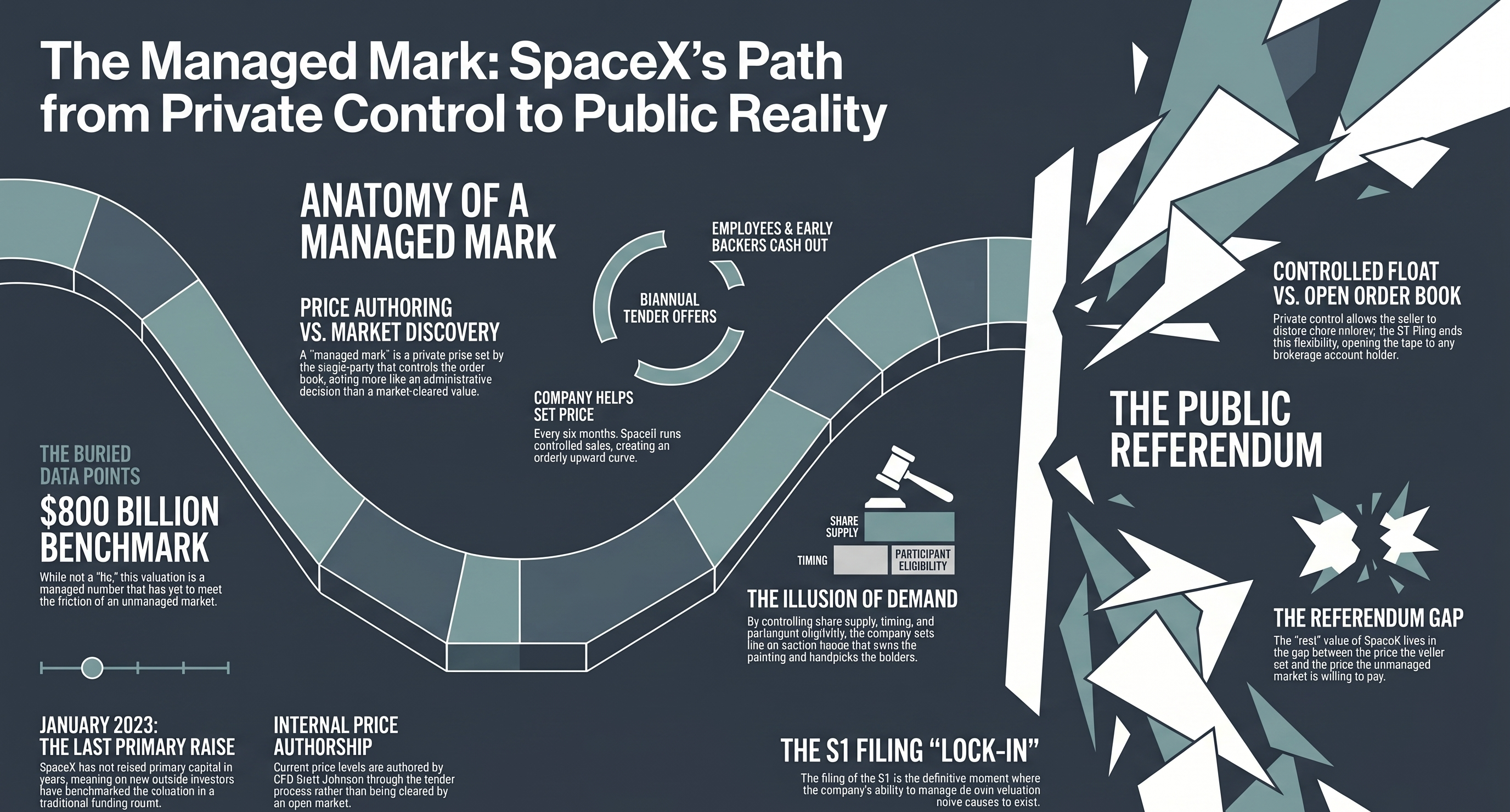 Download the one-page infographic
SpaceX has finally pulled back the curtain, filing to go public with a staggering $800 billion valuation—the largest price tag ever hung on a private enterprise. The headlines are screaming "validation," but if you look past the lead paragraph and into the guts of the S1, a much more clinical story emerges. It is a story of a price that is simultaneously "real" and "artificial," manufactured in a laboratory of private finance far away from the chaotic oxygen of a true market. This isn't just an IPO; it’s a controlled experiment about to meet an unmanaged reality. To understand the future of SpaceX on the public tape, you have to stop reading the headlines and start reading the cap table.
1. The Myth of the Market-Cleared Price
The " Managed Mark" is the primary engine behind the SpaceX valuation. Unlike a public stock, where price is the byproduct of an endless, messy tug-of-war between a global pool of buyers and sellers, the SpaceX price is a "managed event. "For years, the company has operated on a relentless cadence of semi-annual tender offers—closed-loop, company-run sales where employees and early backers liquidate their shares. But make no mistake: these are not open auctions. SpaceX carefully curates the mechanics, influencing exactly where these rounds clear. In this environment, the S1 filing’s attempt at "validation" is doing some heavy lifting. While the company presents the filing as the public market finally blessing its previous marks, an analyst sees the opposite: it is an attempt to retroactively justify a price that was authored, not discovered. "The price was effort, not discovery. "This is administration wearing demand’s clothing. When the seller dictates the terms, the timing, and the participants, the resulting number isn't a reflection of the world’s appetite—it’s an administrative setting.
2. Controlling the Curve Through Scarcity
SpaceX has maintained its valuation trajectory by exerting total control over the three pillars of market pricing: supply, timing, and eligibility. By hand-picking who gets to sell and when, the company has produced what I call the "orderly print. "The result is a valuation curve that looks less like a market chart and more like a staircase drawn with a ruler—each print slightly higher than the last, appearing every six months with metronomic precision. This creates a dangerous psychological paradox: the illusion of inevitable momentum. In a living market, prices breathe; they fluctuate and retreat. But SpaceX has presented a curve it drew itself, using artificial scarcity to maintain a "mark" that hasn't faced a single day of volatility.
3. The Auction House Paradox
To grasp the fragility of this $800 billion figure, consider an auction house that owns the painting it’s putting on the block. The house hand-selects the bidders, sets a high reserve price, and manages the room with an iron fist. When the gavel finally falls, the "hammer price" is real in one narrow sense: sophisticated buyers in that room actually paid it. No one was defrauded. However, that price is meaningless to the outside world. It tells us nothing about what that painting would fetch on a sidewalk where the house doesn’t control the float. The SpaceX valuation is contingent on a total lack of market freedom. It is "real in the room," but it lacks the stress-test of a free-entry market where anyone with a brokerage account can cast a vote.
4. The "Buried Line" in the Filing History
The most damning data point in the filing is the one everyone skipped: SpaceX hasn't raised a single dollar of primary capital since January 2023. For a significant stretch of time leading up to this IPO, the company has not tested its valuation against a single new, external primary investment. Instead, the valuation has been authored internally through tender mechanics overseen by Chief Financial Officer Brett Johnson. While the financial press quoted the $800 billion figure like gospel, any treasurer reviewing the filing history can see the gap. For nearly two years, the price has been a self-reported narrative. The company has been grading its own homework, and the world has been accepting the grade without seeing the test.
5. The Collision with the "Unmanaged Market"
The filing of the S1 represents the exact moment where the "effort" ends and the "discovery" begins. It is the moment administrative control dies. Once the stock hits the public tape, Brett Johnson is no longer the author of the price. This transition creates the ultimate market friction:
The Authored Price: A flexible, curated number set by a seller who manages the order book.
The Public Referendum: A rigid, unmanaged reality where the seller has no say in who sells or at what price the trade clears. The central bet of this IPO is whether a price meticulously constructed in a vacuum can survive its first contact with a free market. History suggests that when a seller loses control of the order book, the "authored" price rarely survives the transition.
6. Conclusion: The Gap Between Two Numbers
SpaceX is a phenomenal company—perhaps the most important aerospace firm of the century—but its $800 billion valuation is an administrative construct standing at the edge of a cliff. The most important story of this IPO isn't the number on the front page of the filing; it is the "gap" that will inevitably appear when the seller loses the ability to set the reserve price. The decision to spend the last several years setting its own marks is a decision that cannot be undone. It has locked the company into a valuation that hasn't been stress-tested by a primary raise since early 2023. Here is the test: within 12 months of the public debut, the "authored" price will meet the "market" price. My bet is that they are two very different numbers. The true valuation of SpaceX isn't what the seller claims it's worth today—it's whatever the market is willing to pay when the seller no longer has a say.