// The money read, in writing
The $43 Billion Bet: Why "Contract Duration" is the New King of Software
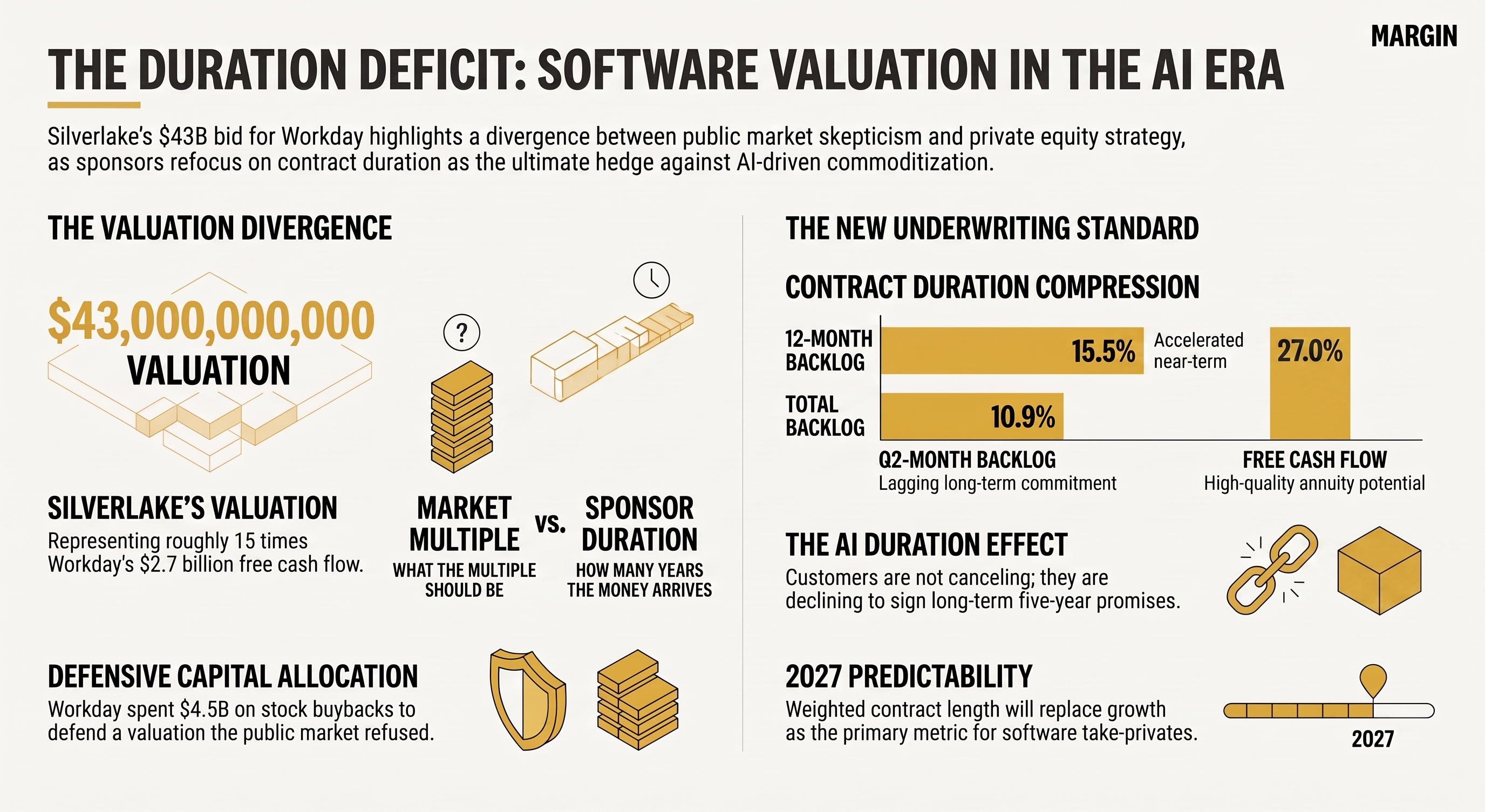 Download the one-page infographic
The public markets spent 2026 marking software companies down with a vengeance, fueled by a visceral anxiety now known as the " SaaS Apocalypse. " Yet, while retail investors and hedge funds fled for the exits, Silverlake quietly put a $43 billion bid on the table to take Workday private. For those running Corporate Development, this massive gap in sentiment is the only number that matters. Why would a private equity titan commit a king’s ransom to a company the public market is treating like a falling knife? The answer isn't a speculative bet on a growth rebound. It is a fundamental shift in how sophisticated capital underwrites software. We are no longer in an era of valuing "potential"; we are in an era of "sorting"—identifying who actually owns cash that lasts.
Takeaway 1: The "SaaS Apocalypse" is About Commodity, Not Churn
The " SaaS Apocalypse" isn't a nickname for a lack of performance—it’s a crisis of confidence in long-term defensibility. The fear isn't that companies will stop using software; it's that AI will strip away the "moat" that justified high subscription fees. Workday’s fundamentals remain robust: it closed its last fiscal year with $2.9 billion in operating cash flow (up 19%) and an adjusted operating margin near 30%. This is not the profile of a dying business. However, the market is pricing in a future where software is no longer a premium service, but a baseline utility. "The worry: AI turns rented software into a commodity. The seat you sell now becomes the free feature somebody ships next year. "
Takeaway 2: The Hidden Signal in the Backlog
The " AI anxiety" that the market is so obsessed with is already showing up in the filings, but not where most analysts are looking. It’s not in the churn rate or the top-line revenue—it’s in the duration of the commitments. In a recent quarter, Workday’s 12-month backlog grew by 15.2%, while its total backlog grew by only 10.9%. This means near-term committed revenue is climbing faster than the whole book. In plain English: the average contract is getting shorter. Customers aren't canceling Workday; they are simply refusing to promise five years of loyalty. They are hedging against AI disruption by shrinking the duration of their contracts. This is the "duration problem," and it’s the primary risk to any software valuation today.
Takeaway 3: PE Sees an Annuity, Not a Growth Story
Silverlake’s $43 billion bid is a bet on the reliability of the cash, not a "bubble price. " At roughly 15 times operating cash flow, they are pricing an annuity. This isn't a broad "call at the bottom" for the sector. Rather, private equity is sorting the sector by "who owns cash that lasts. " Contrast Silverlake’s move with the Medallia casualty: Blackstone and lenders recently seized Medallia after its sponsor, Thoma Bravo, chose to walk rather than fund $3 billion of debt it could no longer service. These aren't opposing trends; they are the same move. Capital is fleeing "growth stories" with shaky debt and moving toward "durable annuities. "However, a Strategic Analyst knows this isn't a foregone conclusion. Silverlake’s bid is a position, not a closed deal. In this environment, talks get reported and die—and if contract duration continues to shrink, that 15-times-cash multiple will stop looking conservative very quickly.
Takeaway 4: The High Cost of Defending a Valuation
Before the bid surfaced, Workday doubled down on an aggressive capital return strategy, burning $2.9 billion on stock buybacks over the last year, including $1.6 billion in a single quarter. To a cynical observer, this was a mere "ledger entry"—a battle the company was losing against market sentiment. Workday spent billions of real cash defending a valuation the public market had already refused to support. The irony is that this defense didn't rescue the shareholders who sold during the decline; it essentially subsidized the premium the private equity buyer paid later. The company was lighting cash on fire to hold a line that the market had already breached.
Takeaway 5: The Metric Your Board Deck is Missing
Growth and margin are no longer sufficient underwriting criteria in an AI-uncertain world. The next wave of software take-privates will be priced on one thing: Weighted Contract Length (Duration). While your sales team focuses on the annual contract value (ACV), the sponsors are looking at the decay rate of the commitment. Duration is the number the seller’s story works hardest to avoid because it reveals exactly how much the customers trust your long-term roadmap. In an era where "features" are becoming "commodities," the length of the contract is the only true measure of defensibility.
Conclusion: The New Underwriting Reality
We have shifted from "growth-at-all-costs" to "duration-of-cash-flow. " As AI threatens to turn premium seats into free features, the value of a software company is no longer tied to its theoretical TAM, but to how many years the money is contractually obligated to keep arriving. By 2027, weighted contract length will be the first metric every sponsor underwrites. For founders and executives, the directive is clear: check yours before your next board meeting. It is the figure a buyer is already reading, the one the market is already punishing, and likely the one your current deck is least prepared to show. Do you actually know yours?