// The money read, in writing
The $11 Billion Calendar: Why Novo Nordisk Just Rewrote the Rules of Pharmaceutical Strategy
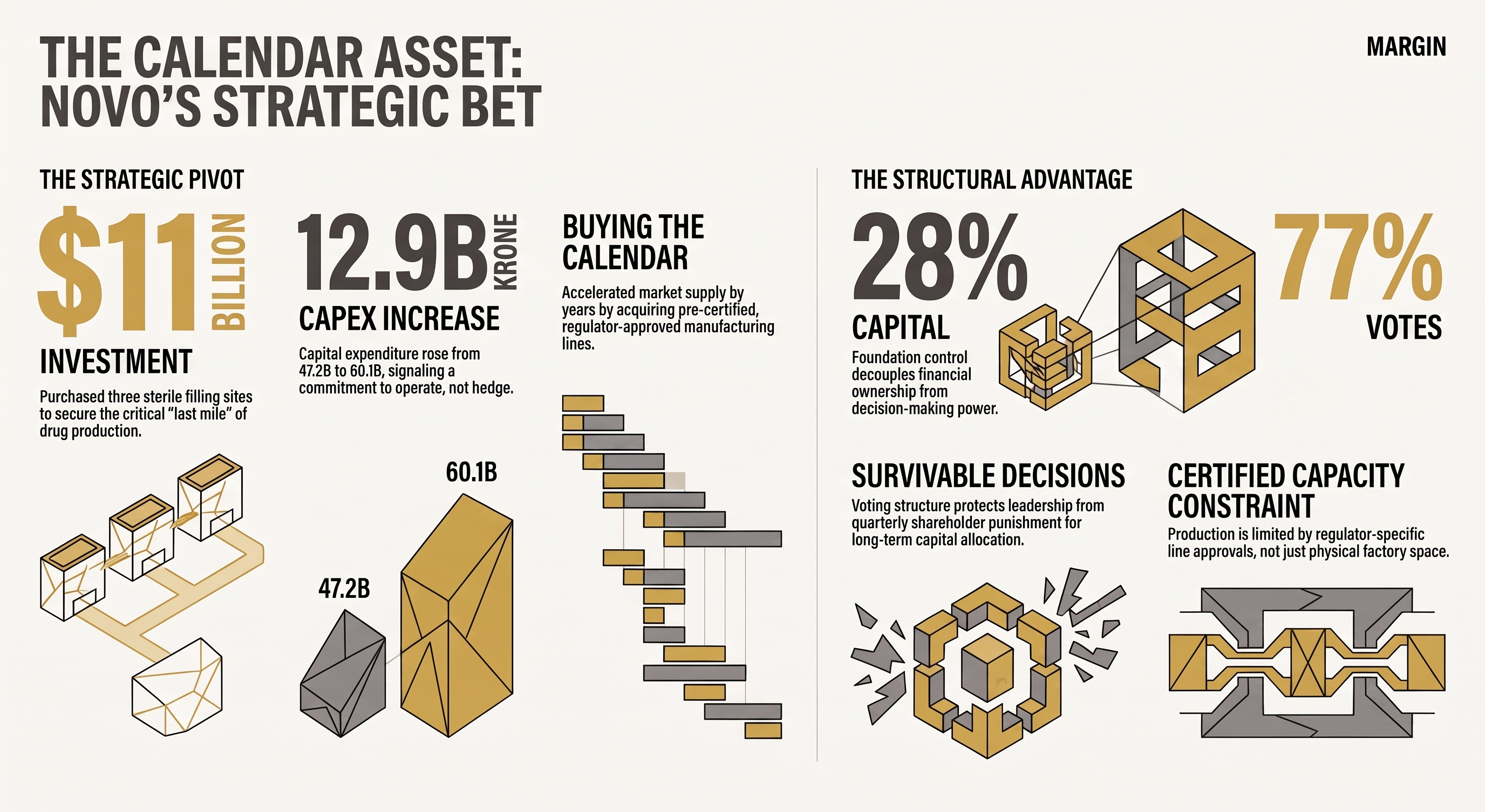 Download the one-page infographic
In the pharmaceutical world, the standard playbook is defensive: you wait for the orders to justify the expense before you build the factory. Novo Nordisk just incinerated that playbook. By spending $11 billion to acquire three manufacturing plants before they were strictly "needed," the Danish giant signaled that the battle for the multi-billion dollar obesity market won’t be won in the ivory towers of R&D, but on the cold, mechanical floor of the filling line. While the industry fixates on miracle molecules, Novo Nordisk has identified the true bottleneck: the sterile filling capacity required to put those molecules into the hands of millions. It is a counter-intuitive, high-stakes gamble that prioritizes the calendar over the balance sheet.
Takeaway 1: Buying the "Least Glamorous" Step
There is a profound irony at the heart of modern medicine. The success of a therapeutic revolution—the GLP-1 weight-loss drug—now hinges not on genetic sequencing or clinical trials, but on the mechanical precision of a nozzle and a rubber stopper. This is "fill-finish," the process of sterilely filling syringes and pens. In the global supply chain, sterile filling capacity is the one input that "no check buys" on short notice. Novo Nordisk learned this the hard way through 2021 and 2022, when their launch pace was dictated by the schedule of outside contractors rather than their own ambitions. By paying $11 billion for three specific Catalent sites—Anani, Bloomington, and Brussels—out of a total company valuation of $16.5 billion, Novo effectively admitted that the most "unglamorous" step in the process is the one that actually holds the keys to the kingdom. "Filling a syringe is the least glamorous step in pharma and the one that decides whether a drug ships. "
Takeaway 2: The Foundation Moat—Why Ownership Matters
Most CEOs are forced to make "the allocation that survives the call"—a strategy designed to appease quarterly shareholders who punish any spending that isn't immediately justified by an order book. Novo Nordisk CEO Lars Fruergaard Jørgensen doesn’t have that problem. Novo Nordisk’s unique ownership structure creates a "foundation moat" that allows for decisions that would get a traditional CEO fired. A foundation-controlled holding company owns 28% of the capital but holds 77% of the votes . This decoupling of money and control allowed Novo to choose the slower, costlier road of acquisition over the easier path of licensing. They spent $11 billion on filling lines that could have gone to the R&D pipeline because their voters prioritize decades of market dominance over next Tuesday’s stock price.
Takeaway 3: You Can’t Buy Capacity in the Abstract
In industrial strategy, there is a " Certification Trap" that most analysts overlook. You cannot simply buy "capacity" like a commodity. Manufacturing capacity in pharma is not just about steel and floor space; it is about regulatory qualification. A filling line is a certified resource. Regulators inspect a specific line for a specific product, and that approval is non-transferable. This makes existing, certified lines a finite and fiercely guarded resource. By acquiring the Catalent sites, Novo Nordisk didn't just buy assets; they bought the regulatory right to produce. They moved from "renting" capacity—staying subject to someone else's maintenance windows and production delays—to owning the very step that had previously throttled their growth.
Takeaway 4: The Strategy of Buying a "Date"
The most critical insight of this $11 billion move is that it wasn't an investment in real estate; it was an investment in time. In a market with a fixed amount of certified manufacturing capacity, there is a queue. You cannot pay to expand the queue; you can only pay to jump it. By purchasing facilities that were already certified and operational, Novo Nordisk moved their supply timeline up by years. While competitors are stuck in the regulatory waiting room—building new plants and waiting years for inspections—Novo has already secured the market’s calendar. "The asset register says factories. The decision was a calendar. "
Takeaway 5: The "Capex" Litmus Test for Investors
For those looking to distinguish between a company’s strategic commitment and its PR department’s aspirations, there is a simple litmus test: the relationship between acquisition announcements and the Capital Expenditure (Capex) line.
Commitment: When the acquisition of capacity is followed by a proportional jump in Capex, the company intends to operate. In Novo’s case, capital spending surged from 47.2 billion kroner to 60.1 billion kroner. They didn't just buy the plants; they committed the capital to run them.
Optioning: If a company announces a major "capacity deal" but the Capex line remains flat, they are merely hedging. They are buying an option, not a reality. As the industry saying goes: " One without the other is a press release. "
Conclusion: A New Entry on the Industry Ledger
The pharmaceutical industry has undergone a fundamental shift. The competitive edge has moved from owning the molecule to owning the timeline of the market. Novo Nordisk’s books now show three new factories, but the real value is hidden: their ledger contains a date that their competitors cannot buy at any price. Before the next year is out, a competitor will inevitably announce a delay in their drug launch because the certified lines they needed were already taken. It leads to a vital question for any industrial leader: Which "un-glamorous" bottleneck in your supply chain is currently holding your entire industry’s calendar hostage?