// The money read, in writing
Beyond the Allen Key: The Radical, Desperate Logic That Built the IKEA Empire
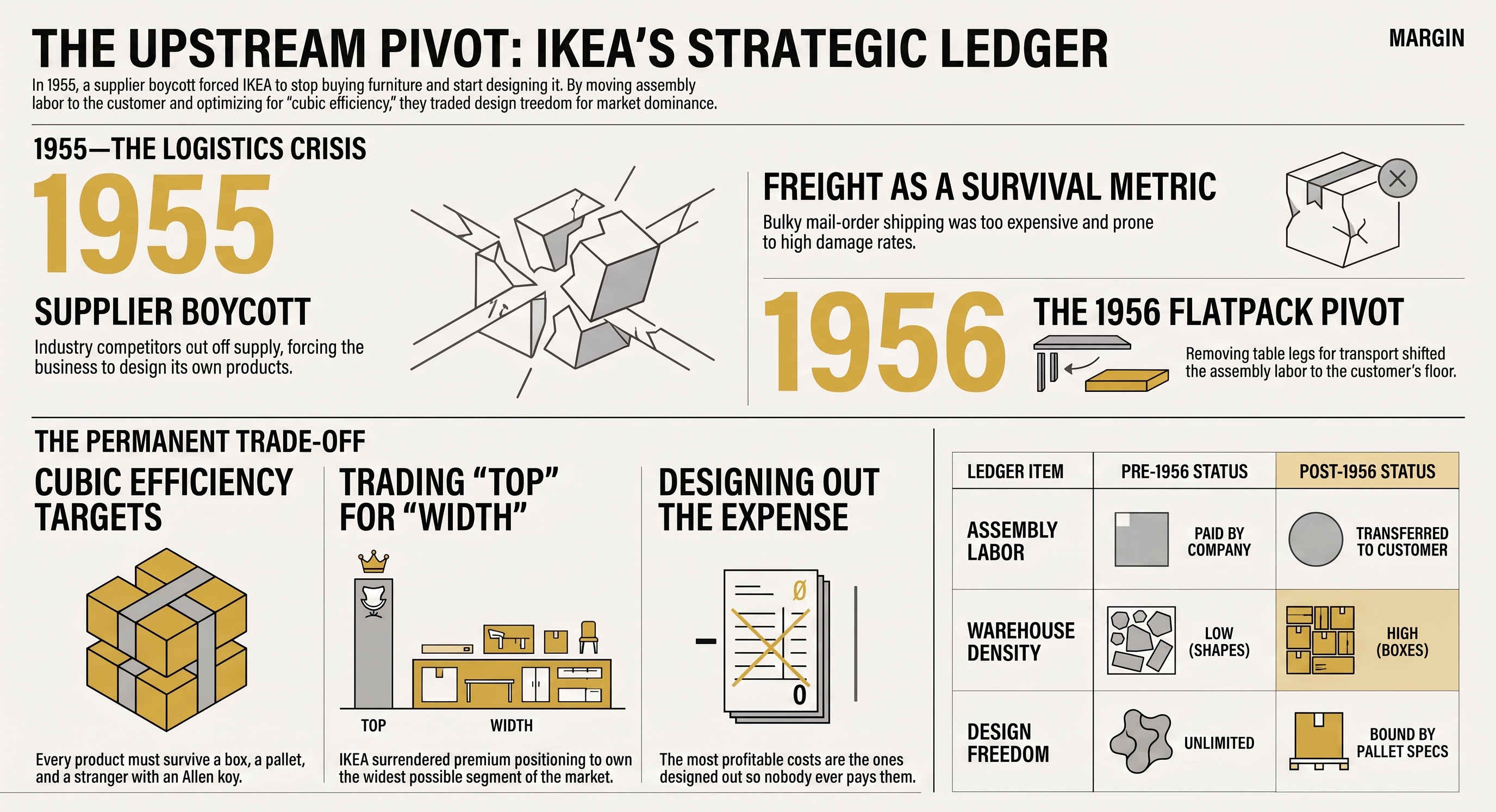 Download the one-page infographic
The image of a frustrated customer hunched over a particle-board side table, Allen key in hand, has become a global cliché. We often frame IKEA’s flatpack model as a "clever idea"—a stroke of Swedish ingenuity designed to make furniture affordable. But the reality is far more clinical and far more desperate. Flatpack furniture wasn't a choice made from a position of strength; it was a survival strategy for a business that had no other move left. Founded in 1943 as a mail-order business, IKEA didn’t begin selling furniture until 1948. In those early years, they were simply middlemen, buying from local makers in Almhalt rather than designing in-house. Their only competitive advantage was price. By 1955, that single weapon had provoked a war: the traditional furniture industry responded by pulling the ladder up, orchestrating a supplier boycott that cut IKEA off from its goods.
Takeaway 1: Innovation Born of Exile (The 1955 Boycott)
The 1955 boycott was an existential crisis that forced a total reconstruction of the IKEA business model. Being "cut off" meant they could no longer operate within the established norms of furniture retail. This wasn't an inconvenience; it was an exile. In the mail-order world, shipping bulky, fully assembled furniture was a logistical nightmare. It was expensive, and products were frequently damaged in transit. This wasn't just a minor operational headache; it was a threat to the profit and loss statement. "Freight wasn't a line they managed. It decided whether the business existed. "The most impactful business decisions rarely come from a brainstorm in a boardroom; they are forced upon companies that have been pushed out of the room. IKEA’s innovation was the direct result of being denied the traditional way of doing things.
Takeaway 2: The Lovet Table and the Birth of Flatpack
The pivot point occurred in 1956 with a leaf-shaped side table called the " Lovet. " An employee named Gillis Lundgren was attempting to fit the table into a car after a photo shoot. Realizing it wouldn't fit, he took the legs off. This mechanical act of convenience fundamentally altered the company’s ledger. By shipping the table with the legs detached, IKEA realized three immediate gains: per-unit freight costs plummeted, warehouse density skyrocketed, and the final stage of production—assembly—was removed from the factory floor. The logic was simple and cold: you store boxes, not shapes.
Takeaway 3: The Unpaid Laborer (Moving the Ledger)
The genius of the IKEA model is not that it deleted the labor of assembly, but that it moved it. IKEA identified a line item on their ledger—assembly labor—and transferred it to the customer’s living room floor. This is a "transferable labor" model that many companies try to copy but few execute with such discipline. IKEA understood that for a customer to accept this third line item, there had to be a psychological trade-off. They provided the hardware, the instructions, and a price low enough that the labor felt like a "fair" trade. However, this shift carried a massive strategic risk: by handing the customer the Allen key, IKEA also handed them the power to assemble the product incorrectly and blame the brand for the resulting instability. "IKEA didn't delete that labor. It moved it to a party who doesn't invoice, then paid for the privilege with instructions, hardware, and a price low enough to make the trade feel fair. "
Takeaway 4: The Great Trade-Off (Giving Up the Top of the Market)
To gain the efficiency of the flatpack, IKEA had to make a permanent sacrifice. They traded the top of the market for the width of it. By committing to the flatpack, they accepted a "live engineering rule" that has bound the company for 70 years: every product must be able to survive a box, a pallet, and a stranger with an Allen key. This constraint was never "solved"—it was made permanent. It effectively rules out whole joinery traditions and premium finishes that cannot survive the rigors of a flat box. They didn't just change their shipping; they surrendered the right to design furniture freely forever.
Takeaway 5: Move Logistics Upstream
Most modern businesses attempt to solve logistics through "last mile" optimization—focusing on better delivery routes or tighter windows. This is a reactive approach that takes the product as a given. IKEA’s strategy represents a fundamental shift: moving logistics "upstream" of design. Instead of trying to ship a difficult product more cleverly, they changed the product until the freight problem shrunk. Their packaging philosophy is clinical: protect the product only as much as needed, no more and no less. Their solutions are found in cardboard, not museum plaques. While the exact magnitude of savings from this model remains an IKEA trade secret—the company has never published the figures, and circulating numbers are largely untraceable—the direction of the strategy is undeniable. The ultimate signal of this strategy isn't found in an earnings call; it’s found in the packaging specs. When a company starts publishing "cubic efficiency targets," you know they have finally moved logistics to the beginning of the design process.
Conclusion: The Expense You Design Out
The IKEA story is a lesson in identifying which "problem" your business is ignoring because it assumes it’s a fixed cost. The most dangerous expenses are the ones so embedded in your industry that it never occurred to you they were yours to question. By designing out the expense of assembly and the "air" inside a shipping crate, IKEA created a gap in the market they have owned for seven decades. The ledger tells the final story: A table lost its legs, a labor line moved to the customer, and a company gave up half the market to own the other half. The expense you design out is the one nobody pays. The one that bleeds you is the one you kept because you thought it belonged to someone else. Which line is your business treating as somebody else's problem downstream when it belongs upstream in the design?