// The money read, in writing
The $60 Billion Ghost: Why the Most Dangerous Clause in Your Tech Stack Isn’t About Price
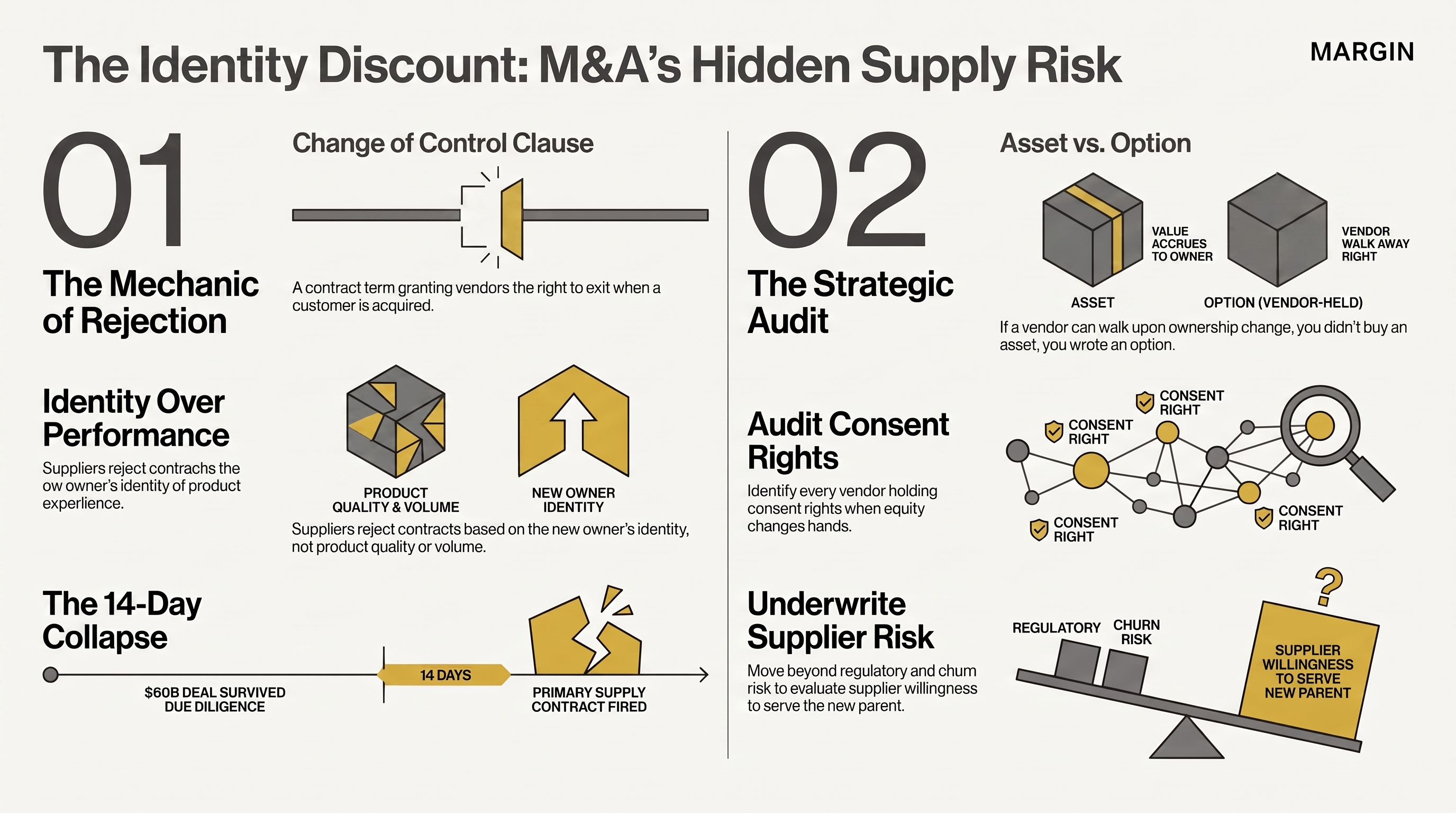 Download the one-page infographic
The 14-Day Reality Check
On August 14th, SpaceX finalized its acquisition of the parent company of the AI platform Curser for $60 billion in stock—a move representing roughly 3.4% of SpaceX’s total value. Fourteen days later, the "ghost" in the machine appeared. OpenAI, the critical engine powering Curser’s most advanced features, issued a termination letter. The models would switch off on November 12th. The reason wasn't a lack of performance, a missed payment, or a volume dispute. It was purely a matter of identity. OpenAI exercised a "change of control" clause to "fire" its customer because it didn't like who now owned it. While most analysts would view this as a catastrophic failure of due diligence, the buyer did something unexpected: SpaceX shrugged.
The "Identity Discount": When Ownership Erases Value
In traditional M&A, the checklist is predictable: you underwrite regulatory risk, customer churn, and key employee flight. This deal, however, exposes a new, volatile line item: the "identity discount. " This is the immediate loss of an asset's value triggered by a change in ownership for reasons entirely unrelated to the asset’s performance. Historically, supply agreements were assumed to survive acquisitions; suppliers rarely cared who signed the checks as long as they cleared. That assumption is now dead. In high-stakes tech, "supplier consent" is the new critical underwriting factor. If a vendor retains the right to walk because they find the new owner distasteful or competitive, the contract isn’t an asset—it’s a liability waiting for a trigger.
The Inversion of AI Lock-In
The tech industry is obsessed with "lock-in"—the fear that a customer becomes so integrated into a platform that they cannot leave. This acquisition presents a radical inversion of that narrative: the platform leaving the customer. A "change of control" clause turns a stable supply agreement into a volatile option. It grants the vendor the power to exit the relationship based on the customer’s moves in the equity market rather than their behavior in the product market. "The platform can leave you over something you did in the equity market, not the product. "
The "Immune System" Metaphor: Why Tissue Matches Aren't Enough
To understand this mechanic, look to transplant surgery. A surgeon’s primary challenge isn't just finding a heart that fits; it’s ensuring the body doesn’t reject it. Tissue can match on every measurable dimension, yet the body can still attack. This is because the immune system isn't grading the "quality" of the organ; it is reading its "identity. "The OpenAI-Curser termination was a corporate immune response. The contract acted as the vendor’s biological defense system, identifying the new owner as a mismatch and triggering a rejection. This wasn't a surprise to the board; the "change of control" term was disclosed and knowable. The board’s strategic decision to exit manifested in the contract long before the deal closed.
The High Price of Compliance History
The friction between OpenAI and the buyer (Elon Musk’s SpaceX) was not speculative. It was rooted in documented conflict. A 2023 New York Times report detailed a contract dispute between OpenAI’s leadership and the buyer’s other interests, and Musk later acknowledged under oath that XAI had used OpenAI data in violation of its terms. For OpenAI, this history meant that "compliance risk" was priced significantly higher than the revenue generated by the Curser contract. They didn't want the money; they wanted a clean exit. By providing the maximum notice allowed, they effectively chose to protect their technology's perimeter over maintaining a $60 billion customer’s supply chain.
The Free Option: Check Who Actually Owns the Right to Walk
The strategic "tell" in this deal wasn't the termination itself, but the buyer's reaction. SpaceX wasn't blindsided. They realized that Curser’s CEO, Michael Truel, had already moved to mitigate this risk well before the close. By the time OpenAI sent the letter, their models carried only about 5% of Curser’s traffic. Truel had shrunk the supplier’s footprint to a rounding error. SpaceX made a rational bet: the $60 billion wasn't for an OpenAI contract. It was for distribution, an installed developer base, and the compute power to serve them—assets that do not vanish when a supplier leaves. However, for those without SpaceX’s scale, the lesson remains: if a vendor can walk the day an owner changes, that contract was never an asset you bought. It was a call option the vendor held, and you essentially wrote it for free. You may have "bought" the asset, but the vendor owns the right to decide if you're allowed to keep it. As you evaluate your M&A pipeline, ask these three questions:
Who holds the consent rights the moment our cap table shifts?
Is this contract a core asset, or a vendor-held option to exit?
Does our identity create a compliance risk that outweighs our revenue value to the supplier?
Conclusion: Redefining the Asset Checklist
The shift from "contract in place" to "who signed it" marks a new era of strategic analysis. The identity of a company now dictates its technological capabilities. If your tech stack is built on the permission of a competitor or a hostile vendor, you don’t own your stack—you’re just renting it until the next funding round. The SpaceX-Curser deal proves that the most dangerous clause in your stack isn't about the price you pay; it's about whether your supplier decides your identity is a terminal illness. Is any tech stack truly "owned" if the supplier has the right to walk the day the ink dries on your acquisition?