// The money read, in writing
The Zara Paradox: Why Paying More for Labor is a $4.2 Billion Masterstroke
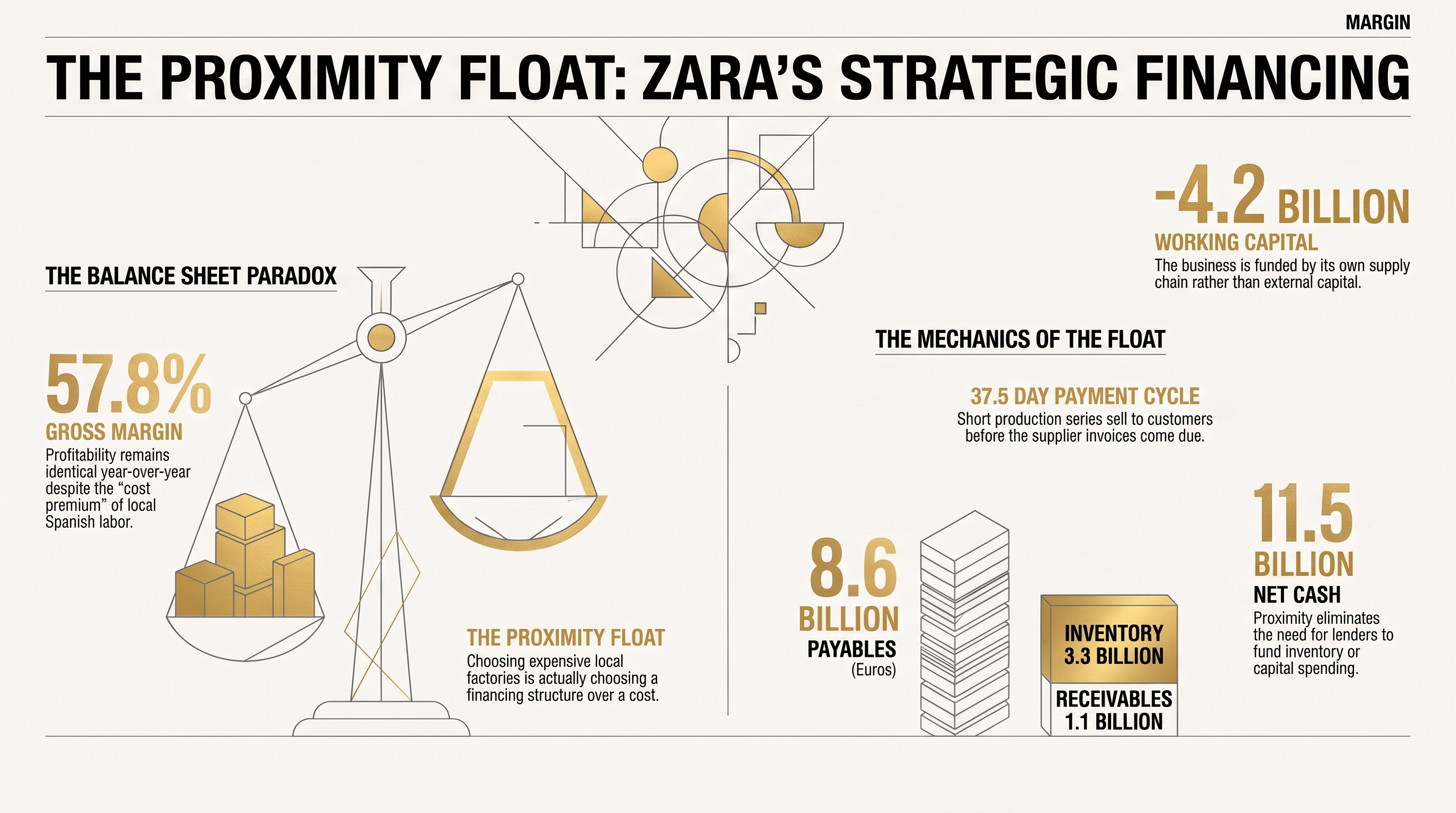 Download the one-page infographic
Negative €4.2 billion. That is the staggering working capital figure at the heart of Zara’s balance sheet—a number that represents a structural defiance of retail gravity. While the global fashion industry spent the last four decades chasing the lowest possible unit costs in distant labor markets, Zara made a counter-intuitive bet on proximity. By keeping a massive share of its production in expensive sewing clusters near its Spanish headquarters, the company hasn't just built a supply chain; it has engineered a financial engine that generates billions in "free" capital. Chief Executive Oscar Garcia Maceiras signed the March 2025 director’s report, which states the strategy plainly: Zara utilizes 10 supplier clusters, with a "highly significant" part of procurement located near its Spanish base. Interestingly, the filing avoids an official percentage for this near-shore production—management declined to provide one even as analysts widely estimate it at roughly half of all volume. This refusal to be pinned down on a specific ratio underscores a deeper truth: Zara doesn't view proximity as a manufacturing quota, but as a fundamental financial prerequisite. Despite paying a clear premium for local labor, Zara’s margins remain untouchable. For the year ending January 2025, the company reported a gross margin of 57.8%—identical to the previous year—while the return on capital for the Zara segment held steady at a robust 36%. These results prove that the "extra" cost of sewing in Europe isn't being passed to the consumer; it is being recovered in a place the cost line never looks.
1. Proximity is a Financing Strategy, Not Just Logistics
To most retailers, labor is a cost to be minimized at all costs. To Zara, labor is a tool used to buy "the short calendar. " By manufacturing close to home, Zara can wait until the season is underway to decide on production series, reacting to real-time data rather than months-old forecasts. This shift reframes the entire manufacturing budget. "They did not choose an expensive factory. They chose a financing structure and filed it under cost of sales. "
2. The Magic of Negative Working Capital (-€4.2 Billion)
Zara’s financial model is built on what we might call the " Proximity Float. " In a traditional retail model, the buyer’s own capital is "trapped" for every week a garment spends in transit from a distant factory. Zara flips this. Because their production-to-shelf cycle is so rapid, they often sell the clothes to the consumer and collect the cash before the supplier’s invoice even arrives. The 2025 financial report reveals the scale of this imbalance through three critical line items:
Inventory: €3.3 billion
Receivables: €1.1 billion
Payables: €8.6 billionThe math constitutes the " Golden Rule" of the Zara model: when Payables (€8.6B) are significantly larger than Inventory and Receivables combined (€4.4B), the supply chain is effectively financing the buyer. Zara isn't using bank loans to fund its operations; it is using its suppliers' time.
3. The 37.5-Day Race Against the Clock
The engine of this float is a relentless race against the calendar. Zara’s average payment period to suppliers is 37.5 days. For a competitor sourcing from 12 time zones away, those 37.5 days would be largely consumed by shipping and logistics, forcing the company to use its own capital to hold the goods. Proximity is the only way to beat this clock. By keeping production series short and "in season," Zara ensures that goods are converted into revenue within that 37.5-day window. Speed doesn't just mean "fashionable"—it means the business is funded by its own momentum.
4. Radical Independence from Lenders
The ultimate result of this structure is a level of fiscal sovereignty that is "practically non-existent" elsewhere in the sector. Zara carries €11.5 billion in net cash, allowing it to fund €2.7 billion in annual capital expenditures without breaking a sweat. A Business with No Lenders Because the supply chain provides the necessary liquidity, Zara operates with a total absence of external debt. This creates a powerful feedback loop: no bank sets the pace of the business, and no lender can dictate movement or speed. Zara answers to no one because it doesn't need external capital to keep its shelves full.
5. Built-In Resilience Against Global Shock
Zara’s short supply chain acts as a shock absorber. The 2025 filing noted political disruption in distant sourcing clusters—the kind of event that leaves competitors with inventory stranded on ships or trapped behind geopolitical bottlenecks. Zara, however, reported that "goods kept arriving. "When you decide production in-season, you stop needing capital to hold inventory that might never arrive. A supply chain short enough to pivot instantly is a supply chain that survives global volatility while competitors’ capital remains "trapped" at sea.
6. Conclusion: The Ledger of the Future
Zara has successfully reframed the "cost premium" of local labor as a high-yield investment in financial sovereignty. While the ledger records higher manufacturing costs every quarter, those costs are the price of admission for a -€4.2 billion working capital advantage. The Zara model poses a radical question for the modern executive: Is your "cost of sales" an actual expense, or is it merely an inefficient financing structure in disguise? In the end, Zara wasn't just buying faster sewing; it was buying independence and paying for it at the factory gate.