// The money read, in writing
Why Dyson’s Latest Launch Is a Masterclass in Corporate Defiance
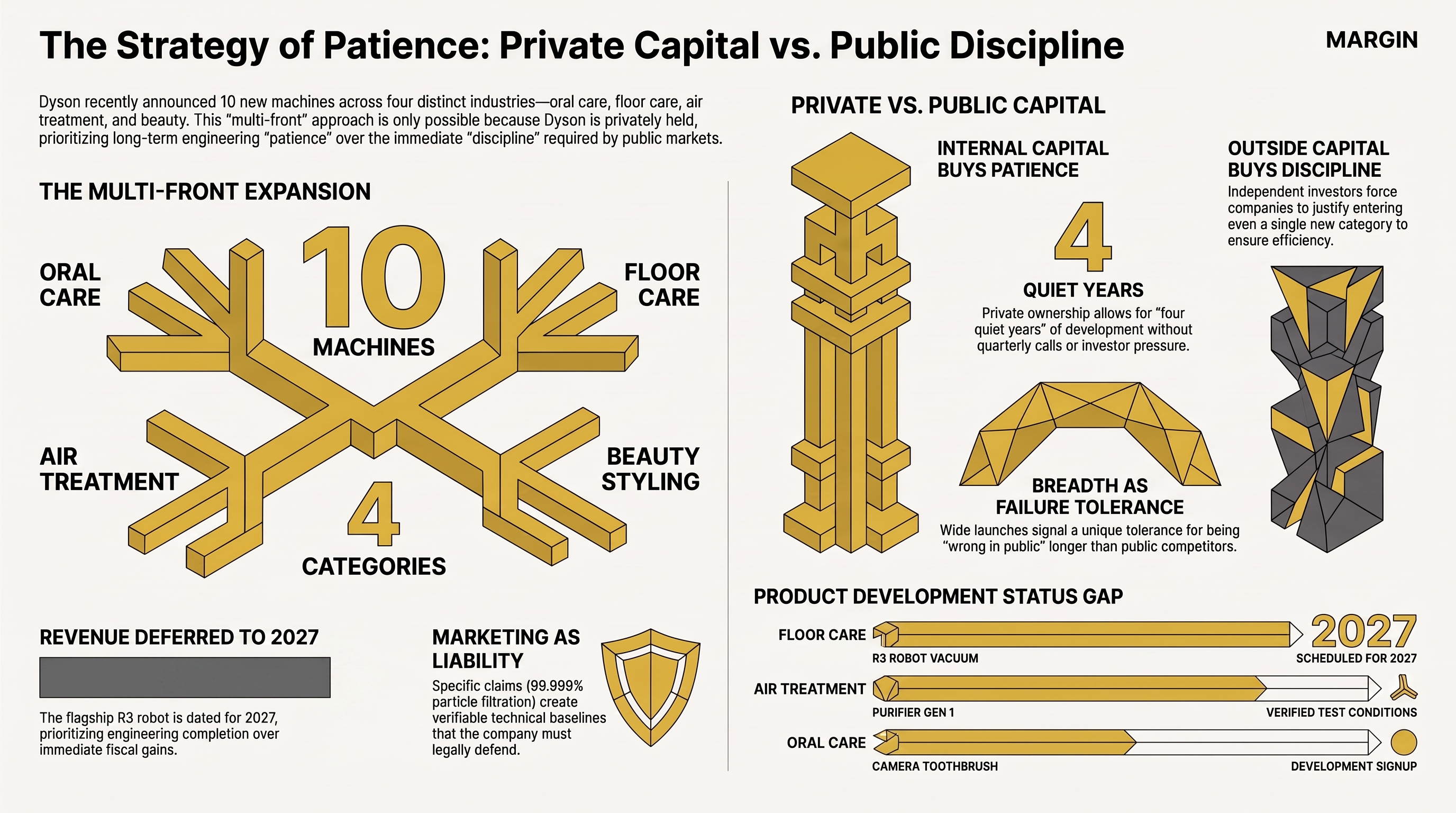 Download the one-page infographic
The Ten-Machine Blitz
In a single week, Dyson didn’t just release a product; they opened fire on four different fronts simultaneously. The scale of the announcement is a strategic anomaly: ten machines across oral care, floor care, air treatment, and beauty. The catalog includes a camera-equipped toothbrush, three robot vacuums, a standing mop, three air purifiers, and a specialized styling brush. For a company of this magnitude, the standard playbook is to pick one category, defend it with everything you have, and appease shareholders with predictable growth. Instead, Dyson has opted for a "four-front war," engaging four different sets of competitors and four distinct consumer buying decisions all at once. The central curiosity here isn't the hardware itself, but the institutional behavior behind it. Why would any firm choose to invite this much friction in a single window?
The Audacity of the "Four-Front War"
Traditional corporate strategy is built on the discipline of focus. Publicly traded firms usually lack the stomach for this kind of breadth because it spreads resources thin and confuses the "story" told to investors. To the casual observer, Dyson’s decision to sprawl across categories looks like a display of pure confidence. In reality, breadth isn't confidence. It is a tolerance for being wrong in public longer than a public company could survive. By launching into four categories at once, Dyson is not necessarily saying they will win all four; they are saying they have the capital structure to absorb the failure of three. It is a fundamental defiance of the "pick one battle" mantra that governs the rest of the tech industry.
The 2027 Flagship: The Most Honest Line in Tech
The centerpiece of this blitz is the R3 robot vacuum, a $1,199 flagship that represents the pinnacle of their floor care engineering. However, there is a massive gulf between the hype and the hardware: the R3 isn’t scheduled to ship until 2027. While the lower-tier R1 and R2 models will hit shelves sooner, the flagship remains a distant promise. This is the point where the announcement stops being a retail event and starts being a strategic maneuver. If you visit the R3’s landing page, you won't find a " Buy Now" button. The page offers you a signup, not a checkout. By admitting out loud that "the engineering isn't finished," Dyson is performing a rare act of transparency. They are taking the consumer’s attention today while deliberately deferring the revenue into future fiscal years—a move that would trigger a crisis of confidence in a public company but serves as a moat for a private one. "If that date holds, the breadth was real. If it slips quietly, the announcement was the product. "
When Hyper-Specific Data Becomes a Liability
Dyson’s marketing has always leaned on the "engineering-first" persona, but their latest claims take this to a level of extreme specificity that borders on a strategic liability. They claim their new purifiers capture 99.999% of particles as small as 1/100th of a micron. Crucially, this isn't an abstract boast; it is tied to a modified Korean air cleaning standard conducted in a 30m³ chamber. By naming the exact chamber size, the participant counts, and the modified baselines, Dyson is using hyper-transparency as a weapon. However, this scrutiny cuts both ways. A vague marketing claim is easy to pivot away from, but a number you can go and check is a liability. Dyson has effectively made its own engineering precision a public hostage; they must now defend these specific, self-defined metrics for the entire life of the product. They aren't just selling a machine; they are daring the industry to meet a bar they’ve meticulously documented.
The Secret Power of Private Ownership
The engine driving this defiance is Dyson’s capital structure. Because the company is privately held, the capital funding this four-category push is entirely internal. There is no outside investor to persuade, no "raise" attached to the launch, and no quarterly earnings call to survive. This internal capital buys a level of patience that is unavailable to competitors. However, this lack of oversight is a double-edged sword. While private ownership allows for long-term engineering roadmaps, it can just as easily fund four bad ideas with nobody to stop them.
Outside Capital: Buys discipline. Independent voices ask whether entering a fourth category is a vanity project or a viable business move.
Internal Capital: Buys patience. It allows for a higher tolerance for being "wrong" in public while the engineering catches up to the marketing. The ownership structure doesn't change the scale of Dyson’s ambition, but it fundamentally changes who has the right to say "no"—and how loudly they can say it.
Conclusion: The Price of Patience
The real story of this ten-machine blitz isn’t found in the suction power of a vacuum or the bristles of a toothbrush. It is a test of whether the people funding the work can afford to wait. The 2027 release date for the R3 is the most honest line in the entire announcement because it functions as a benchmark for the company’s integrity. Is this three-year engineering roadmap a genuine act of transparency, or is it a sophisticated way to lock in brand loyalty and prevent revenue from moving to competitors? For the modern tech consumer, the choice is between the immediate gratification of a finished product and the slow, uncertain promise of an honest roadmap. Ultimately, the success of this "masterclass in defiance" will be measured by whether Dyson can actually deliver the flagship they’ve already convinced the world to wait for.