// The money read, in writing
The £2 Billion Arithmetic: Why Dyson’s "Failure" Was Actually a Masterclass in Discipline
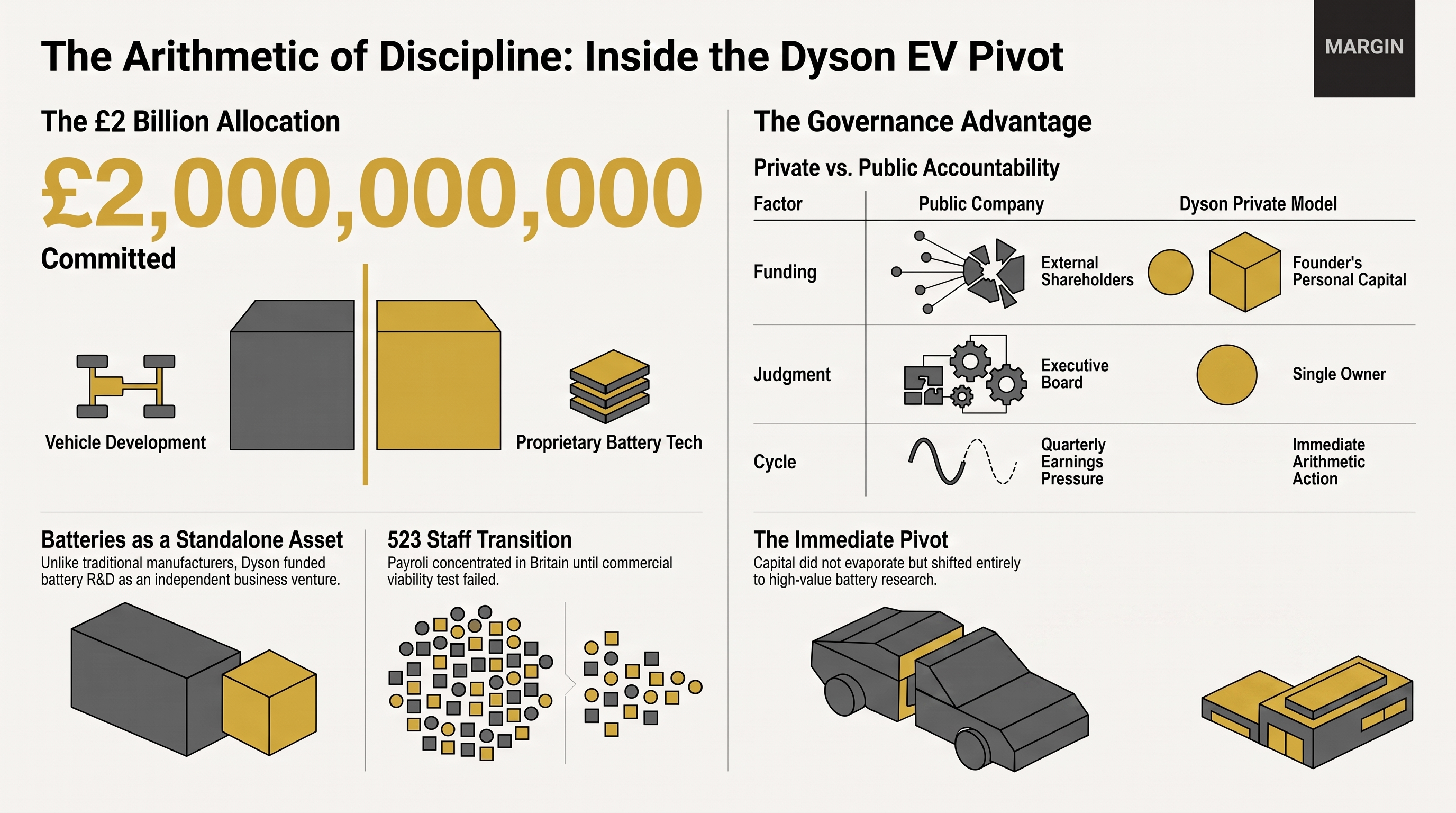 Download the one-page infographic
On a Thursday in October 2019, a single email dismantled a national headline. To the casual observer, the news was a punchline: the vacuum cleaner company that thought it could build a car had finally hit a wall. But inside Dyson’s Wiltshire headquarters, the narrative was far more sophisticated than a simple "failure to launch. "By the time the plug was pulled, the Dyson car wasn't a set of sketches or a clay model; it was a functioning, high-performance machine that engineers called "fantastic. " Yet, Sir James Dyson terminated the project with the clinical precision of a surgeon. This wasn’t an engineering defeat; it was a nine-figure commitment meeting the cold reality of the balance sheet. In the world of high-stakes R&D, this was a masterclass in knowing when to stop—not because the machine failed, but because the math did.
The Market’s Cold Shoulder
The hardest part of manufacturing is moving from a prototype to a viable product. Dyson had already conquered the engineering hurdles, producing a vehicle that met every performance benchmark. But a "perfect" machine is a liability if the unit economics are broken. Dyson’s decision was grounded in a brutal market reality: the company had aggressively sought a buyer for the project, and nobody came. The market’s silence confirmed what the internal spreadsheets already suggested—the vehicle could not carry its own cost. As Sir James Dyson wrote to his team:" We simply can no longer see a way to make it commercially viable. "Killing a "darling" that actually works is a rare exhibition of corporate discipline. Most executives are seduced by the sunk-cost fallacy, throwing good money after bad to save face. Dyson, however, refused to let a functioning invention bleed the treasury dry just for the sake of corporate pride.
The 50/50 Hedge
To understand the £2 billion commitment made in 2016, you have to look past the chassis. While the media fixated on the vehicle, Dyson was running a strategic hedge. The capital wasn’t dumped into a single bucket; it was split "at par"—£1 billion for the car platform and £1 billion for battery technology. In a traditional automotive play, capital is used to "widen the core," incrementally improving existing lines. Dyson’s strategy was different. Most automakers treat batteries as "bolt-in" components—commodities purchased from third-party suppliers. Dyson treated the battery as a standalone business. The car was never the sole end goal; it was a high-speed test bed for the energy cells. Because "cells outlive the product" they are housed in, the battery chemistry remained a foundational asset even after the car project was scrapped. This wasn't a failed car project; it was a battery program with a very expensive laboratory.
The Funder and the Judge
The Dyson car survived only as long as its arithmetic made sense, a feat only possible because of what we might call the " Single Ledger" advantage. In a public company, a project of this magnitude is governed by a messy " Separation of Powers. " Shareholders fund the program, while executives defend it. This creates a perverse incentive for management to hide behind "one more cycle" or "market adjustments" to avoid a career-ending write-down during an earnings call. At Dyson, the "funder" and the "judge" were the same person. Because Sir James Dyson used his own capital, there was no outside equity to placate and no quarterly theater for analysts. The moment the project failed to "survive contact with the ledger," the judge could act. This allowed the program to end early and quietly, rather than surviving unnecessary cycles driven by corporate optics.
The Governance of Two Tests
The human cost of this discipline was concentrated in a team of 523 people—500 of them in Britain. The " Thursday email" they received wasn't an apology for their performance; it was a capital statement. High-stakes R&D operates under a paradox: a team can solve every technical challenge, innovate at the highest level, and build a "fantastic" machine, yet still see their work terminated by a spreadsheet. It is a harsh reminder of the governing logic of industrial innovation. As the project’s end demonstrated, every venture must pass two tests: the engineering test and the commercial test. Two tests, and only one governs a spend.
The Ledger’s Final Record
The Dyson car didn’t evaporate; it evolved. The capital didn’t disappear—it moved into battery density and chemistry, technologies that are already migrating into the company's future product pipeline. The strategic pivot ensured that the three-year, nine-figure investment yielded a generational leap in energy storage rather than a bankrupt car division. The internal logic of the Wiltshire headquarters is best captured by the final record of the project:" The ledger doesn't record a canceled car. It records a battery program that got 3 years of funding and a test bed that paid for it. "For any leader, the Dyson case study poses a haunting question: If you had built a "perfect" product that couldn't move the needle on the balance sheet, would you have the discipline to kill it today, or would you let it bleed you for another year?