// The money read, in writing
Why Microsoft’s New AI Code of Conduct Is Actually a Warning for Your CFO
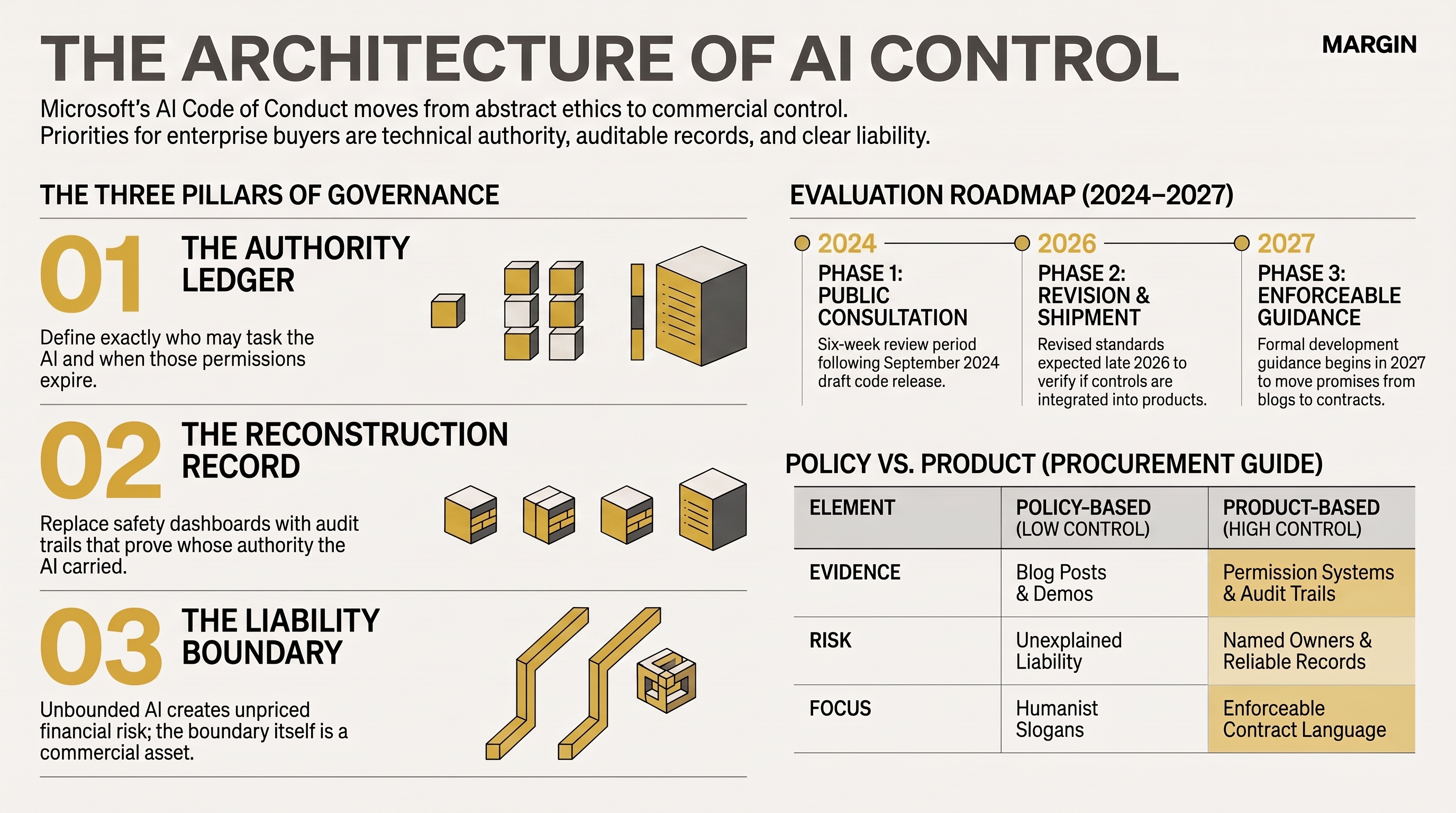 Download the one-page infographic
Beyond the "Ethics" Label
Public discussions regarding AI ethics are often dismissed as "ethics theater"—soft, philosophical frameworks that rarely survive a rigorous procurement process. However, Microsoft’s draft AI Code of Conduct, released on September 14th, is a cold, strategic signal that the era of vague promises is ending. This is not a manifesto; it is a procurement shift that will determine which vendors carry the liability and which buyers get stuck with the bill. For the CFO, this document forces three immediate questions that must shape every AI contract:
Which promise creates exposure?
What record proves it?
And who is on the hook when an AI system crosses a boundary?
Takeaway 1: It’s Not Ethics, It’s Economics
Enterprise AI is a matter of financial risk and control, not moral alignment. The "colder" question every executive must ask is: Who pays when people matter more than AI has to become control? When you acquire AI, you aren't just buying a tool; you are acquiring data, workflows, and decisions. The true strategic asset for your business is the boundary you set around that technology. If an AI model cannot be bounded, audited, and defended, the buyer inherits a liability they cannot accurately price. "The interesting part is colder. Enterprise buyers acquire data, workflows, decisions. The boundary is the asset. "
Takeaway 2: Authority Must Be Granular, Not Vague
Microsoft’s draft emphasizes that models must stay in scope and accept human correction. In practice, this means the Rationale is the Authority Ledger . Without a technical "why" recorded alongside every action, your authority is legally and operationally indefensible. "Human control" is a mere slogan with expensive consequences if it is not backed by granular technical permissions. A functional system must define precisely what an AI is permitted to do: for instance, it may be granted permission to read payroll records but strictly barred from exporting them. Crucially, a manager must have the technical capability to stop a process before it becomes evidence in an audit log. Without these controls—defining who allowed the task and when that permission ends—the business is flying blind.
Takeaway 3: A Dashboard Is Not Evidence
Executive leadership must distinguish between a "safety dashboard" and a functional audit record. A dashboard that signals a system is "safe" provides zero protection during a financial or legal audit. It is fluff, not evidence. To control financial risk, procurement must demand a record that allows them to reconstruct the exact chain of events:
What was the AI asked to do?
What specific data did it use to formulate its response?
Whose authority did it carry at that moment? Procurement only stops reviewing policy and starts controlling risk when they can answer the uncomfortable question: " What happened and who was responsible for letting it happen? "
Takeaway 4: The Value of a "Smaller Operating Envelope"
The assumption that a more "capable" AI is always more valuable is a fallacy in a regulated environment. Often, a smaller operating envelope —one with tighter limits, a named human owner, and a reliable record—is worth significantly more than a wide, unexplained risk. When a vendor provides a "slogan" instead of a technical control, the buyer is hit with the Integration Bill . This cost is paid in organizational friction:
Security Reviews: Prolonged scrutiny because the tool cannot be bounded.
Finance Delays: Deployment slows as risk cannot be priced.
Legal Exceptions: Internal teams must draft complex workarounds to manage unaddressed vendor liability. If the vendor does not turn their code into product controls, the buyer carries the weight of the integration bill and the underlying risk.
Takeaway 5: The 2026/2027 Enforcement Horizon
The clock is already ticking. Microsoft’s draft was released on September 14th, kicking off a six-week consultation period that is happening now. They intend to revise the code in late 2026 and use it to guide actual product development in 2027. If you are evaluating an AI contract, do not buy the phrase—test the economics underneath it. You must look for where the promise becomes enforceable. Enforceability is not found in a blog post or a demo; it is found in the permission system, the audit trail, and the contract language. Watch Microsoft closely after October 2026: if they do not ship actual product controls and audit evidence, this code was merely "positioning. "
Conclusion: Human Control as a Commercial Feature
We are witnessing a pivot from the "humanist AI frame" popularized by figures like Mustafa Suleyman toward "human control" as a definitive commercial feature. As AI integrates into the core of the enterprise, the ability to bound and defend these systems is what creates value. The real risk to your balance sheet is authority you cannot price, cannot govern, and cannot defend. When you pull up your next AI contract, do you know exactly who pays when the boundary fails?