// The money read, in writing
The $145 Billion Ledger: Decoding Meta’s High-Stakes Pivot to Personal AI
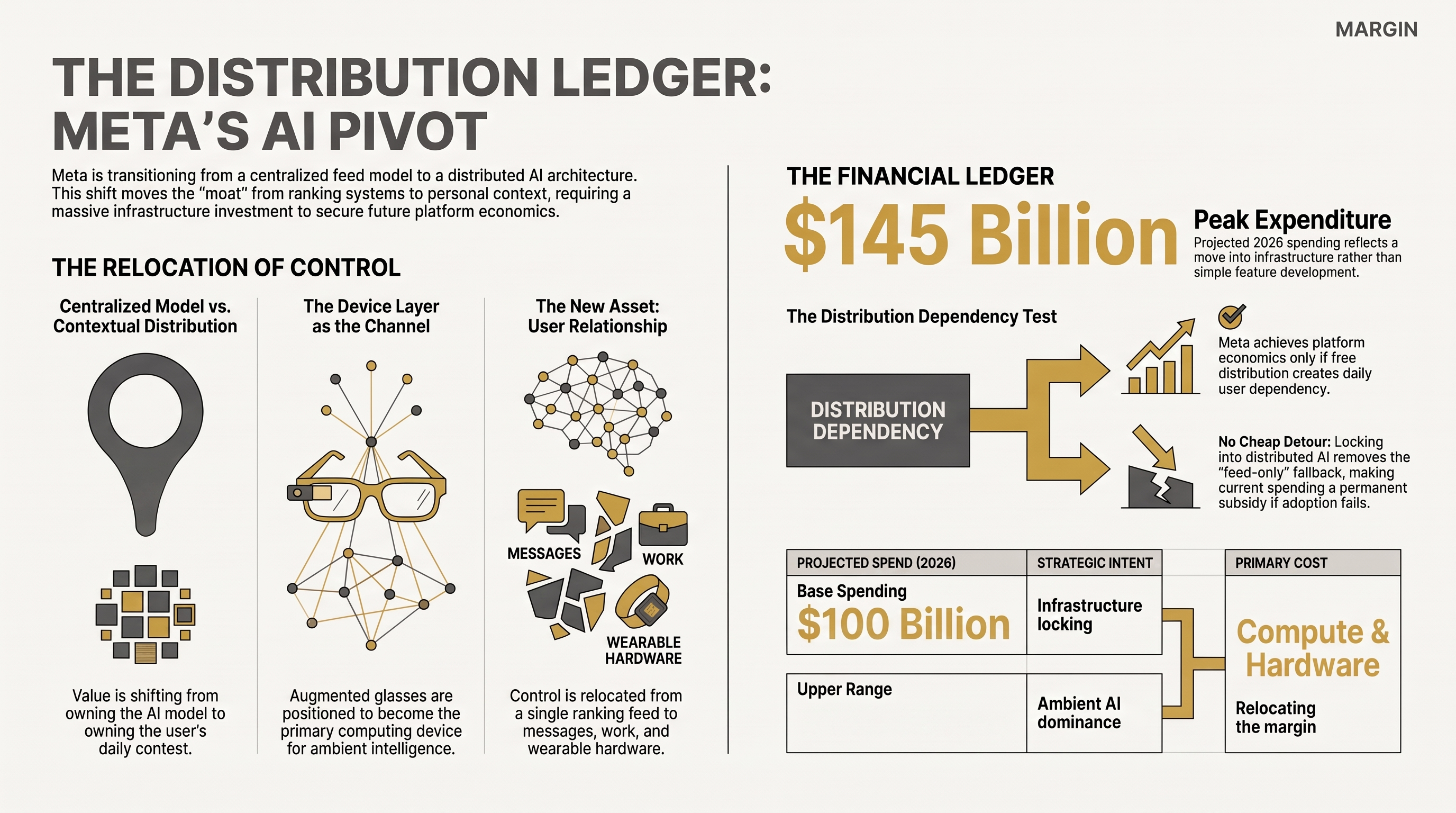 Download the one-page infographic
The architecture of the internet is shifting, and with it, the economic engine of the world’s largest social ecosystem. For two decades, our digital lives were governed by the "feed"—a centralized stream where a single ranking system turned human attention into high-margin profit. But Mark Zuckerberg is now signaling the end of this era, pivoting toward a concept he calls "redistribution. " To the casual observer, this sounds like empowerment or even corporate charity. To a digital economist, however, it is a cold-blooded calculation to relocate where power sits in the AI era. Meta is moving away from its role as a "central utility" to become something far more integrated: the ambient infrastructure of our daily lives.
Breaking the "Feed" Ledger
Traditionally, social platforms thrived on a " Distribution Ledger" that sought to monetize concentration. In this model, the platform wins by funneling billions of users into a single, proprietary algorithm—one feed, one ranking system, one captive audience. However, the rise of generative AI breaks this ledger. Meta has recognized that in an AI-native world, value no longer sits exclusively inside a single app. Instead of fighting to keep users trapped in a central utility, Meta is betting on "redistribution," where intelligence is spread across messages, workplace tools, and wearable hardware. This is a radical, counter-intuitive pivot. For a company built on concentrating attention to now argue that centralized intelligence is the "wrong future" is a massive strategic gamble. Meta is essentially attempting a moat migration: they are moving control from the delivery of content to the ownership of the user relationship itself.
Ambient AI Has a $145 Billion Price Tag
This strategic shift is not a simple software iteration; it is a massive capital allocation that fundamentally alters the company’s cost structure. Meta is effectively buying the right to make AI feel ambient—always on, always present. According to Fast Company projections, Meta’s capital expenditure is set to surge past $100 billion, with the upper range hitting $145 billion by 2026. From an economic perspective, this represents a shift from variable costs—adjusting features and algorithms—to massive, fixed infrastructure costs that require high-volume utility to break even. "This is not a feature budget, it's allocation. "This is the " Soft word, hard bill" of Meta’s new era. The rhetoric of "personal AI" is the soft word; the $145 billion infrastructure spend is the hard bill. This level of spending locks the company into a specific infrastructure story with no cheap detour. If this "ambient" distribution fails to translate into habitual daily use, Meta faces a stranded-asset crisis—an incredibly expensive infrastructure with no path back to its old, high-margin, low-overhead feed model.
The Pivot from Compute to Context
In the current AI arms race, strategic value is being contested across two different accounting terms. In the " Centralized AI" model, value is owned by whoever possesses the most raw compute and the most powerful model. But Meta is betting that raw compute will eventually become a commodity. In their " Personal AI" model, the only proprietary monopoly left is context . Meta is betting that "context"—the intimate, real-time data of a user’s daily moments, environment, and conversations—is a more defensible asset than processing power. By positioning personal AI as a safeguard against concentrated power, Meta is attempting to frame its ecosystem as the "safe" alternative. Strategically, this ensures that Meta remains the essential, inescapable layer between the individual and their digital reality. In this ledger, whoever owns the context owns the value.
Glasses as the New Primary Computing Device
For this new ledger to be profitable, Meta requires a hardware channel that can "see and hear context all day. " This is why smart glasses have moved from the periphery to the center of Meta’s roadmap. They are the essential intake valves for the context Meta needs to survive. If Meta can successfully transition the user relationship to hardware, the economic extraction model changes. The massive infrastructure spend no longer looks like a standard data center bill; it becomes "rent on the day. " If an AI assistant follows you through your 16 waking hours via your glasses, Meta is effectively charging rent to every service, interaction, or piece of information you encounter. Hardware dominance allows them to gate-keep the AI experience, justifying the $145 billion bill through the sheer persistence of the relationship.
The "Dependency" Catch
While Meta leans heavily into the branding of "open source" and "generosity" with its Llama models, a digital economist sees a strategic "loss leader" designed to create market dependency. The company has already hinted at the limits of this generosity, suggesting that as AI approaches "super intelligence," safety concerns may necessitate closing the ecosystem. This reveals that the strategy isn’t about being "open"; it’s about ensuring that the industry builds on Meta’s foundations. "If distribution becomes dependency, Meta gets platform economics. If not, it bought a very expensive subsidy. "If providing free access to models increases the world’s dependency on Meta’s infrastructure and standards, the "margin" hasn’t disappeared—it has simply moved. If they succeed in making Meta AI the default context-provider for humanity, they achieve a new form of platform dominance. If they fail, they have merely spent $145 billion subsidizing their competitors' R&D.
Conclusion: Follow the Money Backward
The market has yet to fully price in this shift because it still values Meta on its high-margin advertising business. But if you follow the money backward from that $145 billion spend, you see a company that is no longer content with owning a feed; it is a company trying to own the context of the human experience. The pivot from "concentration" to "distribution" is a trillion-dollar bet that the next great monopoly won't be a destination we visit, but an atmosphere we breathe. As we move into this era, we must ask: Do we prefer a digital world governed by a central utility we can occasionally look away from, or one where AI is ambient and helpful, but creates a new, inescapable form of hardware-gated dependency?