// The systems read, in writing
The $2.2 Million Workaround: What the CRISPR Headlines Aren’t Telling You
 Download the one-page infographic
In December 2023, the FDA approved CASGvi, the first medicine designed to rewrite the source code of human cells. It is a genuine breakthrough for patients with sickle cell disease, a brutal inherited blood disorder. The product has shipped, and for those treated, the results are transformative. But if you are the type of reader who checks the "methods section" before trusting the headline, you’ll find the seam in the story. In the world of biotech, the demo and the shipping product are often different machines. While the popular narrative suggests we’ve finally found a magic wand for DNA, the reality is that CASGvi only works because it utilizes a massive clinical workaround to avoid the single most difficult problem in genetic medicine.
The Edit Happens in a Dish, Not Your Body
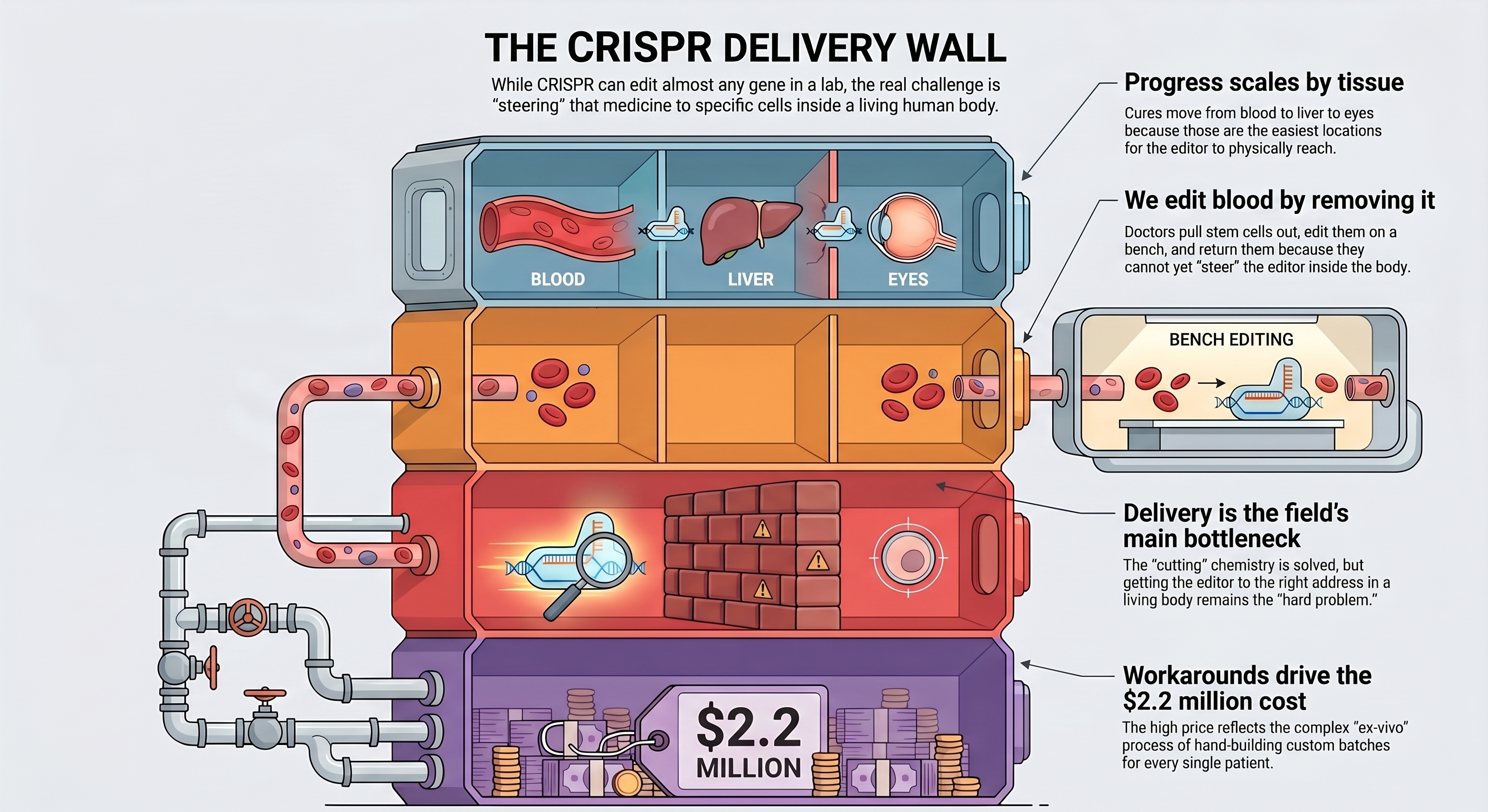
The "tell" regarding CRISPR’s current limitations is how the treatment is actually administered. CASGvi is an ex vivo process. This means the editing never actually happens inside the patient’s body. Instead, doctors harvest blood stem cells, edit them on a laboratory bench, and then return the modified cells to the patient. This is a brilliant workaround, but it isn’t a universal solution. It works for sickle cell because blood is the exception to the rule: it is the one tissue you can physically remove, fix, and reinject. As the source of this technology’s first success, blood allows us to ignore the fact that we still can't "reach" most of the human body. To put it bluntly: you can't pull someone's brain or heart out, fix the DNA on a bench, and put it back. "The science can edit almost any gene. The medicine can only reach cells you can physically remove and return. "
The "Hard Problem" is Delivery, Not Chemistry
CRISPR reached the clinic not by conquering the " Hard Problem" of gene editing, but by routing around it. That problem is delivery. There is a profound distinction between "editing chemistry"—the ability to cut DNA—and "steering the edit"—the ability to get that chemistry to the right address in a living body without hitting the wrong cells. Jennifer Doudna’s Nobel Prize was for the chemistry, and that chemistry was never the bottleneck. We must be precise: the statement "we can edit any gene" is technically true in a lab setting, but it is not the same sentence as "we can edit any gene in a living body. " One is a solved chemistry problem; the other is an open delivery crisis. "The cutting is solved. Steering the edit to the right address. That’s open. "
The $2.2 Million Price Tag is a Manufacturing Problem, Not Just Greed
When critics see the $2.2 million price tag for CASGvi, the immediate assumption is corporate greed. However, the "methods section" reveals a more systemic issue. Three years into the rollout of these types of therapies, only several hundred patients across nine countries have actually been treated. This isn’t a mass-produced pill; it’s a bespoke, handbuilt manufacturing process. Because we cannot deliver the edit inside the body, every dose requires:
Harvesting the patient's own cells.
Custom-editing a batch in a specialized lab.
Clearing the patient's bone marrow with chemotherapy to make room for the return. This labor-intensive, patient-specific cycle is the reason for the cost. In this context, the price is the workaround. The cost is the direct result of our inability to solve the delivery problem at scale.
The Hierarchy of Reachable Tissues
The field is not moving in a straight line toward curing every disease. Instead, it is climbing a difficulty curve, one "reachable address" at a time. We are currently limited to tissues that are either physically accessible or naturally "easy" for the bloodstream to hit.
Blood: The current frontier. It can be removed and returned (Ex Vivo).
Liver: The next target. While " In Vivo" trials (dosing straight into the blood) are happening here, they only reinforce the rule. The liver is the body's filter; it is the easiest internal address to reach via injection.
Eye: The next targeted tissue because of its self-contained and accessible nature. We aren't on a path to "anything, anywhere. " We are moving one tissue at a time, based entirely on the geography of the human body.
Newer Tools, Same Old Wall
The biotech world is currently buzzing about " Base editing" and " Prime editing. " These are marketed as sharper, more surgical scissors that can change DNA without a double-strand cut. While the chemistry of these tools is indeed an upgrade, they face the exact same wall as the original CRISPR. A sharper pair of scissors doesn't help if you still lack the vehicle to get them to the right cell. Because these newer tools ride the same delivery systems, they remain stuck behind the same bottleneck. The tool has improved, but the "shipping" mechanism is still broken.
Conclusion: Medicine vs. a "Beautiful Edit in a Tube"
The approval of CASGvi is a historic milestone, but we must distinguish between laboratory success and scalable medical reality. The breakthrough succeeded by walking around the wall of delivery, not through it. The next time you hear a headline claiming a new genetic cure is five years away, ask one specific question: " Which tissue? "That one question will tell you everything you need to know. If they can’t reach the cells in a living body, you aren't looking at a scalable medicine—you're looking at a beautiful edit in a tube. For now, the gap between what we can do on a bench and what we can do in a body remains the defining frontier of the field.