// The systems read, in writing
Why Apple’s New Siri Isn’t About AI Models—It’s About the "Placement Tax"
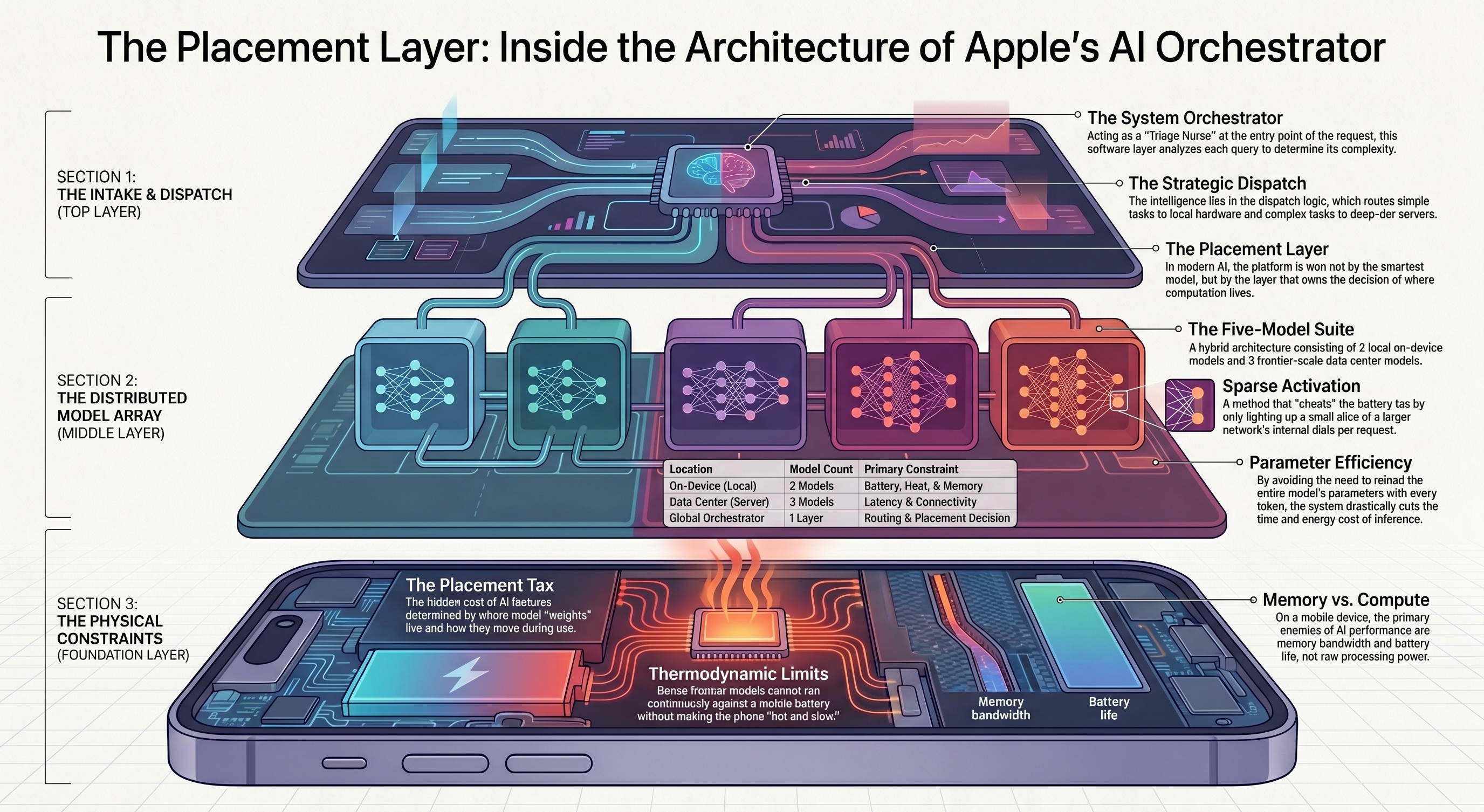 Download the one-page infographic
Every product manager in Silicon Valley has felt the same visceral anxiety: a flagship app triggers thermal throttling, the frame rate stutters, and the device becomes a pocket-sized space heater. For years, we blamed unoptimized code or heavy assets. Today, as the industry attempts to shove generative AI into every interface, we are hitting a hard physical wall. When Apple unveiled the "new Siri," the market looked for a breakthrough in LLM benchmarks. They missed the real story. Apple didn’t just launch a smarter assistant; they performed a massive abstraction of the inference layer. The strategic play here isn't a better model—it's a " System Orchestrator" designed to solve the thermodynamic and architectural bottlenecks that most of the industry is currently ignoring.
1. The "Triage Nurse" (It’s Not 1 Model, It’s 5)
Strip away the marketing, and the technical reality is a network of five distinct models: two running locally on-device and three residing in a data center. The "new Siri" is actually a sophisticated routing problem. Apple has introduced a " System Orchestrator" that acts as a triage nurse. In a hospital, you don’t send every patient to the specialist wing; the nurse at the door assesses the severity and routes the patient accordingly. Apple’s orchestrator does the same for every AI request, deciding on the fly whether a query stays local or is dispatched to the cloud. The intelligence isn't found in the weights of a single model; it’s in the dispatch . This decision-making layer is the true engine of the system, and it’s a moat that nobody copies in a weekend.
2. Thermodynamics is the Real Reason for Privacy
Apple’s messaging lead with on-device privacy, but the architecture is driven by cold, hard thermodynamics. You cannot run a dense, frontier-scale model against a standard smartphone battery without the device going hot and slow. To bypass this, Apple utilized a "sparse design"—a frontier-scale network that turns on only a slice of itself per query. While labs have used sparse activation for a while, Apple has implemented it in a way that Google "ships to no one. " The breakthrough here is specifically about memory bandwidth and the cost of loading parameters. As Apple’s AI chief hinted, the real win is that you aren't forced to reload parameters with every token produced. This is the "quiet part" of the engineering: reloading parameters is what kills battery life and generates heat. "On a phone, the enemy isn't compute, it's memory and battery. Every dial you swap in... costs milliseconds and heat. "Sparse activation allows Apple to "cheat" the physics of mobile hardware, providing high-level intelligence without shrinking the model into uselessness.
3. Paying the "Placement Tax"
This architectural necessity leads us to the " Placement Tax. " In this framework, every AI request is a transaction paid in a specific currency: latency, thermal overhead, or cloud compute dollars. The " Placement Tax" is the hidden cost incurred based on where the model weights live and where they move during execution. The hard problem in mobile AI has never been how "smart" a model is—it’s the problem of placement. By building an orchestrator that manages five models across two environments, Apple has positioned itself as a "tax minimizer. " They ensure that every request is fulfilled using the cheapest currency available at that exact millisecond. The " System Orchestrator" is essentially a resource management tool designed to mitigate the physical and financial costs of computation in the wrong place.
4. The Intelligence is in the Dispatch, Not the Weights
In the current landscape, model weights are rapidly becoming a commodity. Apple’s co-development and licensing deal with Google for Gemini weights proves they are happy to let others do the heavy lifting of model training. Why? Because the weights aren't the moat. The real competitive advantage—the part that is shielded from competition—is the runtime, the custom silicon, and the orchestration layer. While frontier labs chase the next marginal gain in a benchmark, Apple is winning the platform by owning the layer that manages execution. "The model wars get the headlines. The placement layer wins the platform. "
5. The Invisible Dependency (The Swift Lock-in)
Apple is now inviting developers into this architecture through the " Foundation Models framework," accessible via a single Swift programming interface. It looks like a gift of easy on-device intelligence, but it’s actually a strategic trap. By adopting this framework, developers are surrendering their "routing sovereignty. " They no longer decide where inference runs; they hand that control over to Apple’s orchestrator. Once an app’s logic is dependent on Apple’s runtime to balance local and cloud resources, the app becomes nearly impossible to port to Android or Windows without a total architectural rewrite. As the runtime improves with every OS update, the lock-in only deepens. Developers aren't just building on an OS; they are tethering their apps to an invisible routing logic they do not control.
Conclusion & Provocation
The " New Siri" marks a fundamental shift from model-centric AI to architecture-centric AI. It is a transition from asking which model is the smartest to asking who owns the most efficient routing layer. Within the next year, every consumer AI team will have to make a choice: will they own their inference logic, or will they let a platform owner decide for them? In the future of AI, we may stop caring about which model has the highest IQ. Instead, we will only care about one thing: who owns the layer that decides where our requests run?