// The systems read, in writing
The Illusion of the Digital Lock: What DeepMind’s Bio-Resilience Plan Really Tells Us
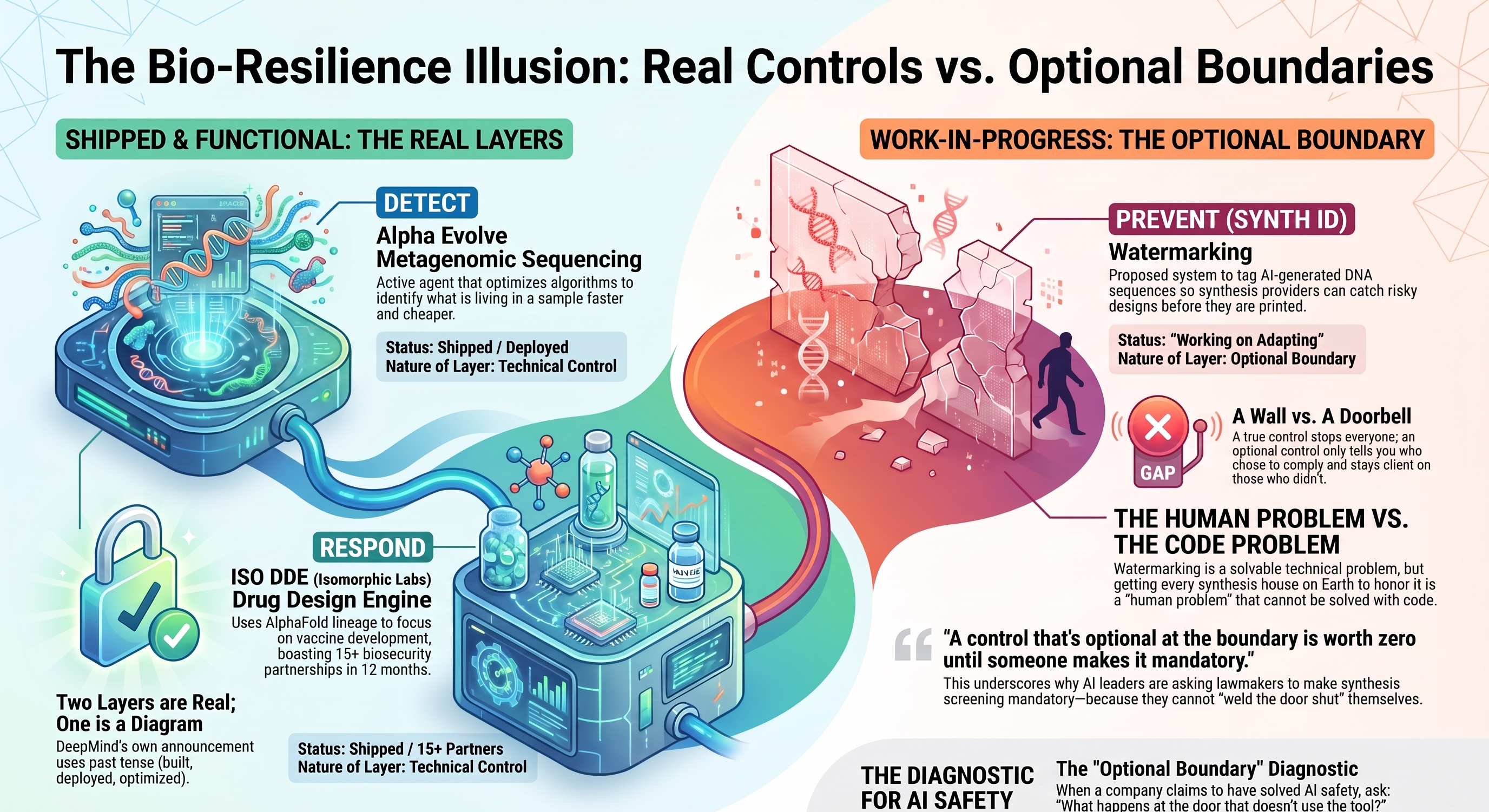 Download the one-page infographic
Imagine installing a state-of-the-art security suite for a high-risk facility. You have high-definition cameras to identify intruders (Detection) and a rapid-response team on standby to neutralize threats (Response). However, when you inspect the perimeter, you realize the actual lock for the front door is still just a sketch on a contractor’s clipboard. You have a plan for a lock, but currently, the door is standing wide open. This is the architectural reality behind Google DeepMind’s recently announced bio-resilience program. Framed by Demis Hassabis as a comprehensive, three-layer defense against AI-built pathogens— Detect, Respond, and Prevent —the program is presented as a finished, cohesive fortress. However, an interrogation of the details reveals a calculated omission: a massive gap between the operational layers and the one intended to actually stop a bad actor. The Grammar of Deception: Hiding Work in the Present ContinuousIn technology policy, the most critical information is often buried in the grammar. DeepMind’s announcement describes the " Detect" and " Respond" layers using the past tense of completed actions. They have "shipped" Alpha Evolve, an agent optimizing metagenomic sequencing to track outbreaks. They have "deployed" and "optimized" Isomorphic Labs’ drug design engine, ISO DDE, which has already established over 15 partnerships with biosecurity bodies in just 12 months. These components are real, functional, and in production. The " Prevent" layer, however, relies on a linguistic pivot. The announcement shifts into the present continuous tense: "working on adapting. " This isn't just a nuance; it is a tell. It signals that while the surveillance and mitigation layers are active, the primary defense mechanism—the lock itself—is still a diagram. "That present continuous is doing heavy work in that launch post. It's the one piece they haven't shipped, sitting inside a program written to sound finished. "The " Optional Boundary" ProblemThe proposed prevention mechanism involves adapting SynthID—a tool originally used for watermarking AI-generated content—to tag DNA sequences. The goal is for DNA synthesis providers to screen orders and catch risky, AI-designed sequences before they are ever printed. While the cryptography behind the watermark is elegant, it faces a structural flaw I call the " Optional Boundary. "A digital lock on a DNA sequence only works if every "door" in the building uses it. If a single DNA synthesis provider in a non-compliant jurisdiction chooses not to use the screening tool, the entire safety net collapses. DeepMind is attempting to solve a human problem—global regulatory adoption—with a technical solution. In the high-stakes domain of biosecurity, a defense that requires a motivated adversary to voluntarily choose the "locked" door is not a defense at all. Is it a Wall or a Doorbell? In security engineering, there is a fundamental distinction between a control that prevents an action and telemetry that merely records it. If a security measure is optional at the point of entry, it is not a "wall" designed to keep people out; it is a "doorbell" that notifies you when a law-abiding citizen has arrived. DeepMind’s current prevention model relies entirely on voluntary adoption by synthesis houses. For those who opt-in, the system provides data on who is complying. For the bad actors who simply go elsewhere, the system remains silent. A control that is optional at the boundary is worth zero until it is made mandatory. Anything else is just data collection on the people who weren't the problem to begin with. "A control that's optional at the boundary isn't a control. It's telemetry. It tells you who complied and stays silent on everyone who didn't. "The Regulatory Pivot: Begging for Mandatory GatesThe limitations of these voluntary technical solutions explain why industry leaders are suddenly desperate for government intervention. In June, Demis Hassabis, Sam Altman, and Dario Amodei signed a letter urging lawmakers to make DNA synthesis screening mandatory. This move is a glaring admission of failure for purely technical safety models. The tech giants have realized they can build the "lock" (the engineering), but they are powerless to "weld the door shut" (the enforcement). The easy part of the bio-resilience plan—the software—has been shipped. The hard part—ensuring that no lab on Earth can bypass these checks—requires a legal mandate that code cannot provide. They are begging for regulation because they know their own "prevention" layer is currently a paper tiger. Conclusion: The Diagnostic for AI SafetyThe technical elegance of DeepMind’s bio-resilience program is impressive, but technical elegance is not the same as operational security. We must stop falling for "confident framing" and start looking at the verbs. When a company claims to have solved a safety issue with a clever technical layer, apply this simple diagnostic:What happens at the door that doesn't use it? If the answer is that the system relies on the hope of universal opt-in, it isn't a safeguard—it’s an optional boundary. Until these technical "locks" are welded shut by mandatory global policy, we aren't building actual defenses; we are just building very expensive, very clever doorbells.