// The systems read, in writing
Beyond the Hype: What Netflix’s "300 AI Titles" Actually Means for Filmmaking
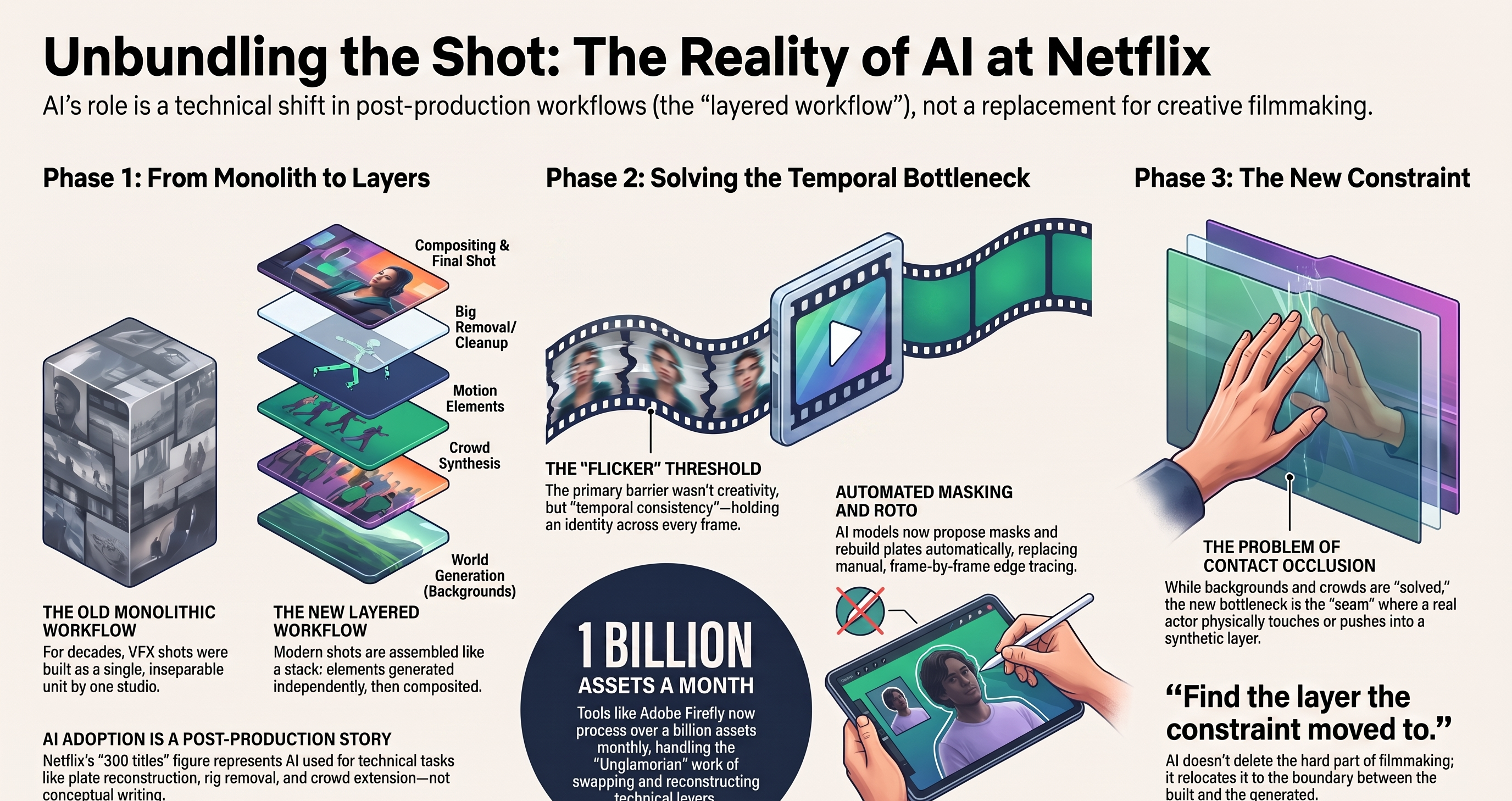 Download the one-page infographic
When Netflix co-CEO Ted Sarandos recently announced that generative AI has touched roughly 300 titles this year, the industry immediately retreated into its usual defensive posture. The public discourse erupted into an existential debate over whether AI is coming for the writer’s room. But in the rush to defend the "soul" of cinema, almost everyone argued the wrong part. The real story isn't about machines replacing human creativity; it is a quieter, more technical evolution regarding the industrialization of the render. The "300" figure isn't a creative milestone—it is an adoption number marking a strategic shift in how the visual stack is assembled.
It’s Post-Production, Not Prompt Engineering
The adoption of AI at Netflix is heavily concentrated in post-production, specifically in the unglamorous trenches of the edit. Take The American Experiment , the one title for which Sarandos provided specific figures. The film utilized 17 minutes of AI-assisted footage, but the machine didn't write the script or direct the actors. Instead, it was used to rebuild shots inside the edit—handling the "invisible" labor of rig removal, plate reconstruction, and crowd extension. The reality of the workflow is best captured by the technical teams on the ground:" These weren't AI movies. They were conventional shots where for one layer—the background, the crowd, the establishing plate—it got generated instead of built. "This is not "prompt engineering" a movie into existence; it is using a more efficient screwdriver for specific, labor-intensive layers of a traditional production.
The Unbundling of the "Visual Effects Monolith"
Historically, a visual effects shot was a "monolith. " A single VFX house would build the shot end-to-end as a proprietary, unified piece of craft. We are now witnessing the unbundling of that monolith into a "layered workflow. "In this new industrial model, a shot is no longer a single thing you build; it is a stack you assemble. Unbundling never deletes the "hard part" of production; it simply relocates it. By treating the shot as a stack, generative AI allows teams to generate specific components independently:
The World: Background environments and establishing plates.
The Crowd: Dynamic background characters that fill out a scene.
The Motion: Specific movement data applied to those elements. The shift is from artisan building to industrial assembly. The "monolith" has been shattered into independent layers, allowing the machine to hold the portions of the stack that were previously the most tedious to construct.
The "Boring" Breakthrough: Temporal Consistency
The gatekeeper that kept generative AI out of professional filmmaking for years wasn’t a lack of "taste" or "creativity"—it was math. The single failure mode was "temporal consistency. "While AI has long been capable of generating a gorgeous still image, those images famously "flickered" the moment they were put into motion. In a professional shipping cut, a generated crowd must hold its identity across every single frame as the camera moves. If a texture morphs or a face shifts between frame 24 and frame 25, the human eye catches it instantly, and the illusion breaks. Think of the compositor as an air traffic controller attempting to hold 50 planes in position simultaneously. Managing one plane is simple; keeping all 50 consistent second after second, frame after frame, is the hurdle that defined the "pro" threshold. Netflix’s 300 titles signal that this constraint has finally been crossed. Compositors now trust the math enough to put it in a final cut.
Automating the "Schedule-Eater"
The most profound strategic shift is occurring in the "compositing layer" of the industry. This is where the "schedule-eaters" live—specifically manual rotoscoping and masking. For a century, an artist had to trace the edge of every moving object frame-by-frame to tell the software what to keep and what to replace. Generative models have now moved the "seam" of production. Instead of an artist’s hand-drawn line, the model proposes a mask automatically and rebuilds the plate behind it. The scale of this restructuring is massive: Adobe Firefly alone now moves over a billion of these assets a month. The labor inside the layer hasn't vanished; it has been restructured from manual tracing to supervising the model’s guess.
The New Bottleneck: Contact Occlusion
As the technology advances, we see the truth of the industry: the "hard part" never disappears; it just moves to a new layer. Today, the background is solved. AI can generate worlds and crowds with staggering coherence. However, the layered workflow hits a hard boundary at the "seam" where the real and the synthetic must physically touch. This is the problem of contact occlusion . When a real actor pushes their hand into a synthetic surface or walks through a generated crowd, the physics of that interaction remains the new "hard part. " The system struggles where the "built" and the "generated" intersect. This physical boundary is where the manual labor is now being concentrated. The "seam" has relocated from the edge of the frame to the point of physical contact.
Conclusion: Follow the Seam
Netflix’s 300 titles are not a sign that the " AI movie" has arrived. They are a signal that the industry has solved the constraint of temporal coherence in the post-production stack. The next time a studio claims a new breakthrough, don't ask if the output "looks good. " That is a consumer question. Instead, ask the strategic question: " Which layer does the machine actually hold? "The tell isn't the number of titles; it’s the seam. We must look for where the real and the generated have to touch—because that is where the human element remains essential. A solved constraint never vanishes; it simply forces us to find the new layer where the "hard part" has moved. The question for the industry is no longer if the machine can hold a layer, but how long it will take for the "seam" to move again.