// The systems read, in writing
The "Sunbird" Paradigm: 5 Surprising Truths About the Fusion Engine That Could Get Us to Mars in Half the Time
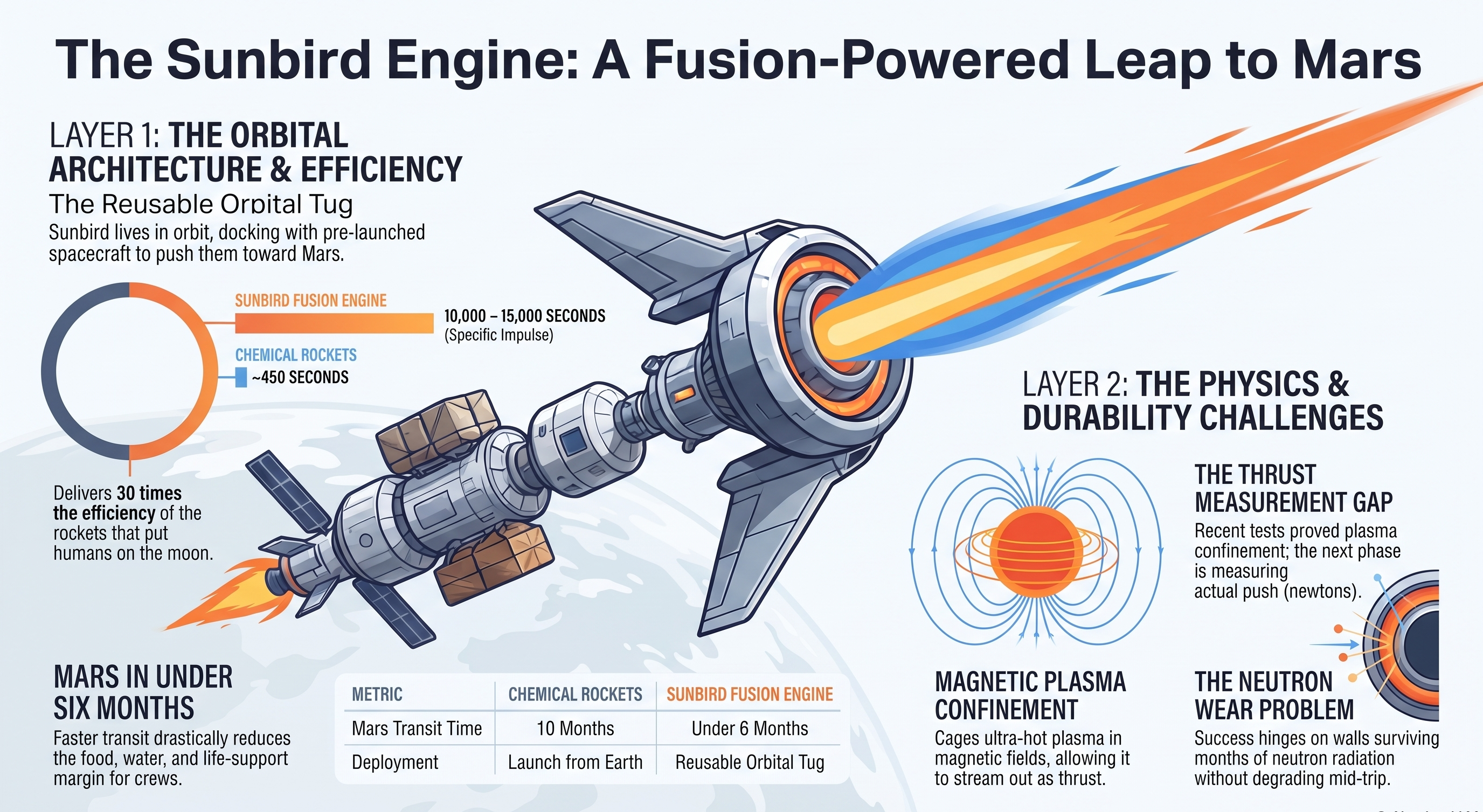 Download the one-page infographic
Deep-space travel is currently a grueling exercise in patience. For decades, we’ve relied on chemical rockets that provide a violent, brief shove before leaving us to "coast" through the void for ten months or more. We have reached the physical ceiling of combustion; we are essentially throwing rocks to move a boat. But Pulsar Fusion is attempting to swap the oars for a warp drive. Their " Sunbird" engine isn’t just an incremental upgrade; it’s a bid to turn the slow drift to Mars into a high-speed transit. If we want to become a multi-planetary species, we have to stop coasting and start driving.
1. It’s an Orbital Tug, Not a Launch Vehicle
To understand Sunbird, you have to discard the image of a rocket roaring off a pad at the Cape. This engine will never touch the ground, and it will never survive a launch. It carries no crew and no cargo of its own. Instead, it is a dedicated orbital tug. Its entire existence is spent in the vacuum of space, docking with spacecraft that have already been ferried into orbit by conventional rockets. Once attached, it provides the push to Mars, then uncouples and returns to orbit for the next job. This design is a masterstroke of specialization. By staying in orbit, the engine bypasses the "violent first minutes" of spaceflight—the shaking, the atmospheric pressure, and the acoustic hell that dictates how most spacecraft are built. This allows the Sunbird to be optimized for the one thing fusion actually does well: pushing gently and forever in a vacuum.
2. The 30x Efficiency Leap (The Specific Impulse Gap)
In the world of propulsion, the only number that truly matters is specific impulse—the measure of how much "push" you get per unit of fuel. To put the Sunbird’s ambition in perspective, consider the gap: a top-tier chemical rocket manages about 450 seconds of specific impulse. Sunbird is targeting 10,000 to 15,000 seconds. This isn’t just a "speck on a slide" for engineers to geek out over; it’s the difference between a ten-month transit and reaching the Red Planet in under six. When you’re planning a crewed mission, that time difference bends every other constraint. It means halving the food, water, and oxygen supplies. it means halving the radiation exposure for the crew. By slashing the travel time, the Sunbird transforms a suicide mission into a manageable logistical leap.
3. When Failure is the Fuel (The Physics Inversion)
The most counter-intuitive part of this technology is that a rocket engine might actually be the easiest way to achieve fusion. In a terrestrial power plant, the goal is to trap superheated plasma perfectly to generate steady energy. In that world, plasma escaping the magnetic "cage" is a catastrophic failure. In a rocket, the goal is the exact opposite. "In a power station, plasma escaping is a failure. In a rocket, plasma escaping controlled out the back is literally the thrust. "It is the same physics, but with an opposite goal. This "physics inversion" is the core of Pulsar’s argument: caging plasma is the hard part, but once you have it, letting it leak out the back in a controlled stream is chemistry class compared to trying to keep it stationary for a power grid.
4. Plasma is Real, but Thrust is Still a Theory
On March 25th in Bletchley, England, Pulsar Fusion gave the world a reality check. During a live stream to Amazon’s Mars conference, the team demonstrated "first plasma. " They proved they could create and confine the sun-hot matter within the engine's exhaust architecture. It was a massive milestone, but Richard Dyn, the lead of Pulsar, was Refreshingly blunt about the state of play: the engine has produced exactly zero Newtons of thrust so far. The confinement is real, but the propulsion remains a theory until it’s measured. The next phase isn't about more flashy lights; it’s the "honest" work of using specialized balances and probes to see if that confined plasma can actually move a mass. We have the fire; now we have to see if it can push the hearth.
5. The "Boring" Secret to Success is Wall Durability
The layer of the story that most coverage skips is the one that actually decides if we ever leave Earth's orbit. It’s not about the glamour of ignition; it’s about the "boring" problem of material science. Fusion reactions throw off neutron radiation, and those neutrons quietly, relentlessly chew through walls and magnets month after month. The failure isn't loud; it's slow. An engine that fires beautifully for three months but degrades and dies halfway to Mars is a death sentence. This is why Pulsar’s partnership with the UK Atomic Energy Authority is more critical than any plasma demo. They are obsessing over wear and tear because the Sunbird has to be a reusable workhorse, capable of 20 trips rather than a single experimental burn. If you can't build a wall that survives the neutrons, you don't have a tug; you have a very expensive piece of space debris.
Conclusion: Watching the Walls, Not the Speed
The Sunbird project is a stack of dependencies: skipping the launch, achieving impossible efficiency, and mastering the physics inversion of plasma. The world will be watching the scheduled 2027 in-orbit demonstration, but don't look for a finished tug. That mission is about testing the core components—the pieces of the puzzle—in the environment where they must live. Our future as a multi-planetary species may depend less on the power of the engine and more on the resilience of the materials holding it together. We are no longer waiting for a miracle of physics; we are waiting for a miracle of plumbing. If the wear data holds, Sunbird is real. If it slips, the rest stays a diagram. Watch the walls, not the speed.