// The systems read, in writing
The $100 Million "No": What Airbus Taught Us About the Real Cost of Software Guarantees
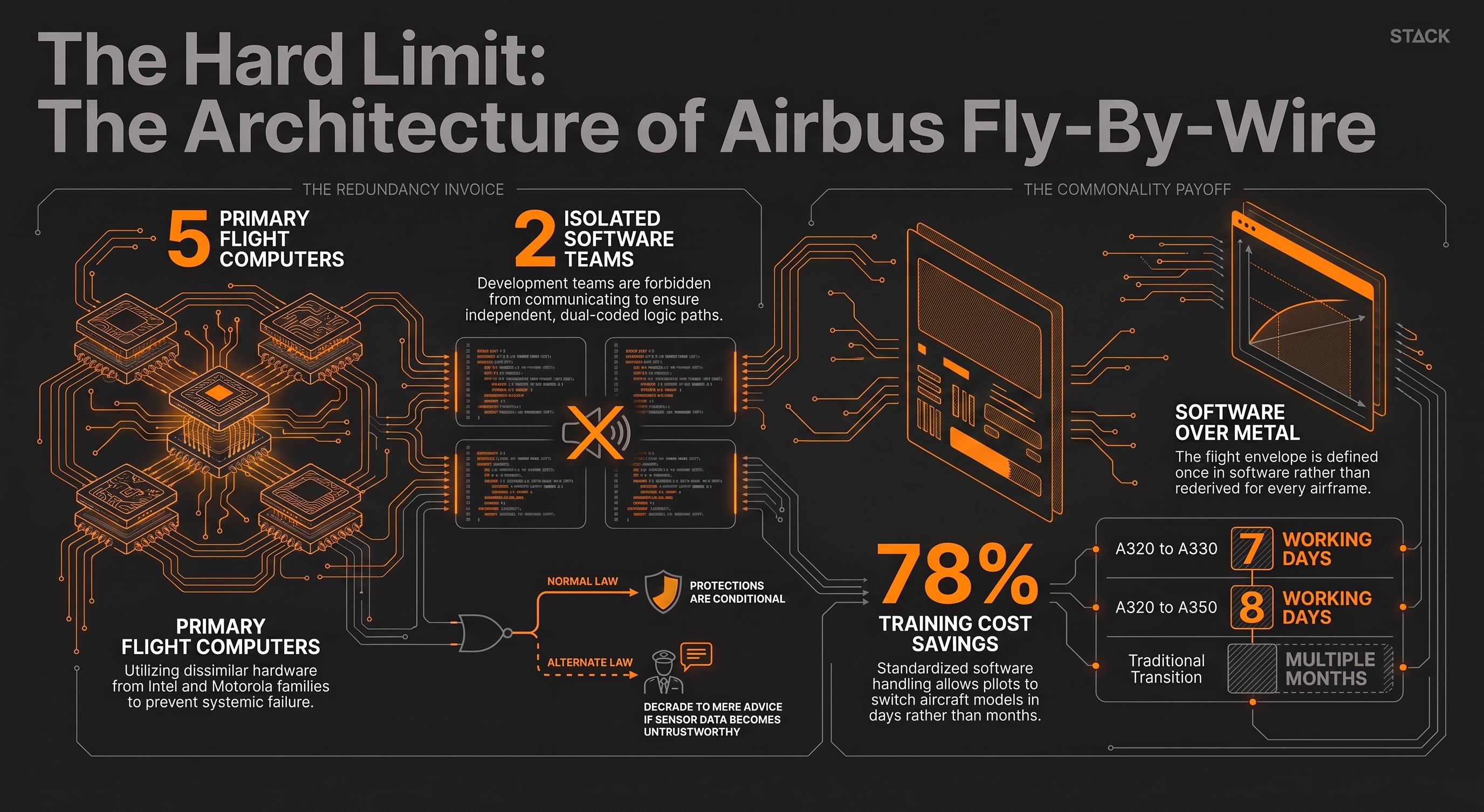 Download the one-page infographic
1. Introduction: The Plane That Refuses You
Imagine you are a pilot facing a sudden, critical obstacle. Your instincts scream to pull the side-stick back to the stops. In a traditional aircraft, you would feel the strain of the cables and the buffet of the air against the control surfaces. But in an Airbus A320, as you reach the edge of the flight envelope, the stick simply goes dead. There is no physical resistance, no "shaker" warning you of an impending stall—only a total, silent refusal. The software has interdicted your command. It has asserted its own model of reality over your muscles, deciding that your intent violates the laws of its digital universe. Airbus has delivered over 12,000 aircraft designed with this specific " Hard Protection. " While critics often debate the safety of removing final authority from the human, they miss the deeper architectural reality: a software refusal is a load-bearing promise. To make that promise, Airbus had to pay a massive "invoice" in hardware redundancy long before the first passenger ever boarded.
2. Takeaway 1: A Software "Refusal" is a Load-Bearing Hardware Claim
In systems architecture, if you tell a user they cannot override a system, you have accepted 100% responsibility for being right every single time. Airbus's " Hard Limits" are not just lines of code in a configuration file; they are an immense hardware claim. Because there is no mechanical backup to the primary controls, the system’s ability to remain "live" is the only thing standing between flight and catastrophe. The "arithmetic" of this redundancy is a masterclass in failover design:
Five Primary Flight Computers: The architecture relies on five units, with four capable of running every major function should the others drop.
Hardware Dissimilarity: To prevent a systemic chip flaw from grounding the entire fleet, the system is decoupled across hardware families—one set runs on Intel chips, the other on Motorola.
Isolated Logic: The software was written twice by two separate, isolated teams. This ensures that a logic error birthed by one team won’t be replicated by the other. Analysis: Are you shipping " Hard Limits" with a " Soft Limit" budget? If your software asserts absolute control, your redundancy is the invoice you must pay. You cannot claim the authority of an automated guard without the infrastructure to ensure that guard never sleeps. "The moment you tell a pilot you cannot override this, you've made yourself responsible for being right every time. That redundancy is the invoice. "
3. Takeaway 2: The Philosophical Divide (Airbus vs. Boeing)
The aviation industry is split by a fundamental question of systems philosophy: where does a boundary live, and who pays rent on it? Airbus utilizes Hard Limits , where the software holds a firm boundary that the pilot’s muscles cannot cross. Boeing utilizes Soft Limits —resistance that the pilot can feel and, crucially, push through. Both manufacturers deal with the same physics, yet they made opposite calls on final authority. Both systems are currently flying, and both are certified as safe. Analysis: This reveals that engineering is as much about philosophy as mechanics. Airbus chose to move the "rent" for safety from the pilot's continuous manual vigilance to the system’s initial architectural design. It is a shift from human-in-the-loop to human-on-the-loop, where the system’s logic defines the reality of the airframe.
4. Takeaway 3: The Fragility of the Guarantee (The Sensor Dependency)
The "guarantee" of software protection is never absolute; it is a state-dependent behavior. When the flight computers lose trustworthy air data, the system undergoes a state degradation. It drops from " Normal Law" to " Alternate Law. " In this mode, the hard stall protection—the very thing the pilot relies on—simply vanishes, replaced by a mere stall warning. The guarantee downgrades itself to advice. We saw this play out on July 6th of this year. A British Airways A320 into Heathrow experienced an air data failure, reverting the ship to Alternate Law. The pilots faced stall warnings on two separate approaches. While they landed safely, the inquiry remains open: were the warnings a reflection of a real stall, or were they the product of the same bad data that crippled the guards in the first place? Analysis: The "guard" (the software limit) is only as good as the telemetry feeding it. If the sensors lie, the protection evaporates exactly when the system enters its most volatile failure mode. "The protection was never absolute. It's conditional on the sensors telling the truth, which means the real guarantee was never the guard at all. It was the data feeding it. "
5. Takeaway 4: The Secret Business Case: 78% Training Savings
Why pay the massive "hardware invoice" for software redundancy? The reward was not just safety—it was the creation of a versioned platform. By abstracting handling characteristics into a software layer, Airbus decoupled the pilot's experience from the physical airframe. This is the " Commonality" play. Because the flight envelope is an interface defined in software, a pilot can transition from a narrow-body A320 to a massive A330 in just seven working days. The jump to the widebody A350 takes only eight. Airbus estimates this "software-defined handling" saves airlines up to 78% in training costs. Analysis: Airbus didn't necessarily decide that software was smarter than pilots; they decided that standardizing the interface was the ultimate business hack. By turning the physical act of flying into a versioned product, they achieved a market dominance that saw the A320 family pass the Boeing 737 as the most delivered airliner in history last October.
6. Conclusion: Check Your Inputs
The Airbus story is a study in the transition from mechanical systems to abstracted interfaces. To build a system that can say "no" to a human expert, you must be prepared to pay for that certainty with relentless redundancy and an absolute dependency on data integrity. As you build and ship your own "hard limits," stop looking at the logic of the limit. Look at the quality of the telemetry. What happens to your guarantee when the inputs go bad? Final Thought: When your sensors fail, your guarantee becomes a mere suggestion—and the danger is that everyone downstream is still building like it didn't.