// The systems read, in writing
The $5 Billion Gamble: What a 60-Year-Old Computer Can Teach Us About the Future of Tech
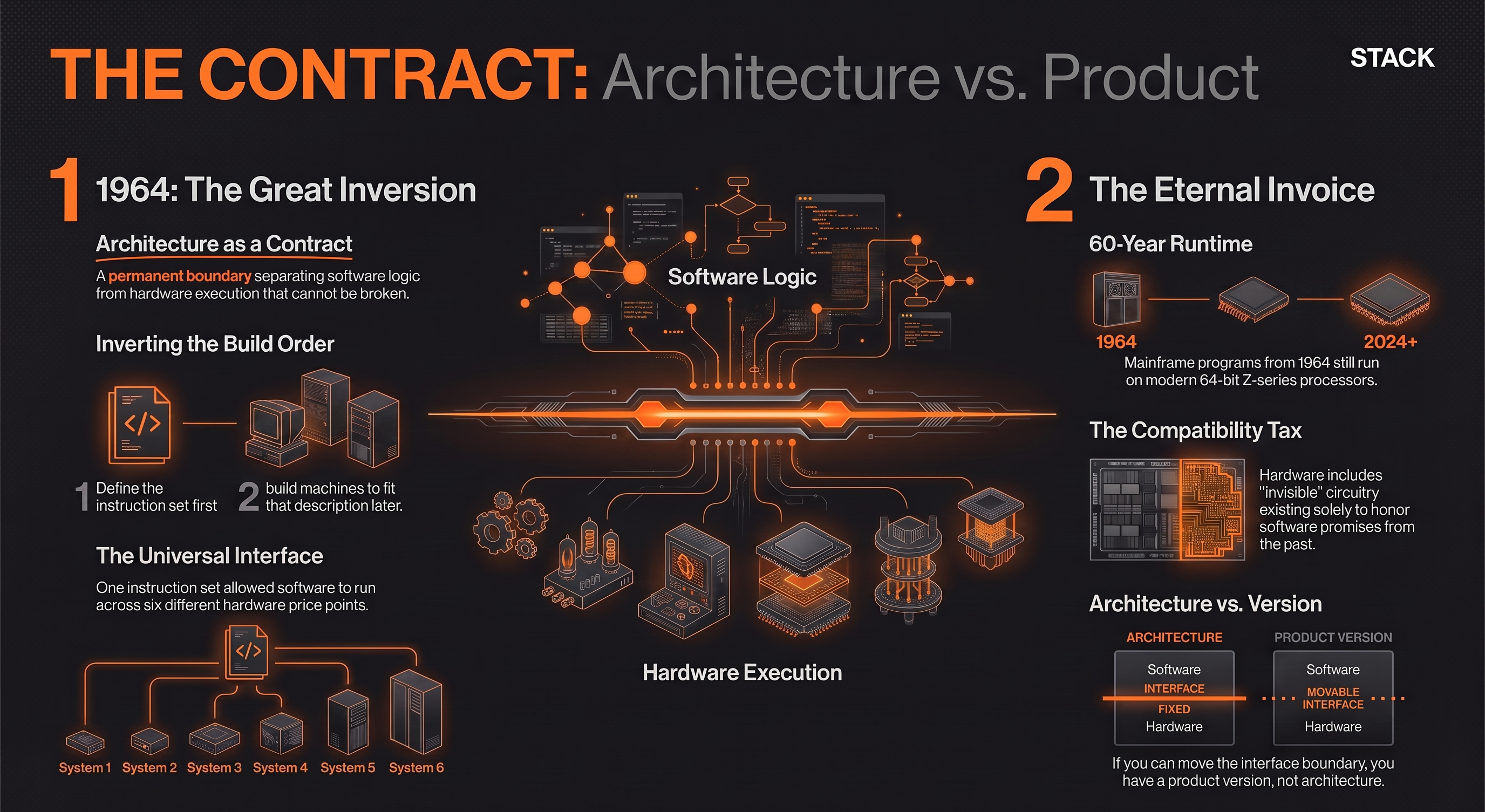 Download the one-page infographic
Introduction: The Ghost in the Machine
In the relentless churn of modern technology, software is usually considered "legacy" after five years and obsolete after ten. Yet, there is a startling anomaly in the world of high-stakes computing: programs written in 1964 for the IBM System 360 still run natively on modern 64-bit mainframes today. This isn't a stroke of luck. It is the enduring result of a $5 billion "bet-the-business" gamble that fundamentally changed how we define a computer. Before 1964, IBM wasn't a unified titan; it was a collection of rival engineering fiefdoms shipping incompatible hardware. The Endicott site owned the "small" line, while Pipsy (Poughkeepsie) owned the "large" line. A program written for one wouldn't run on the other. This fragmentation forced IBM to maintain six sets of duplicate R&D. What we now view as a visionary strategic shift was actually a solution to a massive internal cost problem. IBM realized that longevity wasn't about the machine itself, but about the interface.
The Proof of Concept: The 1410 "Switch"
The confidence to gamble $5 billion—a staggering sum in the 1960s—didn't emerge from a vacuum. It was built on a specific technical breakthrough. In September 1960, IBM shipped the 1410, which featured a 1401 compatibility mode implemented directly in hardware. By simply flipping a hardware switch, the machine could "become" its predecessor. It was a small-scale experiment, but it proved that hardware could be made to "pretend" to be something else to protect a customer's software investment. This successful proof of concept paved the way for April 7, 1964, when IBM announced the System 360—a single architecture that would replace all existing IBM products and redefine the industry.
Takeaway 1: Architecture is a Contract, Not a Product
The genius of the System 360 was the formal separation of software from hardware. Before this, a customer buying a new computer had to scrap their entire library of programs and start over. IBM inverted the traditional build order: they didn't design a machine and then describe its functions. Instead, they wrote the description first—a single instruction set—and then built six different machines at six different price points to match it. The architecture became a boundary that the hardware was forced to respect, regardless of the underlying engineering. "The architecture became a contract. The hardware may change. This boundary may not. "By shipping an interface rather than just a product, IBM allowed the hardware to evolve while the "face" presented to the software remained immutable. The smaller machines in the line weren't just "lite" versions of the big ones; they were entirely different hardware designs that wore the same architectural mask.
Takeaway 2: Compatibility is an "Invisible Tax" Paid Yearly
The Cost of Keeping PromisesBackwards compatibility is often marketed as a feature, but for the systems historian, it is recognized as a physical and financial burden. This compatibility is never "free. " According to the source, "somebody paid in every box. "To honor the promise of the 360, every machine in the family had to include circuitry that existed solely to support the interface. This was frequently painful for engineers, as it required them to allocate silicon and complexity to honor a promise the customer never actually saw. This is an invisible tax. It never appears on a quarterly report, but it is paid every single year in the form of design constraints and increased architectural weight.
Takeaway 3: The "Golden Handcuffs" of Success
The decision to create an unbreakable contract had a permanent impact on IBM’s organizational DNA. It created a "dual lock-in" effect. Once a customer’s software was built on this interface, they were trapped in the ecosystem. But the vendor was equally trapped. Every engineer hired after 1964 inherited a boundary they were not allowed to move. The descendants of that original gamble—the System 370, System 390, and the modern Z series—are still in production. The "seam of 1964" is physically visible in the design of modern 64-bit mainframe processors. Compatibility is not just a property of a machine. It is a control mechanism that compounds in both directions. The customer cannot leave, and neither can the vendor. They are bound together by a $5 billion decision made sixty years ago.
Takeaway 4: The Signal is in the Deprecation Notes
Today’s technology landscape often mirrors the "pre-360" era of fragmentation. Many modern silicon and accelerator vendors treat the software boundary as a mere implementation detail. Their strategy is to "optimize the machine and let the programs follow. "This approach historically loses. The winners are those who commit to an interface they publicly cannot break and "eat the pain" of that commitment forever. If you want to know a company's true strategy, stop looking at the marketing keynotes and start looking at the deprecation notes. "A vendor quietly dropping interface support between generations has told you its architecture is a product. One carrying a deprecated path they obviously hate has told you it's a contract. "A " Version" is a product a company changes when it becomes inconvenient. An " Architecture" is a commitment to an interface that holds the vendor's feet to the fire for decades.
Conclusion: The Invoice Arrives Every Year
True architecture requires the discipline to bear the weight of an interface indefinitely. IBM’s gamble succeeded because they recognized that the ultimate value was in the boundary, not the individual chip. As we evaluate modern tech stacks and the rush toward new hardware accelerators, we must ask the same fundamental question IBM answered in 1964. The invoice for your architectural decisions arrives every year, forever. If you can't name the interface you're not allowed to break, do you actually have an architecture? Or do you just have a version?