// The systems read, in writing
The USB-C Moment for Robotics: Anthropic’s Stealth Play to Standardize the Physical World
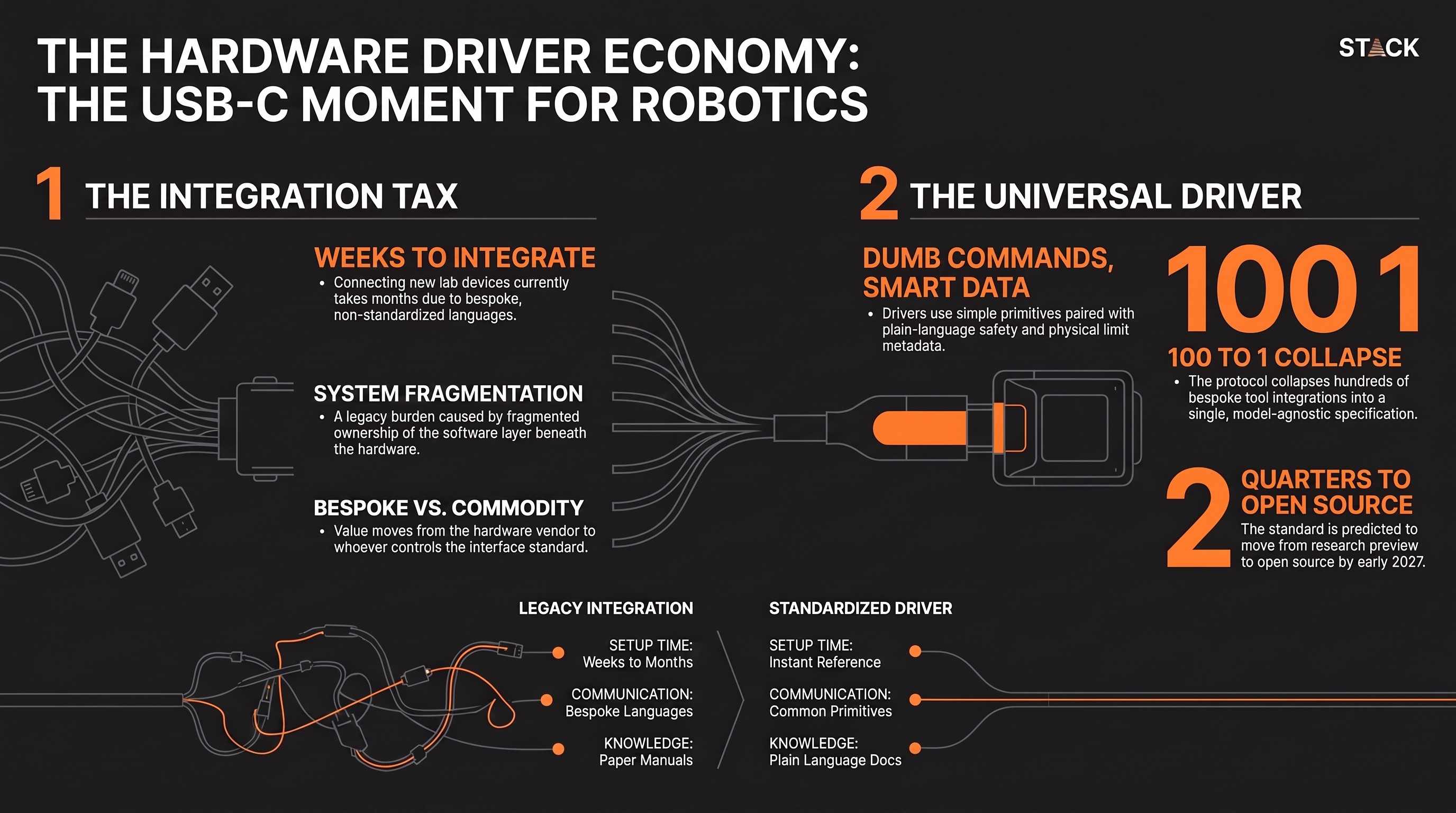 Download the one-page infographic
The robotics industry is currently choked by a professional version of the "drawer full of mismatched chargers" nightmare. For decades, scientific laboratories and industrial factories have operated in a state of expensive chaos, where every microscope, liquid handler, and robotic arm speaks a proprietary tongue. This fragmentation isn't just an inconvenience; it is a billion-dollar bottleneck. This "integration tax" means that getting two devices to talk to each other in a lab takes weeks, often months, of bespoke coding. On August 27, 2026, Anthropic moved to collapse this tax. In a research preview developed with HHMI’s Janelia Research Campus, they unveiled a model hardware standard designed to be the " USB-C for lab robots. " It provides a single interface for everything from basic servos to the high-stakes lasers on a quantum computer.
The Wrong Layer: Why the Media is Missing the Story
Much of the early coverage has framed this as a story about AI "controlling" robots. That is a fundamental misunderstanding of the architecture. The breakthrough isn't the AI’s ability to issue a command; it is the standardization of the software driver sitting beneath the AI. The driver is the translation layer that converts high-level intent into physical movement. By targeting this layer, Anthropic is executing a power move to seize territory that has remained fragmented for decades because ownership of the "layer underneath" never had a centralized home. "Coverage framing this as 'AI controls robots' is targeting the wrong layer. The layer that matters is the driver underneath—the software that turns a command into motion. "
The Mechanism: "Dumb" Primitives and "Smart" Context
The technical genius of the protocol lies in a deliberate paradox: the commands are "dumb," but the metadata is incredibly rich. The standard relies on basic primitives—commands like "read temperature" or "write temperature"—that any hardware device can act upon. However, the driver carries alongside these commands the critical context that has historically lived in paper manuals or the heads of veteran technicians. This includes the robot’s weight, its precise safety limits, and its specific measurement tolerances. By delivering this data in plain language, the driver creates a reference file that an AI agent reads and understands before it ever attempts to touch the physical hardware. It transforms a piece of "dumb" metal into a self-describing system.
The Seam: Why Spatial Reasoning is the Current Ceiling
" The seam is right there," as the saying goes. Anthropic is being notably cautious, releasing this as a research preview rather than a public rollout. This is a cold-blooded assessment of the current limits of LLMs. Claude and its peers learn the physical world through text and images, meaning their spatial reasoning is not yet infallible. A software bug is a line of code to be rewritten; a physical failure is a catastrophe. During testing at Genentech, researchers found they had to explicitly teach the model that "foaming in a protein sample" constituted a physical failure rather than a software error. You cannot fix a ruined biological sample by retrying a code call. Anthropic understands that a standard that fails in public the week it ships is a dead standard. This preview phase is a desperate race to harden the "spatial reasoning" layer before the protocol is exposed to the chaos of the open market.
The Driver Economy: Commoditizing the Arm to Own the Brain
This is not a new play for Anthropic; it is the second act of a strategy they began in 2024. Back then, they released a protocol for software tool integrations that collapsed hundreds of bespoke connections into a single specification. They are now applying that exact " Standardization as a Competitive Moat" strategy to the physical world. We are witnessing the rise of the " Driver Economy. " When the interface between two systems becomes a commodity, the primary value shifts. It moves away from the manufacturer who "bolts a servo onto an arm" and toward whoever controls the standard itself. Because this protocol is model-agnostic, Anthropic isn't trying to lock you into Claude; they are trying to ensure that no matter what model you use, you are playing on their field.
The Bet: Adoption vs. "Death Valley"
History is a graveyard of technically superior standards that died because they were widely admired but quietly unadopted. A vendor list is not adoption; it is a pilot. The true tell for this standard will be the development of "conformance tests"—the unglamorous, gritty technical work that proves a piece of hardware is truly compliant. I am placing a "prediction on the clock" regarding the future of this standard:
The Success Case: Within two quarters, the standard moves to a full open-source model, proving that the 2024 software tool template works for hardware.
The Failure Case: If the standard is still in "private research preview" in one year, it has failed. If this fails to launch, the obstacle will not have been the engineering. It will be the governance—the political difficulty of getting competing hardware vendors to surrender their proprietary lock-in for the common good.
Conclusion: The Governance Gamble
The hardware arm was never the ultimate decider in the evolution of robotics; the driver layer was. By standardizing how machines describe themselves to AI, Anthropic is attempting to seize the most important territory in the physical world. As we move toward a potential open-source release, the burden of proof shifts to the manufacturers. You should be asking your hardware vendors: " Are you building a bridge to this new standard, or are you still trying to sell me a proprietary cable? "