// The systems read, in writing
Why Intel’s "Copy Exactly" Rule is the Secret to Scaling Greatness
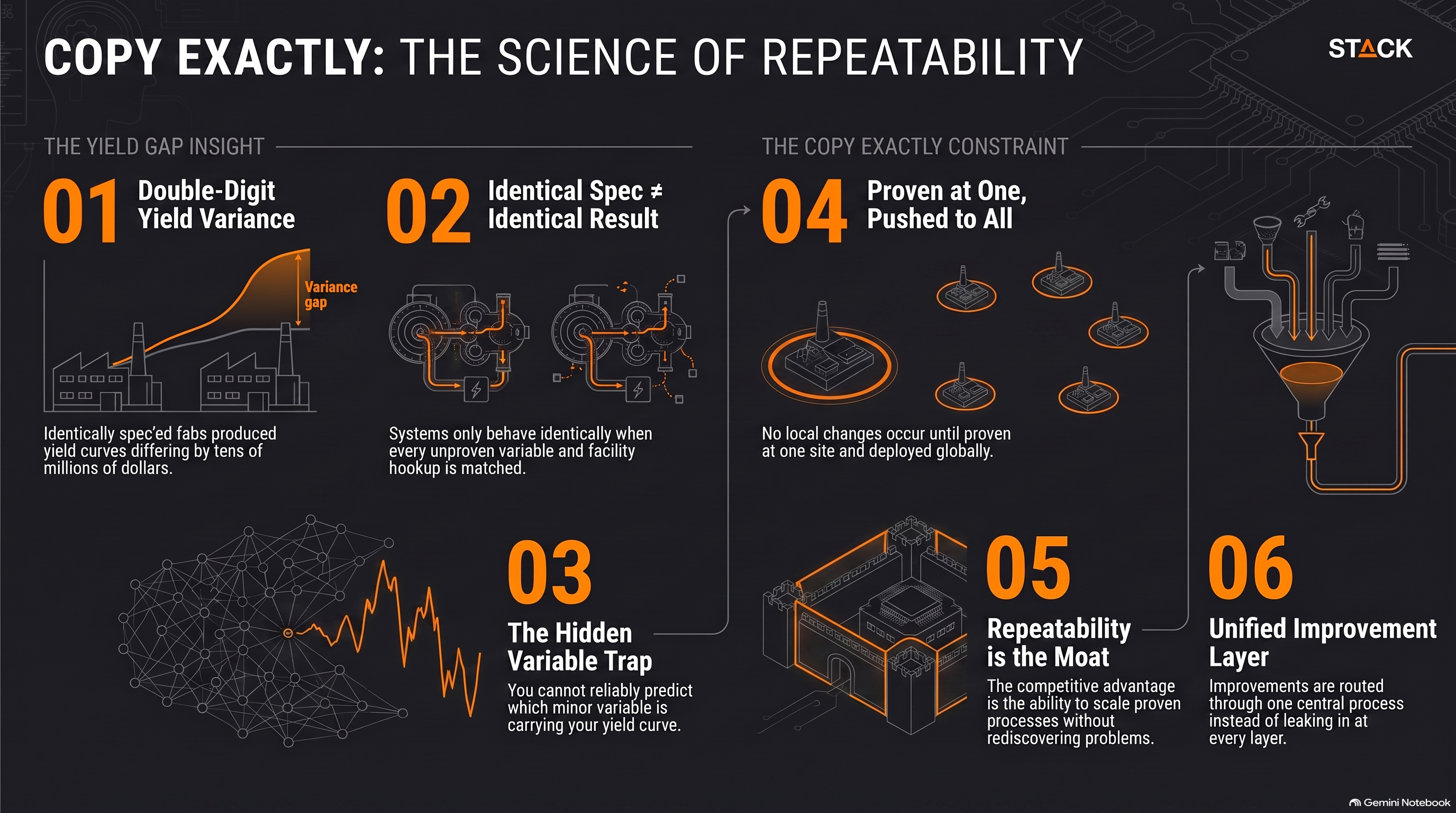 Download the one-page infographic
In February 1992, Intel stood at the precipice of an industrial crisis that defied logic. Two semiconductor fabrication plants, or "fabs," had been constructed using the exact same blueprints. They utilized the same chemical batch numbers and were watched by the same monitors on both ends. On paper, they were perfect twins. In reality, they were total strangers. The yield curves—the metric of how many functional chips a factory actually produces—differed by double digits. This gap wasn't just a technical curiosity; it was a failure that cost the company tens of millions of dollars before the cause was ever identified. It revealed a systemic horror that should haunt anyone responsible for complex systems: the assumption that "identical spec" and "identical behavior" are the same thing. This crisis was not solved by a high-level strategy memo or a marketing press release. It was solved by a gritty, technical framework for plumbing and process called the " Fab 10 startup methodology. " Authored by engineer Chris Macdonald, it would become known as " Copy Exactly," a counter-intuitive discipline that saved Intel’s scale and defined its dominance for decades.
Identical Specifications Do Not Equal Identical Results
The core realization of " Copy Exactly" is profoundly uncomfortable: matching a specification is not the same as matching a behavior. Most engineering teams stop once they’ve checked the first box. They believe that if the paperwork matches and the inputs are the same, the output is guaranteed. Intel proved that this is a dangerous delusion. You can follow the recipe to the letter and still end up with a different result. This is a "shiver-worthy" realization because it implies that our documentation—the source of truth we rely on to scale—is often a lie by omission. "The spec says identical and the system behaves identical are different claims. "For Intel, the lesson was that the paperwork of the first site was never enough to guarantee the success of the second. Behavior is the only truth that matters.
Copy the Parts You Don't Understand (Yet)
To solve the divergence between spec and behavior, Intel abandoned the idea of "selective" copying. Instead, they implemented a level of discipline so absolute it bordered on the obsessive. " Copy Exactly" meant that a new site did not just follow a recipe; it duplicated the invisible infrastructure of the development site. Intel’s discipline was absolute, extending into the most granular details of the fab. They mandated that the following elements match the development site perfectly:
Chemical batch numbers
Detailed equipment configuration
Specific facility layouts
Plumbing and precise tool hookups
The exact monitors used to watch the process on both endsThe logic was as simple as it was humble: in a system with thousands of variables, you cannot reliably tell in advance which one is carrying your yield. Therefore, you must copy even the parts "nobody could yet prove mattered. " If the development fab hooked up a tool a certain way, the new fab did it that way. You copy the unknowns to ensure you don't inherit their consequences.
Innovation is a Bottleneck if it Isn't Centralized
Perhaps the most controversial pillar of this strategy was the " No First" policy. Intel hires the best process engineers in the world, then spends that judgment proving a change rather than making one. If an elite engineer at a new site believes they have found a "quiet" improvement to make a tool run faster, the answer is "no. " This is not "no forever," but "not yet. " This policy is a force field against "improvement leak"—the entropic force where local, uncoordinated "fixes" cause the system to drift. When sites drift, you lose the ability to explain why one fab outperforms another. By routing all improvements through a single, centralized layer, Intel ensures:
Verification over Creation: Changes are proven at one scale before being pushed back through a universal review process.
Simultaneous Propagation: Improvements don't just help one site; they propagate from Fab 12 to Fab 4 everywhere at once.
Systemic Stability: Local judgment is sacrificed for systemic velocity.
Repeatability is the Ultimate Competitive Moat
The true value of this constraint was not about building a "faster" fab; it was about building a repeatable one. In the high-stakes world of semiconductors, Intel used " Copy Exactly" to buy the one thing money usually can't: time. By mastering repeatability, Intel could stand up a multi-billion dollar facility and trust its yield curve from day one. They didn't have to spend years rediscovering and solving the same tuning problems at every new site. The moat was the ability to move a proven process into a new environment at high speed without paying for that speed in yield loss.
The Technical Parallel: The "Ghost" in the Machine
The hardware struggles of 1992 have a visceral parallel in modern software engineering. Every developer has encountered the "ghost in the machine"—the bug that lives on the production server but can’t be found in the staging environment, despite both having the "same" code and config. This scenario is the universal proof of the " Copy Exactly" principle. When two environments that are supposed to be identical produce different bugs, it is a signal that your environment is not as "identical" as your documentation claims. Whether you are plumbing a fab or deploying a container, the gap between spec and behavior is where the most expensive failures live.
Conclusion: Scaling Beyond the Smartest Person in the Room
The philosophy of " Copy Exactly" suggests that the system that scales is not the one where the smartest person is free to improve things locally. It is the one where nobody is. True scale is achieved when individual brilliance is redirected toward the integrity of the whole. In your own organization, are you prioritizing individual tweaks over repeatable scale? Every time a local improvement is made in isolation, it is an "improvement leak" that erodes your systemic truth. The question is: what is that drift costing you in the long run?