// The systems read, in writing
Why the 2026 Duo Changes Everything: The End of the Generic Smartphone
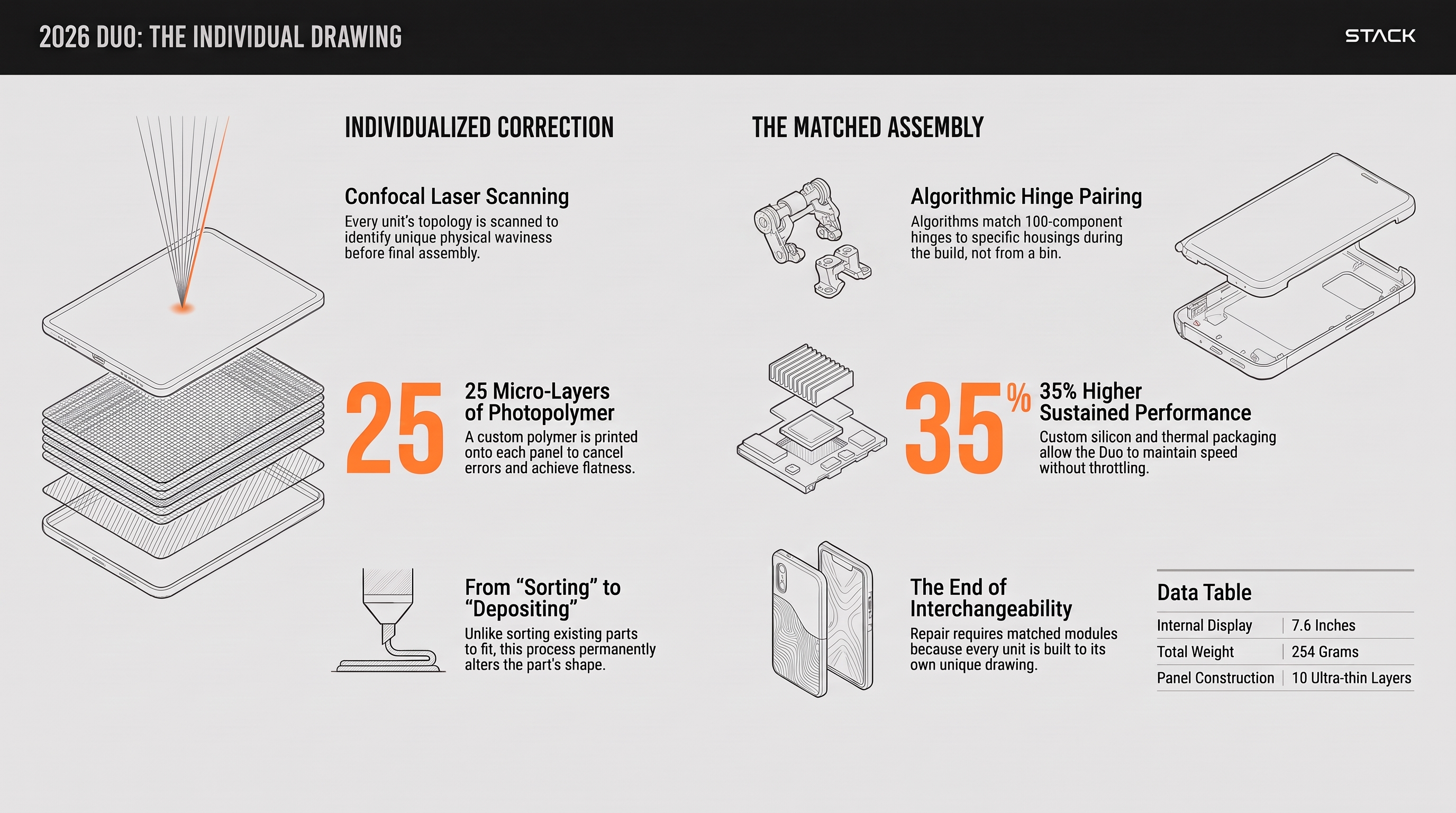 Download the one-page infographic
For a decade, the mobile industry has viewed "the fold" as a compromise to be hidden, a mechanical scar to be masked by ever-more complex hinges and software tricks. With the 2026 Duo, Apple has taken a sharp, contrarian turn. They haven't hidden the seam; they’ve named it, optimized for it, and used it to redefine the scale of mobile productivity. By expanding the internal canvas to a massive 7.6 inches—a full 50% larger than the iPhone 18 Pro Max—the seam stops feeling like a flaw and starts reading as the spine of a singular, expansive screen. This isn’t just a new phone; it is a "matched assembly," a device that marks the transition from mass-market uniformity to bespoke, individualized hardware.
When a Correction Becomes a Feature
The Duo’s 10-layer internal display is an exercise in extreme material science. Apple is literally writing the screen’s texture pixel-by-pixel using maskless laser lithography to place every microlens with surgical precision. Beneath the surface, visco-elastic adhesives allow these layers to glide during the folding motion, mimicking the natural movement of pages in a book. This nano-texture sits atop a cover polymer that is 40% stiffer than the industry norm, providing a structural rigidity that foldables have historically lacked. But the real engineering magic—and the most expensive part of the process—is how Apple handles manufacturing variance. Rather than holding to a traditional "tolerance window" where any panel fits any housing, Apple uses a confocal laser to scan the unique topology of every single unit. They then print up to 25 microlayers of a custom photopolymer directly onto the panel to cancel out the specific "waviness" of that individual unit. This is a permanent, destructive manufacturing choice; you can resort a bin of parts, but you can never "unprint" a photopolymer. Apple is essentially printing a correction for every unit and paying for that perfect flatness in manufacturing throughput. In the world of the Duo, a manufacturing correction has officially shipped as a premium feature.
The Death of the Parts Bin
The Duo’s hinge consists of over 100 precision components, but its complexity is found less in the parts themselves and more in the logic of their assembly. In a departure from traditional "binning"—where a factory worker might pick a part that "fits well enough"—Apple uses real-time algorithms to pair a specific hinge to its "best fit" housing as they move down the line. The stack is no longer identical parts assembled to a drawing. This represents a fundamental shift in the definition of a "part. " While traditional sorting is old factory practice, the Duo goes further by depositing material to physically alter the part's shape to match its neighbor. This is the death of the interchangeable parts bin. Apple has moved away from building to a universal blueprint and toward a methodology where the hardware is "fitted" to itself, ensuring a level of structural integrity that mass production usually cannot guarantee.
Extreme Internal Optimization: The SIM Sacrifice
To unlock the Duo’s potential, Apple has reached the limit of internal space, and the first casualty was the physical SIM tray. By removing the SIM chip worldwide, Apple reclaimed every millimeter of internal volume to make room for a high-energy battery bifurcated across both halves of the device. This isn't just a simple dual-cell setup; custom silicon choreographs the two separate batteries, rebalancing the load so they behave as a single, seamless reservoir of energy. This power density, combined with a "direct die to thermal package" and an integrated vapor chamber, allows the Duo to hit 35% higher sustained performance than the iPhone 17 Pro. While other phones "flash" their peak speeds for short bursts before throttling, the Duo is built to hold its top speed indefinitely. However, this tailoring isn't free—at 254g, the device is heavy for a phone, even if it’s impressively light for two.
The High Cost of Uniqueness: The Repairability Paradox
The very "matched assembly" process that gives the Duo its peerless display and performance creates a looming shadow over the aftermarket: the death of the generic spare. When a panel is corrected to its own unique topology and a hinge is chosen specifically for one housing, the concept of interchangeability evaporates. If a Duo display fails, a technician cannot simply pull a "plain spare" off the shelf. To maintain the device’s original specifications, the replacement must be a "matched module" that accounts for that specific unit's original measurements. This raises a vital point of professional skepticism: Apple’s own repair documentation suggests these are matched modules rather than swappable parts. If we eventually see "plain" spares entering the market that function perfectly without these bespoke corrections, it will prove that the "correction" lived in the software all along. Until then, we must assume the hardware is as unique as a fingerprint. "Apple stopped building to a drawing. Every Duo is now its own drawing. "
Conclusion: A Future of Bespoke Hardware
The 2026 Duo signals the end of the era of the "generic smartphone. " By treating every device as a unique assembly and using laser-printed corrections to achieve a level of fit and finish previously impossible in mass production, Apple has set a new high-water mark for hardware integration. Yet, we must ask if this level of "fitted" hardware is a trap. Are the 35% performance gains and the flawless, stiffened display worth the loss of affordable, interchangeable repairs? As our devices become more individualized and harder to service, the industry is moving toward a future of bespoke hardware—one where perfection is permanent, but so is the cost of maintaining it.