// The systems read, in writing
The $1 Billion Ghost: Why Apple Spent Six Years "Rebuilding" a Part Nobody Sees
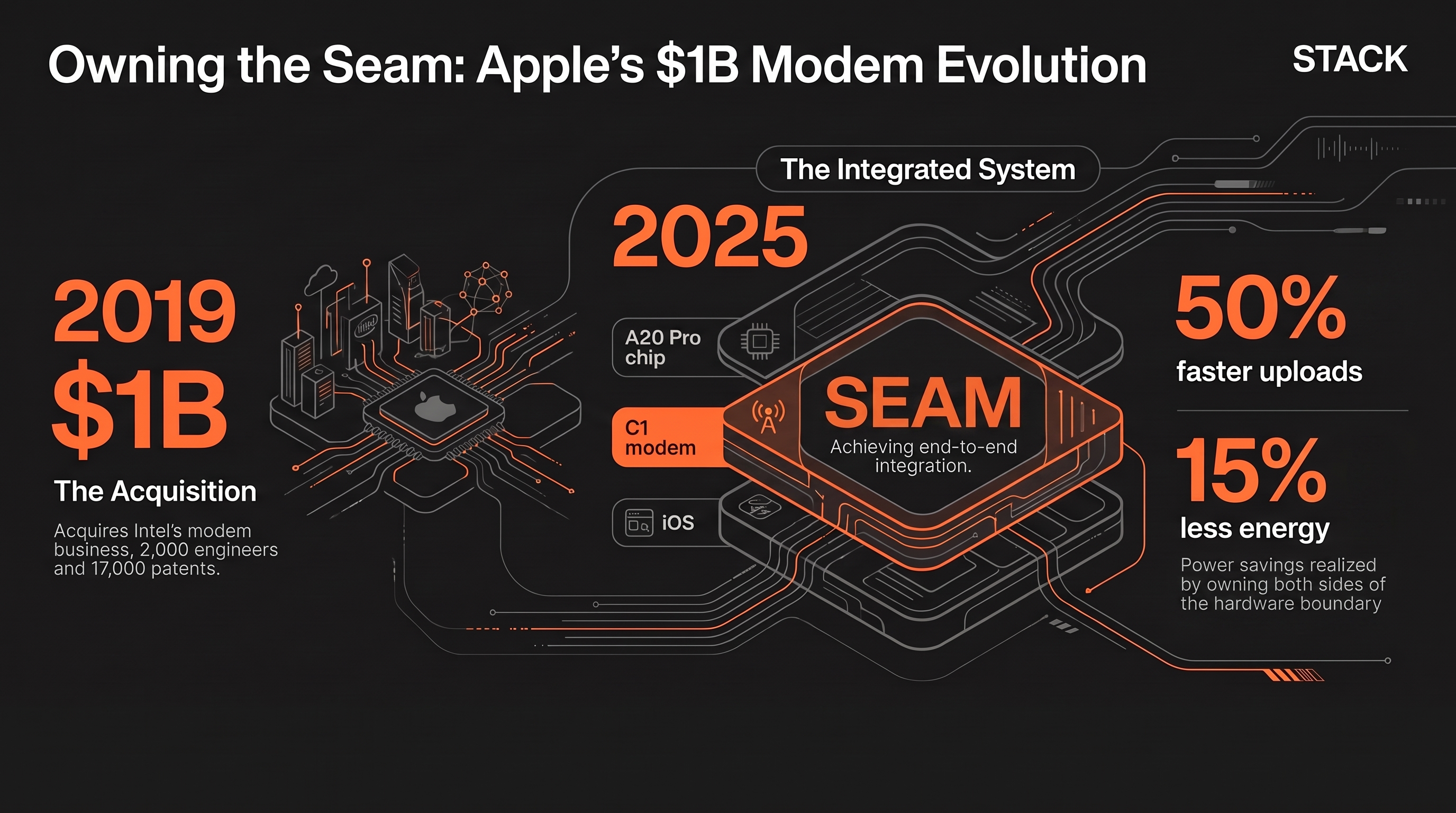 Download the one-page infographic
In July 2019, Apple executed a move that many dismissed as a routine supply-chain defense. They acquired Intel’s smartphone modem business for $1 billion , absorbing 2,000 engineers and a staggering portfolio of 17,000 wireless patents . Then, the project went dark. For over half a decade, while competitors iterated through generations of 5G hardware, Apple’s internal modem project became a "ghost"—a massive investment that yielded no public-facing hardware for six years. The central mystery wasn't just the timeline, but the objective. In the tech industry, a modem is a commodity, a standardized radio layer that simply translates data for cell towers. Was this a massive expenditure just to achieve supply independence from Qualcomm, or was Apple solving a deeper architectural problem that the rest of the industry had accepted as an unchangeable law of physics?
Escaping the "Sealed Box" Constraint
To understand the delay, one must understand the fundamental tension between Apple and the merchant silicon market. When Apple announced the acquisition, Johny Srouji, Apple’s Senior Vice President of Hardware Technologies, stated that the move would "expedite our development" and allow Apple to "further differentiate" on a component most considered a generic part. In contrast, Intel CEO Bob Swan framed the technology differently, viewing 5G primarily as a play for "operators and equipment makers. " This divergence is critical: Intel kept their modem business for PCs and cars, but sold the phone business because they viewed the modem as a standalone radio. Apple saw it as a boundary that needed to be erased. "A purchased modem is a sealed box with a documented interface. You can talk to it. You cannot design across it. That's the cage. "For most manufacturers, a standardized part is a convenience. For Apple, it was a "cage. " Because a third-party modem is a "black box," the device designer cannot modify its internal logic. You can negotiate with a supplier for a faster radio, but you cannot redesign the way that radio interacts with the core of the phone.
Owning the "Seam" (The Orchestra Effect)
The real bottleneck in mobile technology isn't the raw speed of the radio; it is the "seam" where the application processor, the radio, and the operating system meet. In a standard smartphone, these three components struggle to synchronize. Because at least two of these components—typically the chip and the modem—come from different companies, they lack a unified logic for power management. This creates a synchronization lag. Think of it like an orchestra where two sections do not share a conductor; the third section spends half its time waiting for the others to sync before it can play. By building their own modem, Apple effectively hired the conductor. They moved the "seam" inside their own laboratory, allowing the silicon, the radio, and iOS to finally "agree" on when to spend power and when to sleep.
The "Low-Risk" Playbook: C1 and the 16e
When Apple finally broke its silence in February 2025, the debut of its first internal modem—the C1 —didn't happen on a flagship stage. Instead, it arrived in the iPhone 16e , the most affordable and lowest-volume model in the lineup. This was a calculated play to contain risk. Apple has used this exact playbook before: after purchasing a chip startup in 2008 to build their own processors, the resulting A4 chip didn't debut in the flagship iPhone. Instead, it was first tested in the original iPad in 2010. By using the iPad as a proving ground, Apple ensured the silicon was stable before scaling it to the high-volume iPhone 4. The iPhone 16e serves the same purpose today. By debuting the C1 modem in a secondary device, Apple proves the new architecture in a controlled environment. This "risk containment" phase allows them to battle-test the integration of their first radio before it moves to the devices that drive the bulk of their global revenue.
System Integration vs. Raw Radio Speed
With the introduction of the C2 modem , the dividends of this six-year "ghost" project became undeniable. The C2 isn't just a radio; it is a system comprising the baseband, transceivers, power management, firmware, and software. Integrated directly with the A20 Pro chip and iOS, the benchmarks reveal the power of owning the boundary:
50% faster uploads: The system completes tasks faster, allowing the radio to be "lit" for a shorter duration.
15% less energy consumption: Direct gains in battery life achieved through architectural coordination rather than battery size. The breakthrough here isn't a "faster radio" in the traditional sense. It is the realization of what Apple calls "system integration. " Because Apple designs the A20 Pro, the C2, and iOS together as an end-to-end system, they have "the authority to tell the radio what the system needs before it needs it. " This eliminates the power waste inherent in third-party components that must wait for instructions.
Physical Freedom and the iPhone Duo
The benefits of owning both sides of the boundary eventually manifest in the physical chassis. On the iPhone Duo , Apple transitioned to an eSIM-only design. While others have tried this, Apple’s control over the modem allowed them to remove the small carrier chip entirely, as it no longer required a dedicated physical slot. This wasn't just a software preference; it was a hardware optimization. Removing the SIM slot and its associated tray freed up internal volume that was immediately repurposed for a larger battery. This is a design call you can only make when you own both sides of the communication boundary—the internal modem logic and the physical industrial design.
The "Seam" Pattern: A Forward-Looking Conclusion
The six-year silence following the Intel acquisition wasn't a sign of struggle, but a period of fundamental reconstruction. Apple wasn't just building a modem; they were erasing a boundary. Every other smartphone maker still operates under the constraint of the "sealed box," negotiating with third-party vendors for parts they cannot modify. Apple has removed that negotiation entirely. By owning the "seam" between the chip, the radio, and the software, they have created a competitive edge based on system-wide efficiency that competitors cannot replicate simply by buying faster components. The modem was merely the first step in a larger pattern of "owning the boundary. " As we look toward the next 18 months, the question isn't whether Apple will continue this strategy, but which "sealed box" they will target next. Will they turn their attention to the boundaries of advanced sensors , display controllers , or specialized power management ? Whichever it is, expect them to ship something the rest of the industry hasn't even begun to negotiate for.