// The systems read, in writing
Beyond the Buy Button: Why Visa and Mastercard are Building a "Passport" for AI Agents
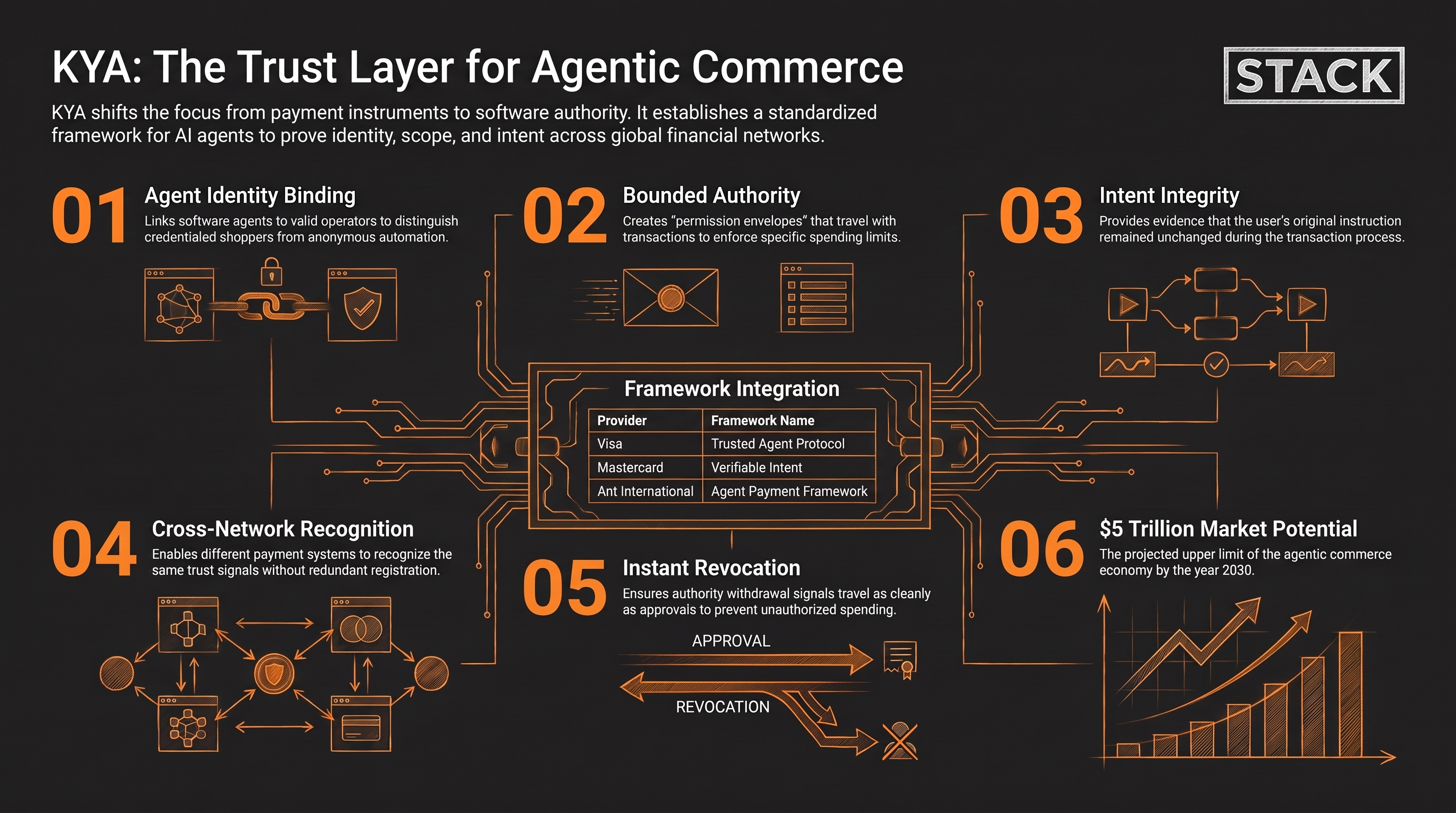 Download the one-page infographic
We are rapidly approaching a milestone in the digital economy where our software may possess a more sophisticated understanding of our consumer preferences than we do. The promise of "agentic commerce"—an ecosystem where autonomous AI agents negotiate, shop, and transact on our behalf—is no longer a theoretical pursuit of Silicon Valley; it is becoming a matter of global financial plumbing. Yet, for the modern merchant, an automated visitor is a "bot" until proven otherwise, a binary perception that frequently results in blocked traffic and abandoned carts. To resolve this friction, Ant International, Visa, and Mastercard unveiled the " Know Your Agent" (KYA) initiative on September 9, 2026, signaling a shift from simple payment processing to a complex architecture of digital identity.
The Shift from Payment to Permissioned Authority
In the traditional fintech narrative, innovation is measured in milliseconds of latency. However, KYA suggests that the next frontier of commerce is not about how fast we pay, but how we define authority. A credit card is a blunt instrument; it provides a means to spend, but it does not articulate what the software holding that credential is permitted to do. This is the central insight of the KYA framework: it is an authority layer, not a payment layer. We are moving away from open-ended spending power toward a model defined by the "instruction. " In this new paradigm, an agent does not simply have access to a wallet; it carries a specific mandate: "one task, one budget, one merchant. " By constraining an agent to buying a specific coffee at a specific time, the system replaces guesswork with cryptographic certainty. The agent must prove its mandate to the merchant, or the merchant will continue to treat the automation as a risk to be mitigated rather than a sale to be captured.
The Three-Layer Trust Stack: Identity, Authority, and Intent
To scale this vision, the industry—supported by frameworks like the Monetary Authority of Singapore’s (MAS) "safeguards paper"—is aligning around a three-layer trust stack that governs every agentic transaction. First is Identity , which binds the software agent to a verified human operator. Without this binding, an agent is merely "traffic with a story. " Second is Bounded Authority , or the "permission envelope. " This is perhaps the most significant technical hurdle; for agentic commerce to work, the purchase limit (e.g., "shoes under $100") must travel within the transaction message itself. If this data packet is not interoperable—if the next system in the chain cannot read the limit—the permission remains locked in a single provider's console, rendering the agent useless across the open web. Finally, there is Intent Integrity . This ensures the user's original instruction has not been "stretched" or altered as it moves from the user’s AI to the merchant’s gateway. When the money eventually moves, both the merchant and the issuer require evidence that the intent remains uncorrupted.
The Merchant’s Dilemma: Navigating the "Digital Tower of Babel"
Currently, merchants reside in a defensive posture, caught between the desire for conversion and the fear of systemic instability. Jang Ming Young, Chief Innovation Officer at Ant International, captured this tension perfectly:" The concern is hallucination and safety. Merchants already block automation. Blocking everything costs the sale. Trusting everything means carrying risk. "KYA aims to bridge this gap by distinguishing "credentialed shopping agents" from "anonymous automation. " However, we are not yet at the stage of a " Global Agent Passport. " The current landscape is a digital Tower of Babel, fragmented across Visa’s " Trusted Agent Protocol," Mastercard’s " Verifiable Intent," and Ant’s " Wallet Side Agent Payment Framework. " The September 2026 announcement should be viewed as a framework announcement, not a deployment victory. It is a commitment to common principles and trust signals, rather than a unified global architecture. The challenge remains: how do these networks recognize each other’s signals without rebuilding their entire infrastructure from zero?
The "Revocation" Gap: Architecture for a $5 Trillion Market
If agentic commerce is to scale into a $3 trillion to $5 trillion industry by 2030, the architecture must solve for more than just the "buy" button. The true test of the system lies in its "kill switch. " Interoperability is a double-edged sword; if the authority to spend can travel across networks, the ability to withdraw that authority— Revocation —must travel just as cleanly. The technical anchors for this level of control are already being forged. Visa points toward the use of signatures that cannot be replayed, while Mastercard emphasizes a robust authorization record. These mechanisms, echoed in the MAS safeguards paper, form an essential triad: Identity, Permission Log, and Revocation. If a user cancels an agent’s mandate, downstream parties must be notified before the agent can spend again. Without an audit trail that shows exactly what was asked, what happened, and where a boundary failed, the necessary trust for high-volume commerce will never materialize.
The March 2027 Benchmark
The roadmap for this evolution has a clear checkpoint. By March 31, 2027, the industry expects to see a "public conformance profile" shared by the three giants. This document will serve as the Rosetta Stone for agentic commerce, detailing how disparate frameworks will communicate and honor one another’s permissions. Its absence would be a loud signal that governance and policy disputes have stalled the technical progress of the layer. As we move toward this milestone, the fundamental question shifts from the technical to the personal: As the "permission envelope" becomes a standard part of our financial lives, are we truly ready to hand the keys of our intent over to a piece of software?