// The systems read, in writing
The Integration Tax: Why Samsung’s ‘Early’ Was Apple’s ‘Perfect’
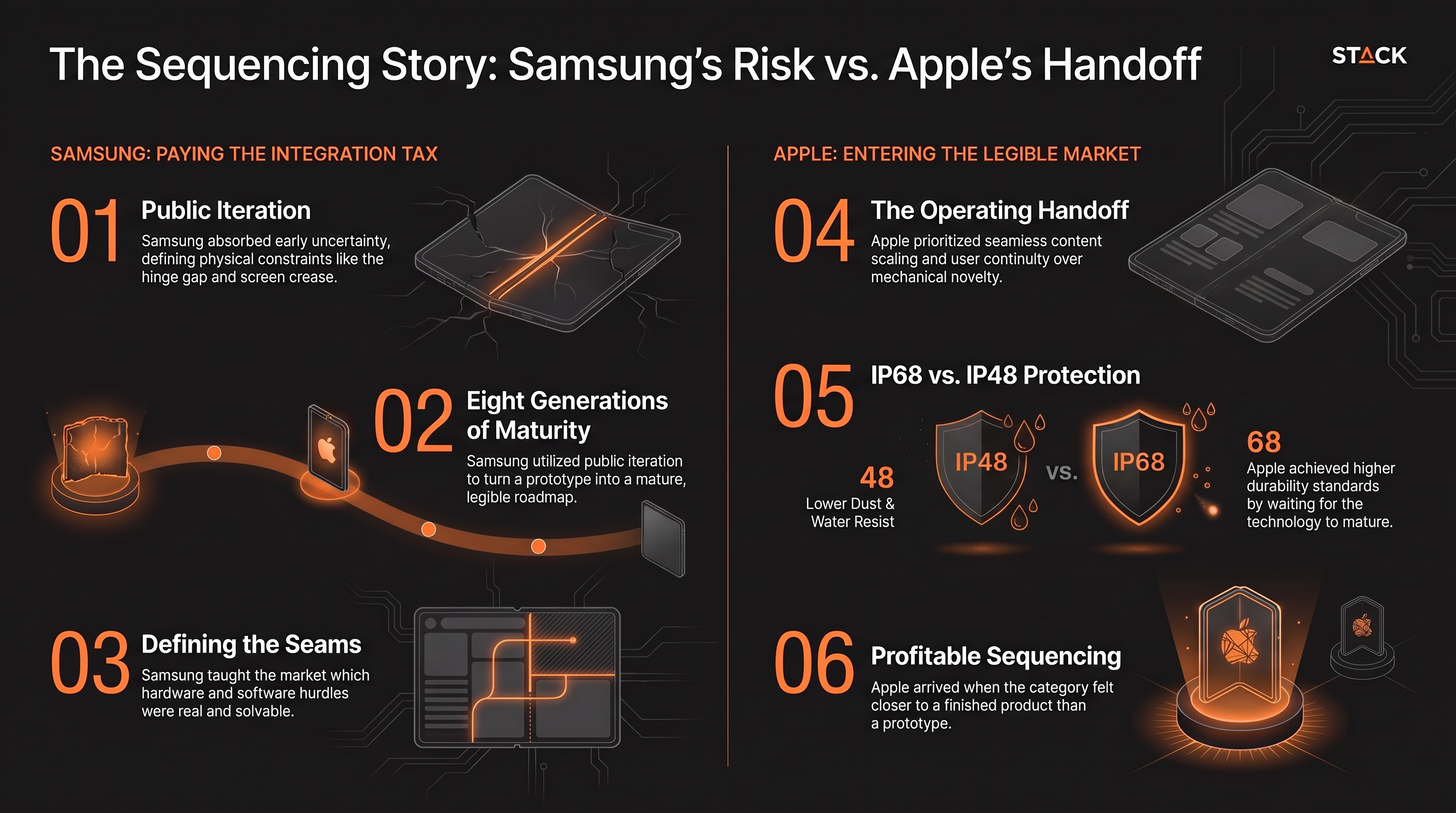 Download the one-page infographic
The seven-year silence between Samsung’s 2019 foldable debut and the 2026 arrival of the iPhone Duo is not a delay; it is a strategic calculation. In the high-stakes theater of hardware, the clock rarely rewards the swift without extracting a heavy toll. This nearly decade-long gap represents more than a manufacturing timeline—it reveals a fundamental divergence in how two titans manage risk, maturity, and the " Hidden Handoff" of a new medium. To understand why Apple waited, we must look at the price Samsung paid to make the category legible.
Takeaway 1: Paying the "Integration Tax" in the Public Square
When a pioneer breaks ground on a new form factor, they pay an " Integration Tax"—the massive R&D and reputational cost of iterating in the open. Samsung didn't just launch a phone; they volunteered to carry the risk of a category’s birth defects in front of a global audience. A foldable is not a single invention, but a "stack of seams" that must be solved in a specific sequence: the screen and hinge move first, the battery follows, and dust protection follows last. By iterating through public failure and refinement, Samsung proved these disparate elements could eventually function as a singular promise. This "weakness" was actually a profound service to the industry, moving the "stack" from a collection of vulnerabilities to a cohesive product. Samsung reinforced the hinge area, extended the protective layer under the bezel, added metal under the screen, and tightened the space between hinge and body.
Takeaway 2: Mapping the "Real Seams" through Scarcity
The strategic history of technology is often written by the "scarce layer. " In the early days of foldables, the scarce thing—physical durability—decided exactly where the product could go. Samsung’s primary contribution was transforming a technological stunt into a predictable checklist. By mapping the "real seams" (the crease, the hinge gap, the app layout), they defined the territory for everyone else. Samsung’s early movement educated the entire ecosystem, forcing Google to adapt Android for devices that change shape mid-use. This process made the category "legible. " Because Samsung identified the constraints of the hardware, they cleared the path for later entrants to treat the foldable not as an experiment, but as a roadmap.
Takeaway 3: The Secret is in the "Handoff," Not the Hinge
The divergence in philosophy is encoded in the glass. Samsung’s Galaxy Z Fold 8 Ultra, with its expansive 8-inch inner display, leans into the maturity of its mechanics. In contrast, the iPhone Duo enters with a 7.6-inch inner display and a 5.4-inch outer display. This is not a lack of ambition; it is a focus on the " Operating Handoff. "While Samsung focused on the "how" of the hinge, Apple focused on the "why" of the continuity. By maintaining similar aspect ratios between the inner and outer screens, the iPhone Duo ensures content scales naturally. The goal is to make the user trust the continuity of the software rather than admire the novelty of the mechanics. Apple chose usability and content scaling over the maximalism of an 8-inch screen to ensure the device feels like a tool, not a demo.
Takeaway 4: The "System Boundary" as a Maturity Marker
A product category reaches maturity when the "system boundary" shifts from asking buyers to accept fragility to offering standard reliability. The technical specifications provide a vital systems clue: the Galaxy Z Fold 8 Ultra carries an IP48 rating, while reports indicate the iPhone Duo maintains a full IP68 protection standard. This jump in durability marks the transition of the foldable from a high-maintenance prototype to a robust, "iPhone-like" appliance. Apple waited until the technology allowed the device to cross this threshold, ensuring that the price of novelty was no longer a compromise in durability. Apple entered when the uncertainty had a shape.
Takeaway 5: Sequencing is the Ultimate Strategy
The relationship between these two companies is a masterclass in sequencing—a " Hidden Handoff" where one party absorbs the uncertainty so the other can harvest the stability. Samsung owned the hardest seams of the engineering struggle, testing the physical limits of the form factor for seven years. This symbiotic, if unintentional, relationship allowed the category to become profitable only after the risks were quantified. Samsung made the foldable inevitable; Apple arrived when the "seam" became a viable market. The platform shift was only ready once the scarce layer of hardware uncertainty had been assigned a solution.
Conclusion: The Inevitable Late Entrant
Samsung’s public struggle was a necessary phase of industrial evolution. Their willingness to take the arrows of early adoption paved the path that made the iPhone Duo look like a natural progression rather than a risky leap. It forces a fundamental question upon the observer: do you value the pioneer who maps the dangerous territory, or the refiner who waits until the path is paved to perfect the journey?