// The money read, in writing
The "Birth Order" Strategy: Why Honeywell’s Breakup is a Fixed Race
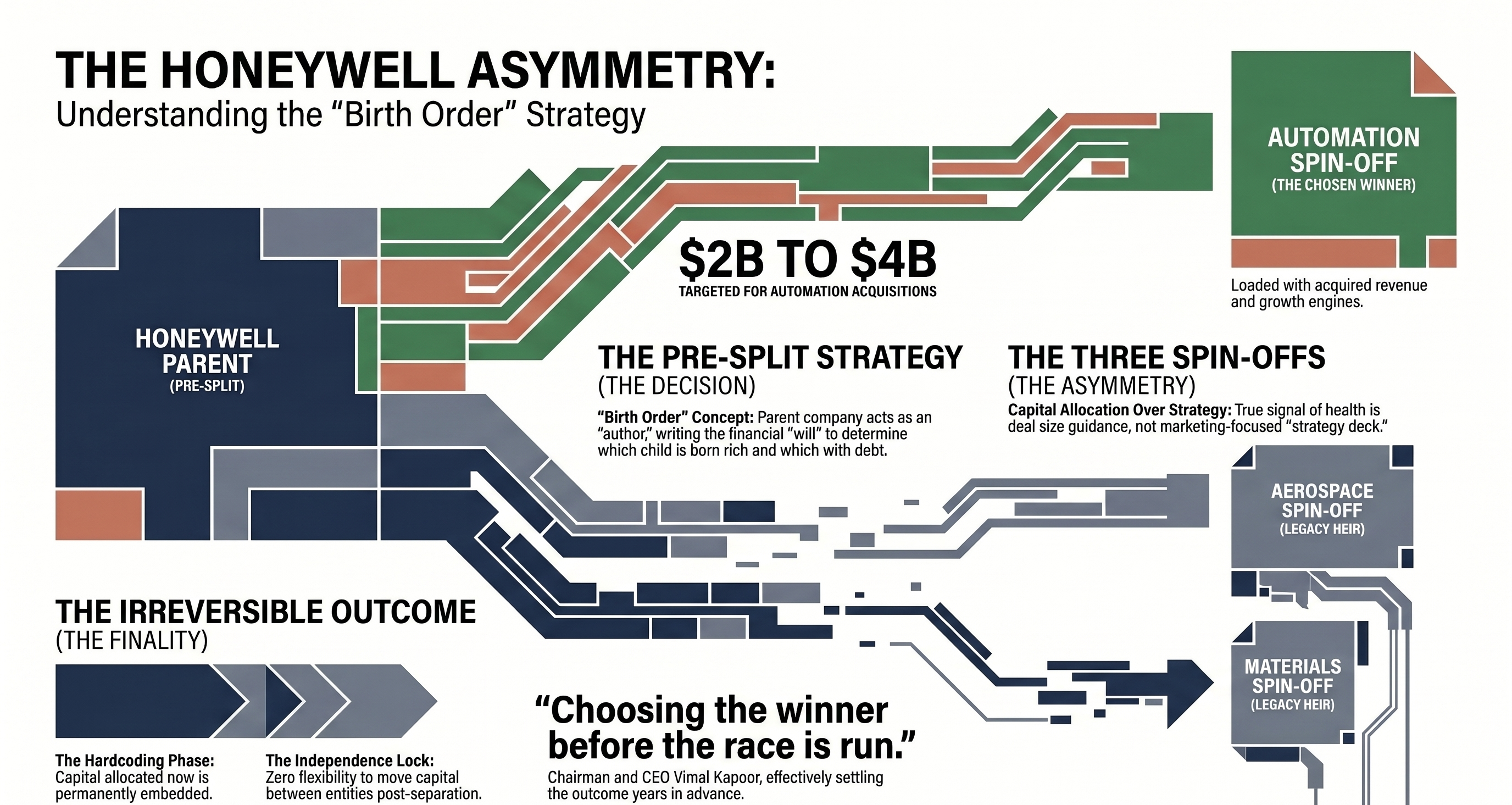 Download the one-page infographic
The official press release from Honeywell presents a tidy narrative of corporate evolution: a conglomerate simplifying its structure, a board seeking focus, and a routine $2 billion to $4 billion acquisition spree in industrial automation. On the surface, it looks like a standard breakup into three entities—Automation, Aerospace, and Advanced Materials—conducted alongside independent M&A activity. Look closer at the cash, however, and the "focus" narrative reveals itself as a tactical sleight of hand. This isn't a series of separate moves; it is a single, calculated maneuver designed to rig the race before it begins. Honeywell isn't just splitting up; Chairman and CEO Vimal Kapoor is actively deciding which of his "children" will flourish and which will struggle before they are even born. The Fallacy of Two DecisionsThe market is being invited to view the multibillion-dollar shopping spree and the corporate split as isolated events. This perspective is a fundamental misreading of the strategic reality. When a company hunts for billions in growth assets while simultaneously dismantling its corporate architecture, the acquisitions become the mechanism for the parent to distribute the future. Viewing these as separate moves ignores the reality that the shopping is how the parent decides who gets what. As the strategic logic dictates:" They are the same decision told in two voices. "By treating these as distinct events, analysts miss the point: the acquisitions are not about the parent company's growth, but about pre-loading the favorite spin-off. Understanding " The Birth Order" In the fiction of a corporate split, the resulting entities are often modeled as though they are born equal. The reality is what I call the " Birth Order. " The parent company acts as a final arbiter, determining before the spin-off which child inherits the growth engines and which inherits "the use"—the industry-adjacent jargon for the corporate debt. This is the cruel part of the strategy: once the split is finalized, the safety net of the parent company vanishes. The flexibility to shift capital between units disappears forever. The inheritance these companies receive on day one becomes their permanent destiny. In this rigged arrangement, the one born rich was chosen before any shareholder had a say. Hardcoding Growth into the Automation EntityThe focus of this strategy is the Automation entity. By aggressively sizing automation deals while the separation is still in progress, Kapoor is loading that specific unit with acquired revenue before it "leaves home. "This isn't merely grooming a portfolio for a clean exit; it is a verdict. Kapoor is effectively holding the pen and writing the corporate will while the children are still under one roof. "Capital allocated now doesn't sit in the parent. It hardcodes into whichever spin-off inherits the unit. "By the time the estate is officially divided, the outcome has already been settled in private. The Automation entity isn't just being spun off; it is being born with a growth engine already bolted on. The Myth of the Level Starting LineThe market is currently failing to price the fundamental asymmetry of this breakup. Most models assume three independent companies starting from the same line, but this ignores the pre-split capital allocation. Consequently, current valuations may be fundamentally flawed because they assume a "fair start" that does not exist. For a Chief Financial Officer, the strategy deck is secondary to the capital allocation. The true signal is buried in the deal size guidance, which reveals which entity is being set up for success and which is being handed the bill. The decision to load one unit with revenue and others with "the use" is nearly irreversible the moment they separate. Conclusion: Watching the Author, Not the BreakupThe breakup will grab the headlines over the next year, but the real story is the "birth order" underneath it. Every acquisition announcement over the next 12 months shouldn't be viewed as news, but as another "episode" in a pre-written script authored by Vimal Kapoor. To understand the true future of these three companies, ignore the strategy decks and follow the balance sheets. Watch which entity walks into independence carrying the newly acquired revenue and which walks in carrying the debt. The asymmetry is being authored right now, and it leaves us with one provocative question: When the next inevitable downturn arrives, can the "chosen winner" actually survive without the parent company’s flexibility to lean on, or will the weight of its inherited destiny prove too heavy?