// The money read, in writing
The Art of Letting Go: What the Pizza Hut Sale Teaches Us About Radical Focus
 Download the one-page infographic
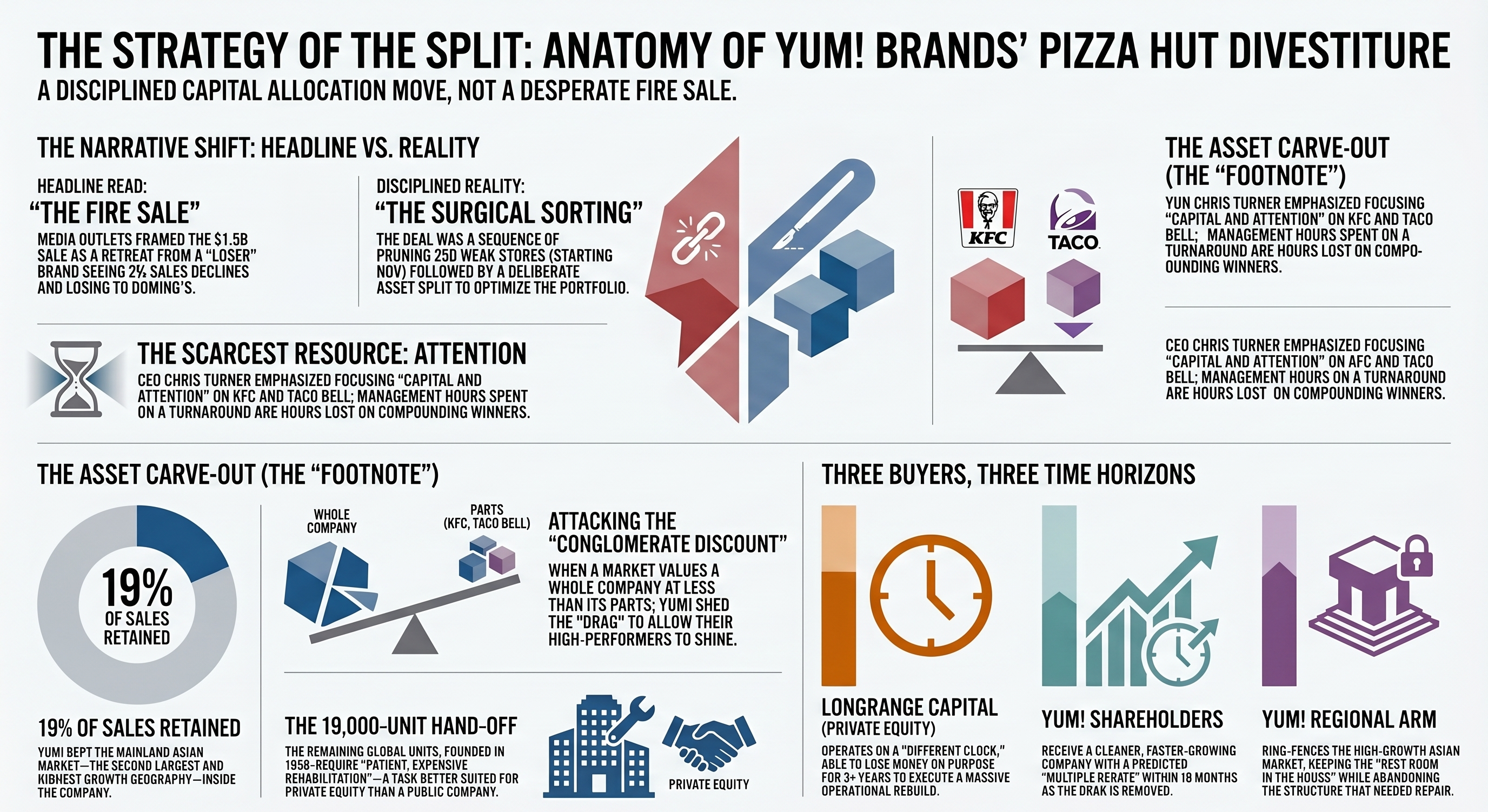
The mainstream media headline is predictable: " Struggling chain dumped. " With sales down 2% and Domino’s relentlessly eating its lunch, the narrative suggests Yum! Brands simply offloaded a loser to the highest bidder. But if you read the deal structure instead of the press release, a different story emerges. This wasn’t a fire sale; it was a masterclass in disciplined capital allocation. By looking past the headline, we see that Yum! didn’t just exit a business—they surgically sorted a portfolio. The $1.5 billion deal with Long Range Capital reveals how a sophisticated operator cleans the house before a sale, ring-fences the growth, and protects the one asset more valuable than cash.
The Scarcity of Management Bandwidth
Yum! CEO Chris Turner framed this divestment around a single word: Focus. While the market obsesses over capital, Turner understands that the ultimate constraint in a multi-brand portfolio isn't the balance sheet—it's the calendar. Every hour leadership spends nursing a turnaround at Pizza Hut is an hour stolen from compounding the brands that are already winning: KFC and Taco Bell. The opportunity cost of fixing a laggard is often invisible, but it is lethal. By offloading the operational burden, Yum! is reclaiming its most precious asset to double down on its high-performers. "The scarcest resource a portfolio company has isn't money, it's management attention. "
The Asian Carve-Out: Why Yum! Kept the Crown Jewels
In any divestment, what you keep tells the market more than what you sell. While Long Range Capital took over the global operations, Yum! strategically carved out the mainland Asian market, keeping it "inside the family. "The Compounder vs. The Laggard This single geography represents 19% of Pizza Hut’s total sales. It is the brand’s second-largest and highest-growth market. Sorting vs. Dumping You don’t keep the best room in a house you are trying to abandon. By retaining the Asian regional arm, Yum! proved this wasn't a panic move. They kept the part that is still compounding and sold the part that needs a "turnaround bill" to someone else.
Attacking the Conglomerate Discount
Yum! has long been a victim of the "conglomerate discount," where the market values the whole at less than the sum of its parts. The high-velocity growth of Taco Bell and KFC was being masked by the structural drag of Pizza Hut’s legacy US operations. This sale is a direct assault on that discount. By shedding the weight, Yum! is forcing the market to look at a cleaner, faster-growing entity. I predict a high-conviction rerate of Yum!’s stock multiple within the next 18 months. Once the " Pizza Hut drag" is removed from the quarterly earnings calls, the market will finally price the remaining brands at the premium they deserve.
The Owner’s Clock: Public Pressure vs. Private Patience
The deal recognizes a fundamental truth about business lifecycles: some assets require a different "clock" than a public company can provide. Pizza Hut is a brand founded in 1958 with 19,000 units—modernizing that footprint is a monumental task. Long Range Capital is inheriting a massive "turnaround bill," but they are better equipped to pay it. A private equity firm can afford to lose money on purpose for three years to rebuild infrastructure. A public company, slave to the quarterly earnings report, cannot afford that luxury of patience. This was a transition of the asset to the owner whose time horizon actually matches the brand's needs.
Grooming the Asset: Strategy is a Sequence
This divestment was a calculated progression, not a reactive flight. The timeline reveals a disciplined "grooming" process designed to maximize value:
November: The strategic review began in silence.
February: Yum! announced the closure of 250 underperforming US locations.
The Exit: The sale only occurred after the "weak stores" were pruned. This sequence proves Yum! wasn't desperate. They spent months cleaning the house and stabilizing the foundation to ensure the asset was attractive to a buyer like Long Range Capital. They didn't just sell a problem; they prepared a turnaround opportunity.
The Question Every Leader Must Ask
This transaction creates a trifecta of value. Long Range Capital gets a massive footprint to rehabilitate on a private timeline; Yum! shareholders get a high-growth, high-margin pure-play; and the regional arm keeps the high-growth Asian market ring-fenced for the future. Ultimately, this deal serves as a challenge to every executive and portfolio manager. The hardest part of leadership is rarely deciding where to plant new seeds; it’s deciding which trees to stop watering. Which part of your portfolio is quietly eating your scarcest resource simply because letting go feels like defeat?