// The money read, in writing
Why the Brand That "Lost" the Marketing War is Actually Winning the Game
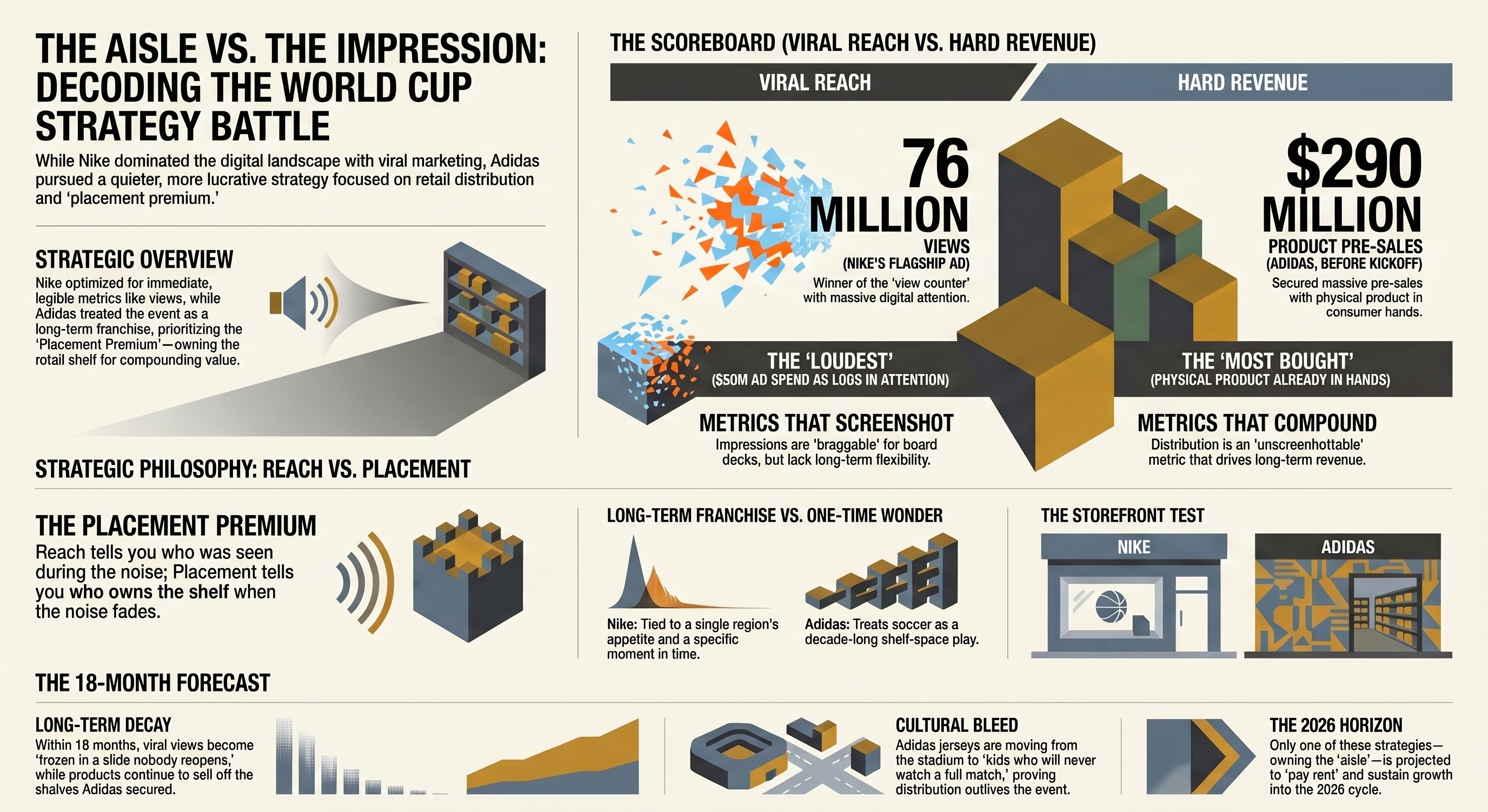 Download the one-page infographic
Three blocks in Soho tell the entire story of the global retail future. At the Adidas flagship store, the building is wrapped floor-to-ceiling in World Cup branding. It is an immersive monument to a tournament the entire planet is preparing to watch. Yet, three blocks away, Nike’s flagship windows are themed for New York Knicks basketball. This is not a scheduling slip; it is a strategic choice. While the world gathers for soccer, Nike has locked itself into a regional appetite. On the surface, the marketing war was a rout. Nike’s " Rip the Script" campaign captured the digital zeitgeist, pulling 76 million views and dominating the social conversation. By nearly every media metric, Adidas—which reportedly spent $50 million only to receive a fraction of that attention—lost badly. But a deeper look at the data reveals a different scoreboard. The attention was never the asset. The aisle was.
The View Count Trap: Who Got Watched vs. Who Got Paid
In modern brand building, it is easy to mistake vanity metrics for business fundamentals. Nike’s strategy, architected by Camo Andrade, is built on " Remix and Reach. " It is a high-octane pursuit of billions of impressions, betting that winning the zeitgeist creates the necessary gravity for the brand. In fairness to Nike, 76 million views represents real pricing power, and the brand continues to extract massive revenue from its dominant home market. However, winning the impression requires exhausting heavy lifting. Contrast this with the Adidas balance sheet: before a single ball was kicked, Adidas had already secured roughly $290 million in pre-sales for World Cup products. "The view count measures who got watched. The pre-sale measures who got paid. "While Nike chased the "moment," Adidas optimized for the transaction. The logic is brutal: the loudest brand and the most bought brand are almost never the same company.
The Placement Premium: Owning the Shelf, Not Just the Screen
Adidas CEO Bjorn Gulden has shifted the brand’s focus toward what we might call the " Placement Premium. " To Gulden, soccer is not a "one-time wonder"—it is a long-term franchise. The strategic distinction is profound. A trophy is handed out once; shelf space lasts a decade. Reach identifies who was seen during the peak of the noise, but placement identifies who owns the aisle once the noise fades. By choosing to theme its flagship windows around a local basketball team while a global phenomenon looms, Nike has accepted a constraint. When global soccer demand compounds, Nike finds itself without the "shelf" to sell into in its most prestigious locations. Adidas, conversely, has optimized for the aisle, ensuring their presence is permanent rather than promotional.
Winning the Distribution, Not the Launch
The path to victory for Adidas is "boring" distribution, and it is already compounding. The brand’s success is visible in the way away shirts are "bleeding" out of the stadiums and onto the backs of kids who will never watch a full ninety-minute match. This is the shift from sports viewership to lifestyle adoption. Longevity does not come from winning the launch or the viral "big moment. " It comes from distribution that outlives the initial marketing noise. Nike’s strategy relies on the constant friction of winning new impressions; Adidas’s strategy relies on the compounding nature of owning square footage. You don’t win the launch; you win the distribution that survives it.
The Discipline of the "Unscreenshottable" Metric
Most operators fail to replicate this model because it requires a specific, painful organizational discipline. Views, likes, and impressions are "legible" and "braggable. " They fit neatly into board decks and provide immediate, dopamine-heavy validation for marketing teams. The metrics that actually matter—repeat buyers and square footage ownership—are "unscreenshottable. " They are slow, quiet, and difficult to measure in a single quarter. But choosing these metrics is what separates a flash-in-the-pan campaign from a market leader. True discipline is the ability to ignore the numbers that look good in a screenshot in favor of the numbers that pay the rent. "The loudest brand and the most bought brand are almost never the same company. "
Conclusion: The Scoreboard for 2026
If we look 18 months into the future, the scoreboard will be undeniable. Nike’s 76 million views will be a static, forgotten figure sitting in an archived slide deck that nobody reopens. Meanwhile, Adidas’s products will still be moving off the shelves they secured during this cycle. The rivalry between these two giants exposes a fundamental truth of modern business: Attention is not the asset—the aisle is. Only one of these strategies is building a foundation that will pay rent in 2026. As you evaluate your own strategy, your own career, or your own brand, you must ask the unsettling question: Who’s buying the shelf while everyone else is counting the noise?