// The money read, in writing
Why Nokia is Betting Its Future on a Product 79% of Customers Can’t Use Yet
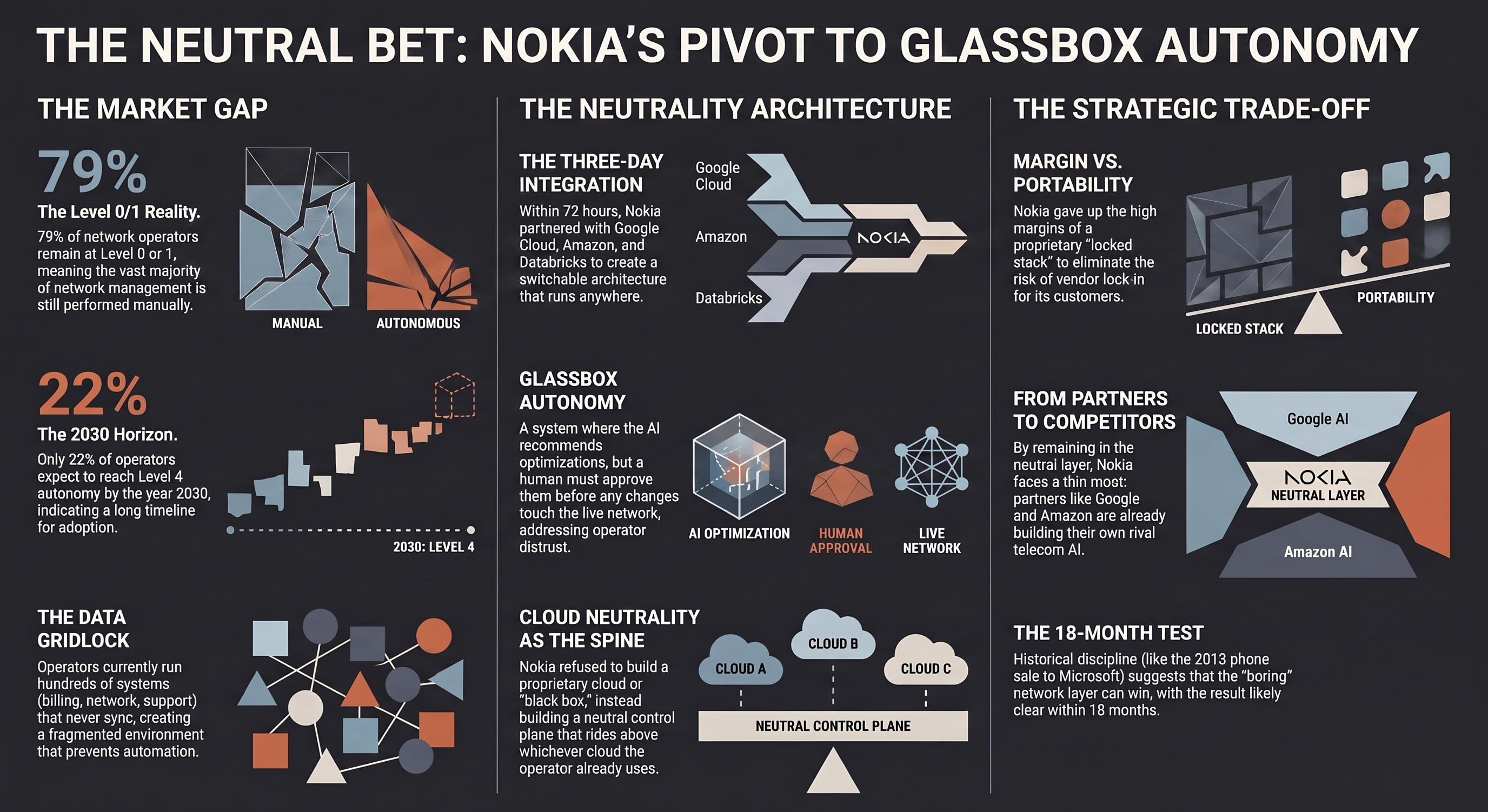 Download the one-page infographic
Nokia just bet its entire autonomous network future on a market where four out of five customers can’t use the product yet. That’s not a typo. It’s the core of a high-stakes gamble revealed at DTW Ignite in Copenhagen. While the obvious read is that Nokia is simply chasing the AI hype train, the architecture of their recent deals suggests the exact opposite: a disciplined move to own the "boring" layer of the future.
The 79% Gap: Selling Self-Driving to Manual Drivers
The data is sobering. Approximately 79% of telecom operators are currently at Level 0 or Level 1 of network autonomy. They are essentially "hands on the wheel," driving their networks manually. Furthermore, only 22% of these operators expect to reach Level 4 autonomy by 2030. Sit with that. Nokia is selling self-driving networks into a market that still drives by hand. But there is a strong case here. The industry is currently gridlocked by a data problem: operators run hundreds of non-syncing systems—billing, network management, customer support—that never talk to one another. Nokia’s pitch isn’t just " AI"; it’s a neutral control plane that rides above these fragmented systems on whatever cloud the operator already runs. It is a sharp read of a fractured market that values integration over innovation.
The "Switch" Strategy: Refusing to Pick a Side
The tell isn't in the press releases, but in the calendar. In a span of three days, Sun, Nokia’s Chief Technology Officer for AI, signed three partnerships that form a single, unified architecture. The sequence was surgical: Google Cloud on Monday, Amazon on Wednesday, and—wedged right in the middle—Databricks, a platform built to run anywhere. "Nokia didn't pick a side. It bolted a switch between them. Strip the press release and look at one number. "By placing Databricks between the cloud rivals, Sun signaled a refusal to be locked into a single provider. This architecture—built on " Agents," a "data fabric," and cloud neutrality as the spine—ensures that the network’s intelligence remains portable. Nokia didn't just sign partners; it constructed a neutral backbone.
"Glassbox" vs. Black Box: Buying Off the Fear
Nokia is also making a distinct psychological play: they call it " Glassbox Autonomy. " In this model, the AI recommends a course of action, but a human must approve it before anything touches a live network. Decode that design choice and it reads clearly: operators don’t trust vendors yet. The "black box" approach—where the AI makes autonomous decisions in a silo—is a deal-breaker for operators terrified of vendor lock-in. Once an operator hands their network to a locked stack, leaving means rebuilding everything. Nokia is following the money backward to the fear it’s buying off. To earn that trust, Nokia had to give up the fat margins of owning a proprietary, end-to-end stack. They are betting that being the transparent, "glassbox" partner is the only way to get through the door.
Commoditizing the Compliment: The Discipline of Owning Less
Nokia’s strategy is a masterclass in "commoditizing the compliment. " By making the surrounding infrastructure—the cloud giants—ordinary and interchangeable, Nokia ensures its own control layer becomes the primary source of value. This is a thinner, more exposed position than that of its integrated rivals. There is no traditional moat to fall back on. In fact, Nokia is currently helping its future executioners; as Amazon and Google build their own telecom-specific AI, the partners Nokia just signed will inevitably become its competitors. The only protection Nokia has is the operator’s desire for neutrality. If the industry chooses convenience over portability, Nokia’s exposed position becomes a liability.
The "Boring" Asset Precedent: Lessons from 2013
This pivot to the "boring" layer is a familiar instinct for Nokia. In 2013, the company famously sold its phone business to Microsoft to focus on network infrastructure. It was a move to lean into the "boring" assets they already owned. It mirrors the " Nike" strategy: winning on placement, not noise. Like Nike, Nokia is betting that being the infrastructure everyone must use is better than being the loudest brand in the room. This discipline cost them the public spotlight for a decade, but the financial results speak for themselves: Nokia posted an operating profit in 2023, while its integrated rival, Ericsson, posted a loss.
Conclusion: The 18-Month Window
Nokia has chosen less margin in exchange for more trust. They are gambling that in an increasingly complex world, the "disciplined move" for an operator is to stay portable and own less of their own stack. The ticking clock is already loud. We will know if this "boring layer" wins within the next 18 months. This window will determine whether neutrality can actually outlast the ambitions of the cloud giants who are already moving into the telecom AI space. When you evaluate your own infrastructure, ask the same question Nokia is forcing the telecom industry to answer: When your vendor inevitably becomes your competitor, will you be locked in, or will you be portable?