// The money read, in writing
The Scarcity Trade: Why Porsche is Cutting Its Ambition in Half
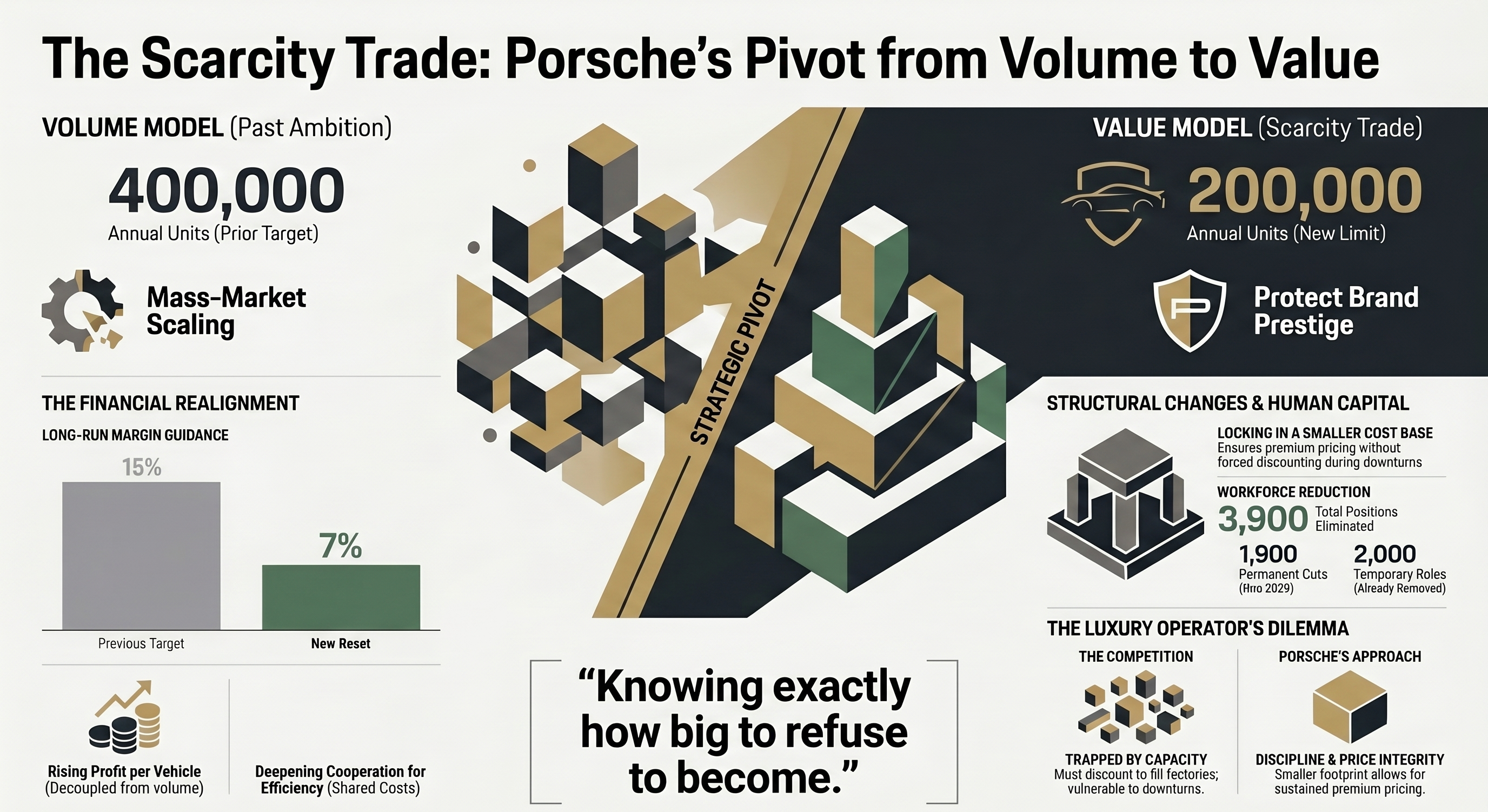 Download the one-page infographic
In the sterile logic of the modern boardroom, "bigger" is the only direction permitted. We have been conditioned to view a retreat from volume as a white flag—a signal of institutional decay or market defeat. But Porsche’s recent pivot is a radical act of discipline that should change how you read every growth story on your desk. This isn't a failure to find buyers; it is a calculated decision about which buyers the brand can no longer afford to chase. By deliberately planning to sell half as many cars, Porsche isn't just issuing a profit warning—it is executing a masterclass in luxury survival.
When Cutting Goals is a Power Move
The architect of this shift is Michael Lighters, who took the chair as CEO on January 1, 2026. Within months, Lighters did what a founding family almost never allows: he looked at the massive factory infrastructure scaled by his predecessor and declared the goal itself the mistake. The prior plan was an aggressive chase for 400,000 cars per year. Lighters has recalibrated that ambition to roughly 200,000. While observers initially read this as a collapse in demand—and I’ll give the bears their due, slipping orders in Asia are a reality—the strategy underneath suggests the reverse. This is a repricing of ambition. By identifying the 400k target as a "mistake," Lighters is choosing to shrink the empire to save the brand’s soul. "He cut the ambition in half. "
The "Vineyard" Logic of Luxury Margins
To grasp this pivot, you have to stop thinking like a mass-market manufacturer and start thinking like a vintner. A premier vineyard will occasionally rip out half its vines on purpose. It isn’t because the soil failed; it’s because a thinner yield is the only way the remaining bottles earn the right to their price. Porsche has signaled this by slashing its long-run margin guidance from 15% down to 7%. In any other sector, that’s a catastrophe. Here, it’s a deliberate, structural "halving. " It is discipline disguised as a retreat. Lighters is pruning the yield to ensure the "bottle" remains a rare, high-value asset rather than a commoditized unit. A wounded company defends volume at all costs; a strong one prunes it to protect the price.
Choosing the "Small" Door Over the Discount
When demand softens, every board faces two doors. Door one leads to discounting, incentives, and "fleet" deals to protect the headline 400,000-unit figure. This protects the ego but dilutes the brand. Door two is the " Small" door: you shrink the operation, protect the price per car, and tell the family the empire is getting smaller. Lighters chose door two, executing what I call the " Scarcity Trade. " You surrender the volume you could have booked to protect the premium that such volume would have eventually destroyed. We saw this same strategic muscle recently when Yum! Brands "freed" Pizza Hut—a realization that some segments are better off smaller and more focused. To facilitate this, Porsche is ensuring the entry 718 stays in the lineup while deepening its cooperation with Audi to share the cost of being small. They are finding a way to make "low volume" financially sustainable.
The High Human Cost of Discipline
There is a "human bill" for this level of discipline, and it is significant. Porsche is cutting 1,900 permanent roles through 2029, on top of 2,000 temporary roles already eliminated. This is the "structural tell. "By removing 3,900 roles, Porsche is essentially burning the ships. They are removing the physical ability to chase volume later. This locks the company into a smaller, more resilient cost base. When the next market downturn hits and rivals are forced to discount heavily to keep their massive plants running, Porsche won't follow. They won't be trapped by their own scale. They are trading flexibility for the ultimate luxury: the power to say no.
The Ultimate Premium Operator Challenge
The hardest decision a premium operator makes isn't how to grow; the market and internal stakeholders will always clap for the bigger number. The real challenge is admitting a growth target was wrong. Admitting the target was a mistake feels like failure, but Lighters has reframed it as the highest form of discipline. "The hardest decision a premium operator makes isn't how to grow. It's knowing exactly how big to refuse to become. "
Conclusion: The Margin Line vs. The Delivery Count
As we move forward, stop watching the delivery count. The only metric that matters now is the margin line. Within the next 12 months, I expect to see Porsche’s profit per car climb even as unit sales drop. When that happens, the analysts who scored this as a retreat will be forced to quietly recut their models to account for this new, high-margin reality. The open question remains: will the family’s patience outlast the smaller revenue? For every leader, the Porsche shift poses a fundamental choice. When a unit you were told to grow starts diluting the margin that actually defines you, what do you do? Do you defend the volume, or do you free the price?