// The money read, in writing
Why the World’s Biggest Chipmakers are Walking Away from Billions in Profit
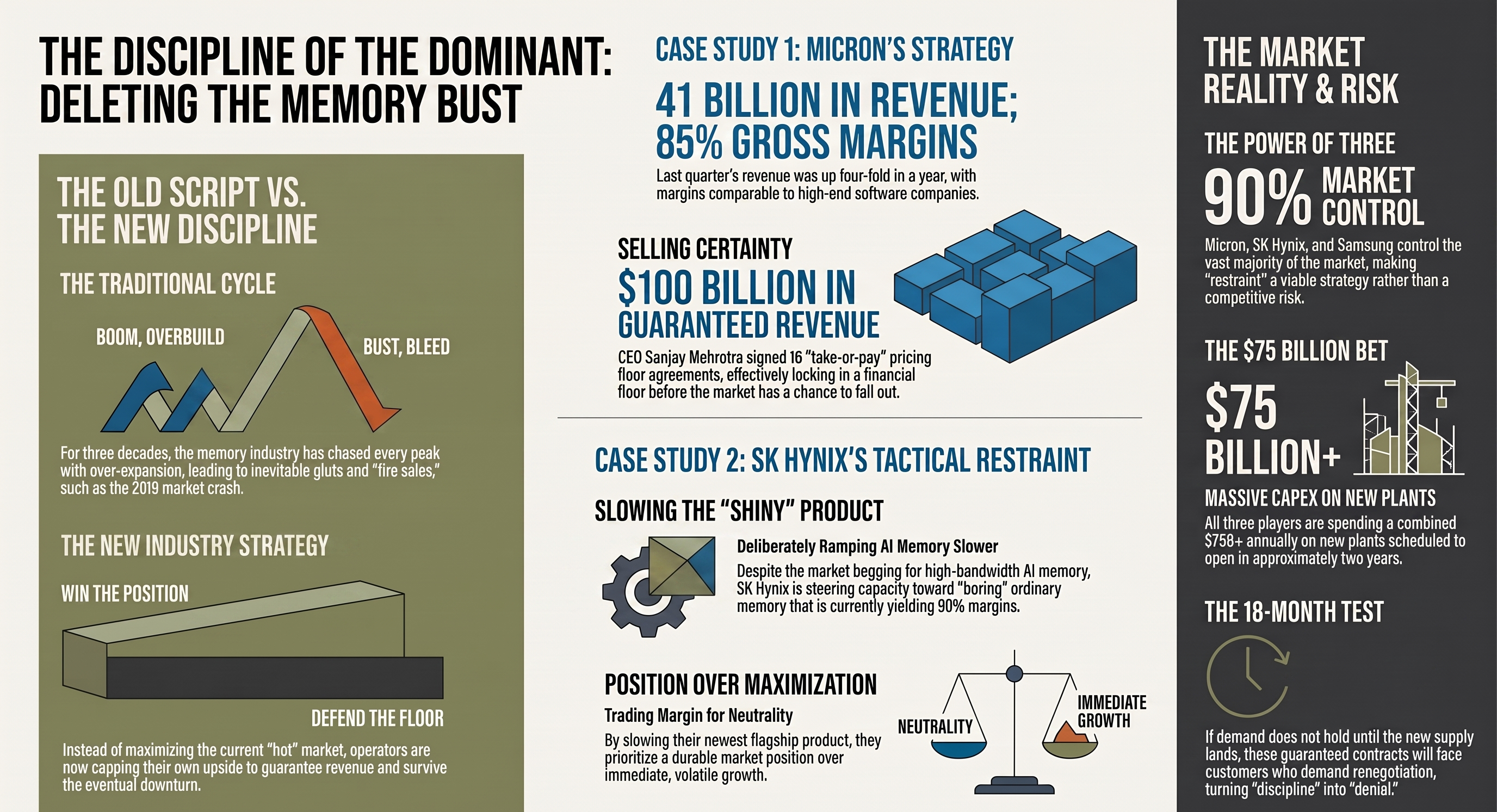 Download the one-page infographic
In an industry historically defined by unbridled greed, Sanjay Mehrotra just hit the brakes at 200 mph. The memory market is currently witnessing a boom unlike anything seen in thirty years. The numbers are staggering: industry revenue has surged four-fold to $41 billion in a single quarter. Gross margins have hit 85%—"software-like" returns for companies that manufacture physical silicon. In any other era, the mandate would be simple: maximize, expand, and ride the peak until the wheels fall off. Instead, the leaders of the world’s most powerful chipmakers are making a cold-blooded trade. They are deliberately walking away from the "upside" to buy something the market rarely offers: a floor. The central question for any observer is why a CEO would willingly sabotage their own profit potential during the best year of their career.
Deleting the "Bust" (The $100 Billion Floor)
Micron CEO Sanjay Mehrotra didn't just report a blowout quarter; he signed away the peak of the cycle. While the press focused on record margins, the real story was the 16 "take or pay" pricing floor agreements he inked. These contracts are a calculated sacrifice. By locking in these floors, Micron has guaranteed itself $100 billion in revenue. However, the downside is absolute: if market prices double again, Micron gets nothing extra. Mehrotra has capped his own upside on purpose. It is a desperate attempt to surgically remove the industry’s historical trauma. For thirty years, memory has followed one brutal, predictable script:
BOOM.
OVERBUILD.
BUST.
BLEED. By securing these agreements, Micron is attempting to delete the "bust" phase from the ledger entirely. "Micron didn't sell memory this week. It sold certainty. "
The "Glamour Trap" and the Value of Boring Chips
Two hundred miles away, SK Hynix—the company that recently dethroned Samsung for the lead in AI memory—is executing the same play. Despite the market’s insatiable hunger for High Bandwidth Memory (HBM), the "shiny" flagship product of the AI revolution, SK Hynix is deliberately slowing its ramp-up. This isn’t a technical failure; it’s a margin play. While the AI story screams for HBM maximization, ordinary, "boring" memory is currently printing 90% margins. SK Hynix has already secured its lead in the glamorous AI sector; it is now starving its most famous product to feed its most profitable one. It takes a rare, cynical discipline to let a flagship product wait while the market is begging for it, but the balance sheet doesn't care about glamour.
The "Discipline of the Dominant"
The parallel moves by Micron and SK Hynix reveal a pattern I call the " Discipline of the Dominant. " These operators are no longer interested in the "obvious maximization" that leads to ruin. They are choosing to win the position first, then prioritize defending the floor over chasing the spike. This strategy mirrors the "neutrality" play famously used by Nokia, where the company sacrificed raw profit margins to secure a durable, long-term strategic position. These CEOs are veterans of the 2019 glut—a period where a sold-out quarter turned into a fire sale almost overnight. They are refusing to attend the "this time is different" party, choosing instead to buy something durable over something spectacular.
Oligopoly as Gravity
The only reason these companies can afford this level of restraint is the part nobody says out loud: the market is an oligopoly. Micron, SK Hynix, and Samsung control nearly 90% of the memory market. In a fragmented market, if you restrain supply, your competitor steals your lunch. In a market owned by three players, restraint isn’t a risk—it’s gravity. When the dominant players collectively choose not to maximize a spike, they effectively dictate the price floor for the entire global economy. However, this discipline is being tested by a massive capital injection. All three titans are currently spending upwards of $75 billion annually on new plants. Because these facilities take two years to open, the current restraint is a high-stakes bet that demand will remain stable until that massive wave of supply hits the market.
Conclusion: The 18-Month Countdown
The strategy deployed by these operators shifts the fundamental question of semiconductor leadership. It is no longer "how high can this go? " but a much colder one: " How do I survive the year the market turns? "The industry has moved to buy certainty, but if demand falters before the new plants open in 24 months, that certainty will evaporate. We will know within 18 months if these "take or pay" contracts are actually durable or if they are simply a form of institutional denial. If the floors don’t hold when the $75 billion in new supply lands, these CEOs won't be remembered for their discipline—they’ll be remembered for being the ones who hit the brakes right before the cliff gave way anyway. For now, they have traded the thrill of the peak for the safety of the floor. The question remains whether the floor is made of concrete or paper.