// The money read, in writing
The "Build vs. Rent" Revolution: What the Hollister-Target Deal Really Tells Us About the Future of Retail
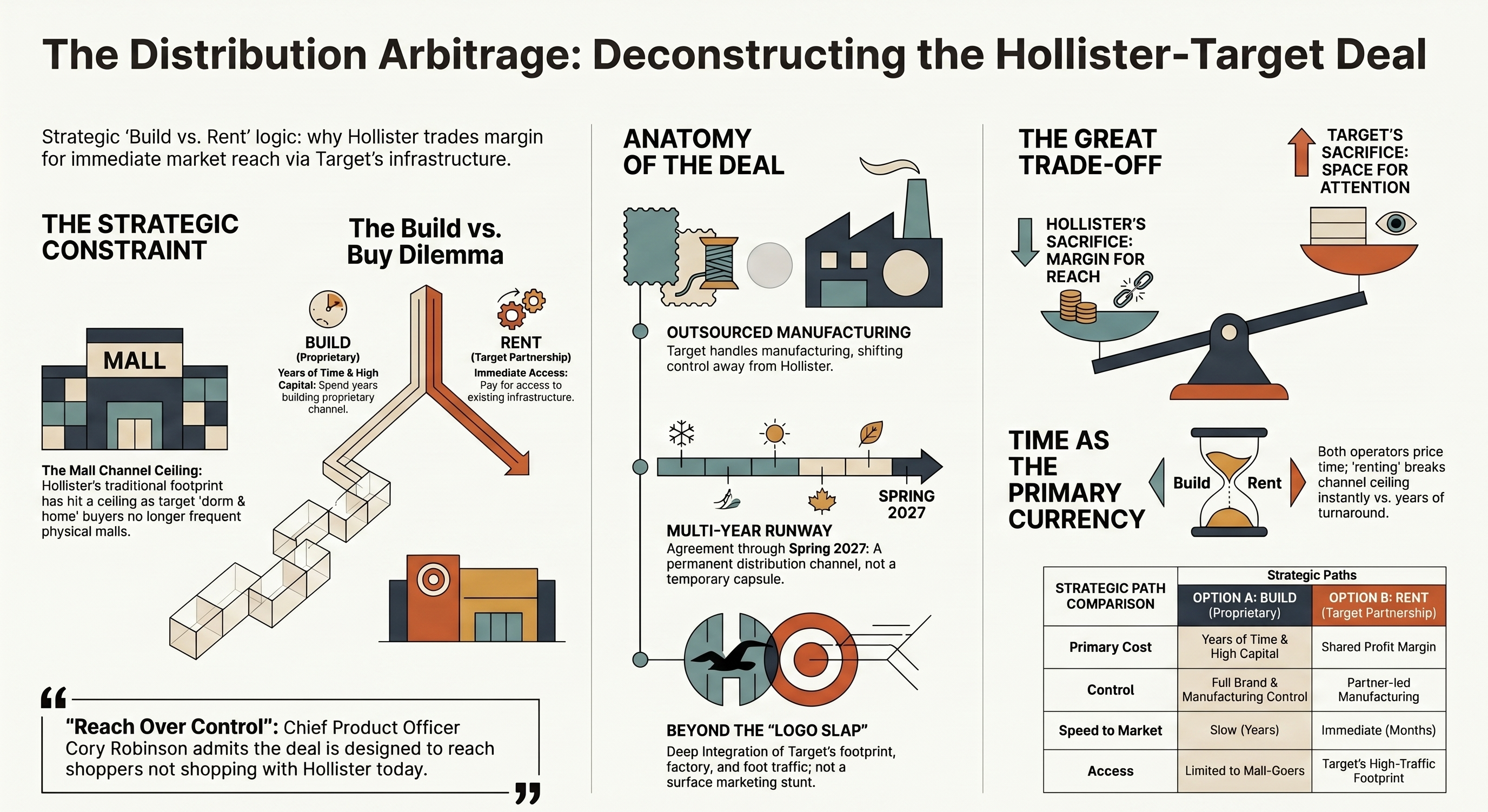 Download the one-page infographic
1. Introduction: Beyond the "Back-to-College" Hype
The surface-level reading of the Hollister-Target partnership is easy, and frankly, lazy. Most observers see a struggling mall brand chasing a hot shopping season by slapping its logo on a big-box shelf. But if you look past the PR noise, you’ll find a much quieter, more revealing structural pivot. This isn't a seasonal promotion; it is a fundamental shift in how modern brands value time over control. Abercrombie & Fitch Co. (which owns Hollister) is being strategically honest about a reality most legacy retailers are too proud to admit: their primary channel is failing them. This deal is a sophisticated "build vs. rent" calculation that prioritizes immediate access to customers over the pride of owning the path to reach them.
2. Takeaway 1: The Tell Isn't the Logo; It’s the Calendar
The most overlooked aspect of this deal is its longevity and operational surrender. In a typical retail collaboration, a brand might borrow a shelf for a single season. The tell here is the roadmap: these drops are planned through Spring 2027. Hollister hasn't just borrowed a shelf; they have leased Target’s entire infrastructure. Perhaps most significantly, Target is handling the manufacturing. For a brand to let a competitor build its products is the ultimate surrender of control, but it’s a necessary one. This multi-year runway and the integration of manufacturing responsibilities transform the partnership from a one-off capsule into a standing distribution channel. Hollister has effectively "rented" a factory, a footprint, and a future.
3. Takeaway 2: The Brutal Math of the "Mall Ceiling"
For Cory Robinson, the Chief Product Officer at Abercrombie, the decision was driven by a simple and brutal constraint: the "mall ceiling. " Hollister’s traditional home is the mall, but the specific customers Robinson is targeting—the dorm and home buyers—simply do not walk through those doors anymore. Robinson faced a stark choice: spend years and massive capital attempting to build a new, proprietary channel, or rent an existing one that already owns the foot traffic. He chose the latter, offering a quote that is almost shockingly honest for a C-suite executive:" The deal reaches shoppers who aren't shopping with them today. " — Cory RobinsonThis isn't an expression of ambition; it is a brand quietly admitting its own channel has hit a ceiling and choosing reach over control to break through it.
4. Takeaway 3: Distribution as the Scarcest Asset
This partnership is a classic "build versus buy" decision. When the asset a business needs most is distribution, and building it from scratch requires years the company doesn't have, buying—or renting—access becomes the only logical move. Hollister is trading independence for speed, acknowledging that in the current retail climate, reach is a scarcer asset than manufacturing autonomy. The Terms of the Trade
What Hollister Gives Up: They surrender a portion of their margin on every unit and hand over manufacturing control to a partner they do not own.
What Hollister Gains: They bypass years of construction and capital expenditure, gaining immediate access to a massive, established customer base they could never manufacture in time.
5. Takeaway 4: Time is the Only Input You Can’t Manufacture
This deal isn't a sign of desperation; it’s a "clockeyed" read of what is actually scarce in modern retail. Both Target and Abercrombie are acting as disciplined, unsentimental operators pricing the same thing: time. In this arrangement, Target is acting less like a retailer and more like a Landlord of Eyeballs . They are renting out their most valuable asset—customer attention—betting that the traffic Hollister attracts is worth more than the shelf space they are vacating. Conversely, Hollister has realized that borrowing the path someone else paved is significantly cheaper than spending years to "build the bigger store. " They are paying in margin to save years of time, the one input that no amount of capital can create.
6. Conclusion: The New Retail Playbook
The Hollister-Target deal marks a turning point in retail strategy. For brands whose primary customer base has exited their traditional channels, renting distribution is no longer a fallback—it is the primary plan. Expect this to be the first of many. Over the next year, mall brands facing similar channel constraints won’t announce traditional "turnarounds" or internal restructurings; they will quietly sign similar leases. For any brand whose customer has already left the mall, signing a lease with a big-box giant is the only way to avoid fading away. For leaders in any industry, this move prompts a vital question: Which "scarce asset" is your business currently trying to build that you should probably be renting instead?