// The money read, in writing
The Controlled Moat Reset: How Global Giants are Front-Running Their Own Obsolescence
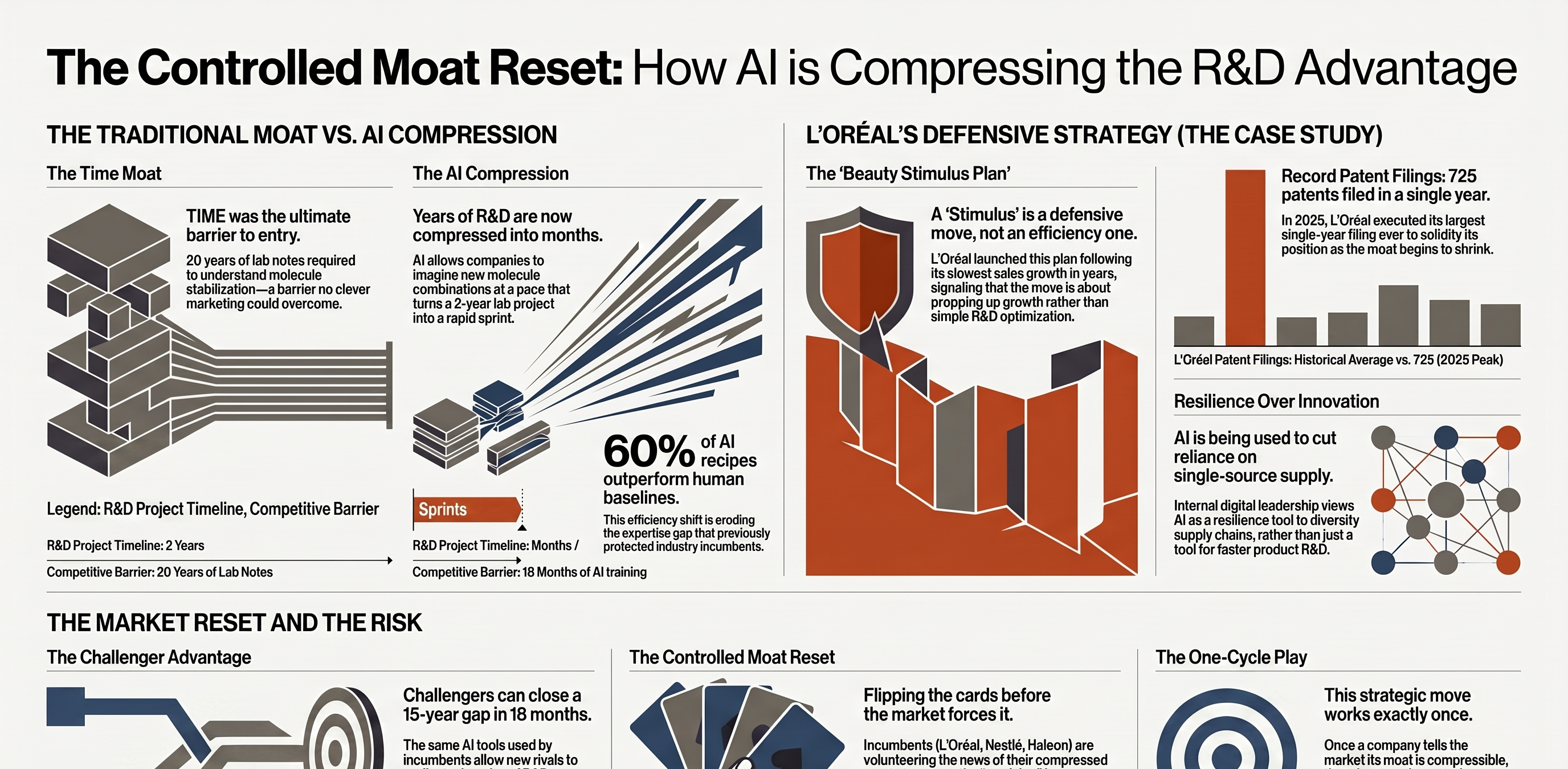 Download the one-page infographic
1. The Hidden Narrative Behind the Innovation
L’Oreal recently used AI to repurpose skincare molecules for shampoo, burying a critical strategic pivot under a charming product story. While the public celebrates technological agility, the reality is far more clinical. Nicholas Hieronimus, L’Oreal’s CEO, launched what the company calls a "beauty stimulus plan" immediately following the company’s slowest sales growth in years. In the vocabulary of a high-stakes operator, the word "stimulus" is doing serious work. You don’t call an innovation roadmap a stimulus unless your organic growth requires immediate propping. This isn't an efficiency play; it’s a confession of stagnation. L’Oreal isn't just innovating; it’s erecting a defensive perimeter because the traditional engines of expansion are flatlining.
2. Takeaway 1: The 725-Patent Perimeter
In 2025, L’Oreal filed a record-breaking 725 patents—its largest single-year filing in history. To the uninitiated, this looks like an R&D offensive. To a technology analyst, this is "flooding the zone. "By using AI to accelerate patent filings, the company is attempting to price the news before the market realizes the core business is under threat. This massive R&D push is a defensive stimulus designed to maintain a competitive floor. Analysts who focus on the "efficiency" of AI-generated IP are missing the point: this is a frantic effort to keep challengers out of a space where the incumbent's growth has stalled.
3. Takeaway 2: From R&D to Resilience Sprints
The strategic value of AI in consumer goods has shifted from "discovery" to "supply chain resilience. " While L'Oreal brags that 60% of AI-generated recipes beat human baselines, the real win isn't flavor or fragrance—it’s velocity. "AI cuts reliance on single source supply. " — Filippo Catalano, Chief Digital and Technology Officer, MondelezThis isn't R&D speak; it’s a resilience decision priced as a product win. What used to be a two-year laboratory project is now a "sprint. " For the VP reading the appendix, the takeaway is clear: the goal is no longer just a better product, but the ability to pivot supply chains instantly, neutralizing the shock of a volatile global market.
4. Takeaway 3: The Liquidation of the Time-Moat
For a century, the primary moat for packaged goods and beauty was time . It wasn't just the brand; it was the twenty years of lab notes required to understand how a molecule stabilizes in a warm shower. This time-cost kept every clever challenger out. AI has neutralized this advantage. Expertise that once took decades to master is being compressed into months. This is a double-edged sword that is currently rerating the entire category:
The Sprint: Incumbents can reformulate in months, not years.
The Erosion: The same tool allows a lean challenger to close a 15-year gap in expertise in as little as 18 months. The historical barrier to entry—the scientific institutional memory of the incumbent—is effectively being liquidated.
5. Takeaway 4: The "One-Way Door" Poker Play
We are witnessing a " Controlled Moat Reset. " This occurs when an operator volunteers the bad news before the market pries it loose. It is the same muscle recently flexed by Micron’s Sanjay Mehrotra, who capped his own record quarter on purpose to manage expectations. Think of it as a poker player whose hand is about to be turned face up by the natural progression of the game. If the cards are coming anyway, you show them yourself and control the "next bet"—the repricing on your own earnings call. Companies like Mondelez, Nestle, and Haleon are flipping their own cards, admitting their moats are compressible before a challenger’s pitch deck does it for them. However, this is a "one-way door" maneuver. Once you tell the market your moat is compressible, you cannot untell it. Your advantage is permanently rerated as temporary. You have exactly one cycle to price this news yourself; after that, the market determines your multiple.
6. Conclusion: The AI Half-Life of Your Expertise
The " Controlled Moat Reset" signals a broader category revaluation. As these giants move to protect their positions, watch the R&D line on the balance sheet. When that spending is quietly renamed " AI investment," the reset has officially moved from the boardroom to the public. For the Vice President who reads the appendix, the question is no longer about the depth of your domain expertise, but its duration. This move works once. You flip your cards on your own timing for exactly one cycle—after that, the table decides. Ask yourself: Is the half-life of your expertise still measured in years, or has it already moved to months?