// The money read, in writing
The $16 Billion U-Turn: What Toyota’s Reversal Tells Us About the Future of Global Trade
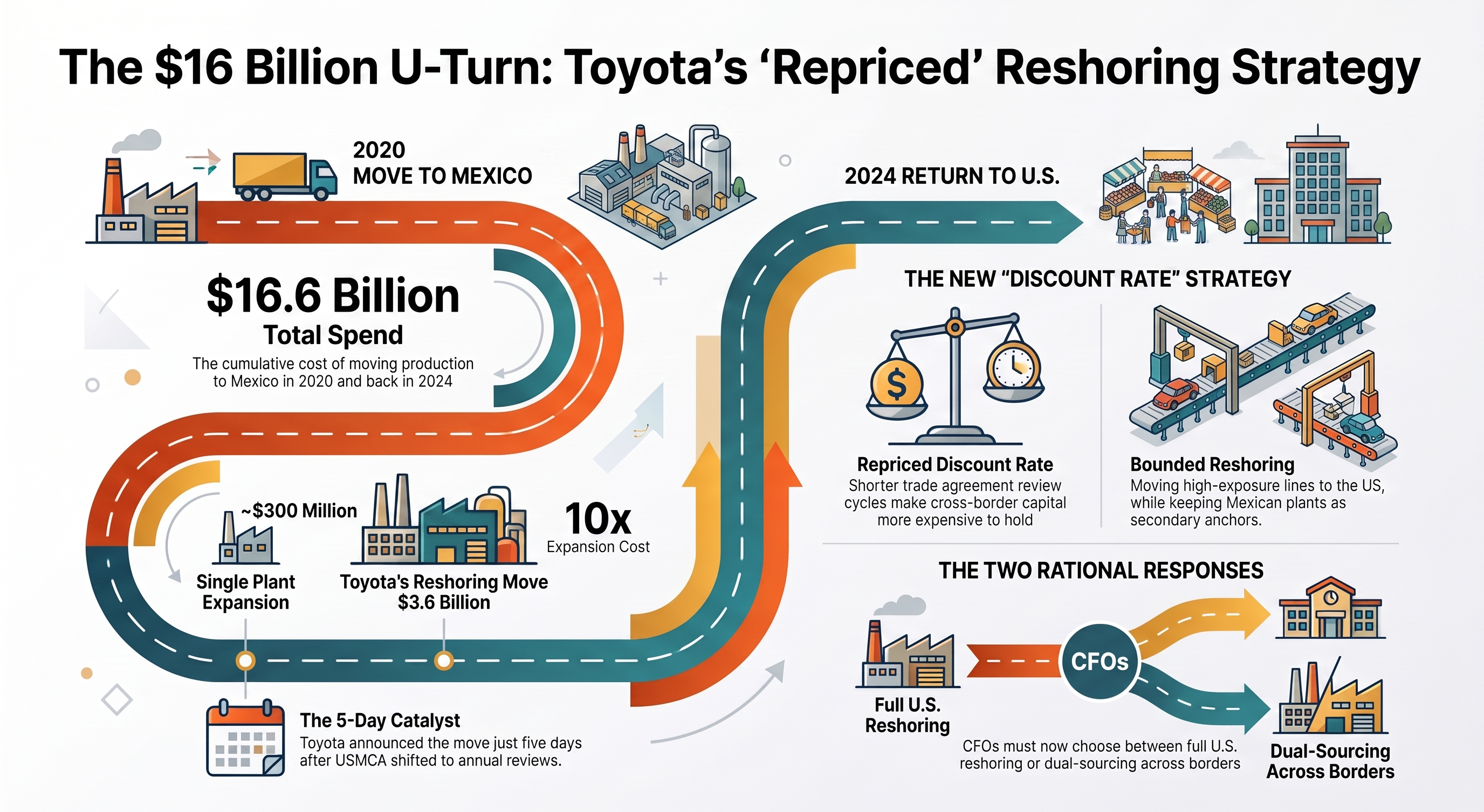 Download the one-page infographic
The Hook: A Record-Breaking Course Correction
Toyota is executing one of the most violent manufacturing reversals in modern industrial history. Just six years after the board authorized a massive shift of its Tacoma pickup production to Mexico, North America CEO Ted Ogawa is pulling the line out of Tijuana and back to San Antonio. While the official press release cloaks the move in "confidence in the regional workforce," the capital stack is screaming what the memo tries to whisper. This is a $16.6 billion "round trip" in capital expenditure—a staggering sum for a single vehicle line to travel in such a short window. Boards almost never unwind a bet of this magnitude midlife. When they do, it signals that the underlying assumptions of global trade haven't just shifted; they have evaporated. This isn’t a routine factory expansion; it is a fundamental recalculation of what it costs to own assets in an unstable trade corridor.
Takeaway 1: It’s Not a Factory Move, It’s a "Discount Rate Repricing"
The $3.6 billion price tag for this expansion is ten times the cost of a routine growth project. To understand why Toyota is paying this premium, you must grasp "discount rate repricing. "Discount rate repricing is the financial realization that when the "tenor" or duration of a trade agreement changes, every capital decision made under the old rules must be marked to the new, higher-risk reality. Because concrete lasts 30 years, shortening a trade review cycle makes that "concrete in the ground" exponentially more expensive to hold.
Takeaway 2: The Five-Day Signal (Why Timing is Everything)
The timing of Toyota’s announcement exposes the mathematical urgency behind the move. On July 1st, the United States-Mexico-Canada Agreement (USMCA) officially transitioned from its multi-decade structure to a system of annual reviews. Toyota’s $3.6 billion announcement followed on July 6th—just five days later. A multi-billion dollar capital shift is not planned in a week. The decision was already calculated, waiting only for the confirmation that the long-term stability of the trade agreement had officially died. "When a trade agreement's review cycle compresses from decades to annual, the discount rate on cross-border capex just repriced. Concrete in the ground is how that shows up. "The shift to annual reviews removed the "option value" floor that previously protected Mexican manufacturing, forcing Toyota to pull its most critical exposure back inside U. S. borders.
Takeaway 3: The Strategy of "Bounded Reshoring"
Toyota is not abandoning its entire footprint; it is practicing "bounded reshoring. " While it is vacating the Tijuana line to eliminate risk for its most critical truck, it is keeping its Guanajuato plant operational. This creates a staged "insurance layer" through dual-sourcing. This strategy highlights the fatal flaw in the "2022 Friend-shoring Doctrine. " The doctrine assumed building in allied, low-risk countries provided multi-decade stability, but annual reviews change what "friend" means in an economic model. By reshoring the critical path while maintaining a secondary Mexican anchor in Guanajuato, Toyota is hedging against a future where a partner can become a trade liability in a single review cycle.
Takeaway 4: The $16.6 Billion "Round Trip" Penalty
The $16.6 Billion Palindrome: Buying Your Way Out of RiskThe math behind this move represents the ultimate "bendrome" of industrial regret. In January 2020, Tacoma production moved from San Antonio to Mexico as part of a $13 billion U. S. investment pledge. This week, Toyota spent another $3.6 billion to bring it back. When a board spends the same money twice on the same production line just to end up where they started, it is a signal to every CFO with a Mexican or Canadian supplier that the ground has moved. This $16.6 billion represents the steep premium paid to buy back the certainty that the USMCA no longer provides.
Takeaway 5: The 18-Month Warning for Detroit
This move is the first data point in what will likely become an industry-wide repricing. Within the next 18 months, watch closely to see if Jim Farley at Ford or Mary Barra at GM names a specific Mexican plant transition. As the saying goes, "one call is a move, the second is an industry repricing. "For boards managing cross-border supply chains, there are now only two rational responses:
Full Reshoring: Move critical lines to the U. S. and accept the labor and construction premium in exchange for zero cross-border risk.
Dual Sourcing: Maintain plants on both sides of the border so that a disruption in one doesn't stop the entire line.
Conclusion: The End of Multi-Decade Stability
What changed for Toyota was not the quality of the Mexican workforce or the efficiency of the factory; it was the cost of holding capital in a territory with a shifting trade tenor. Cross-border capital has become more expensive to hold, and Toyota was simply the first to write down that exposure. While most corporate boards have not yet "opened the file" on their own cross-border risk, their exposure has already repriced. The math has changed. Every executive must now ask: Is our "30-year concrete" currently sitting on a fault line of shifting trade policy?