// The money read, in writing
The Disclosure Template: Why Xbox’s New CEO is Publishing the Numbers Most Executives Bury
 Download the one-page infographic
The Skeleton in the Corporate Closet
Every boardroom has a ghost—a specific, terrifying number that represents a failed strategy, buried under layers of euphemism and creative accounting. When an investment stops compounding and the "flywheel" grinds to a halt, the standard executive playbook is to double down on the jargon and wait for a favorable macro-shift to bail them out. No one wants to admit the thesis is dead. But Asha Sharma, the new CEO of Xbox, has decided to exhume the body. In a document nobody asked her to release, Sharma has practiced a form of radical transparency that borders on the predatory. She isn't just "restructuring"; she is exposing the relatable problem of corporate inertia: the moment you realize your capital has been stagnant for years, but you lack the institutional courage to name the price. By publishing the figures most executives spend a career burying, Sharma has signaled that the era of polite silence is over.
The 64-Cent Reality Check
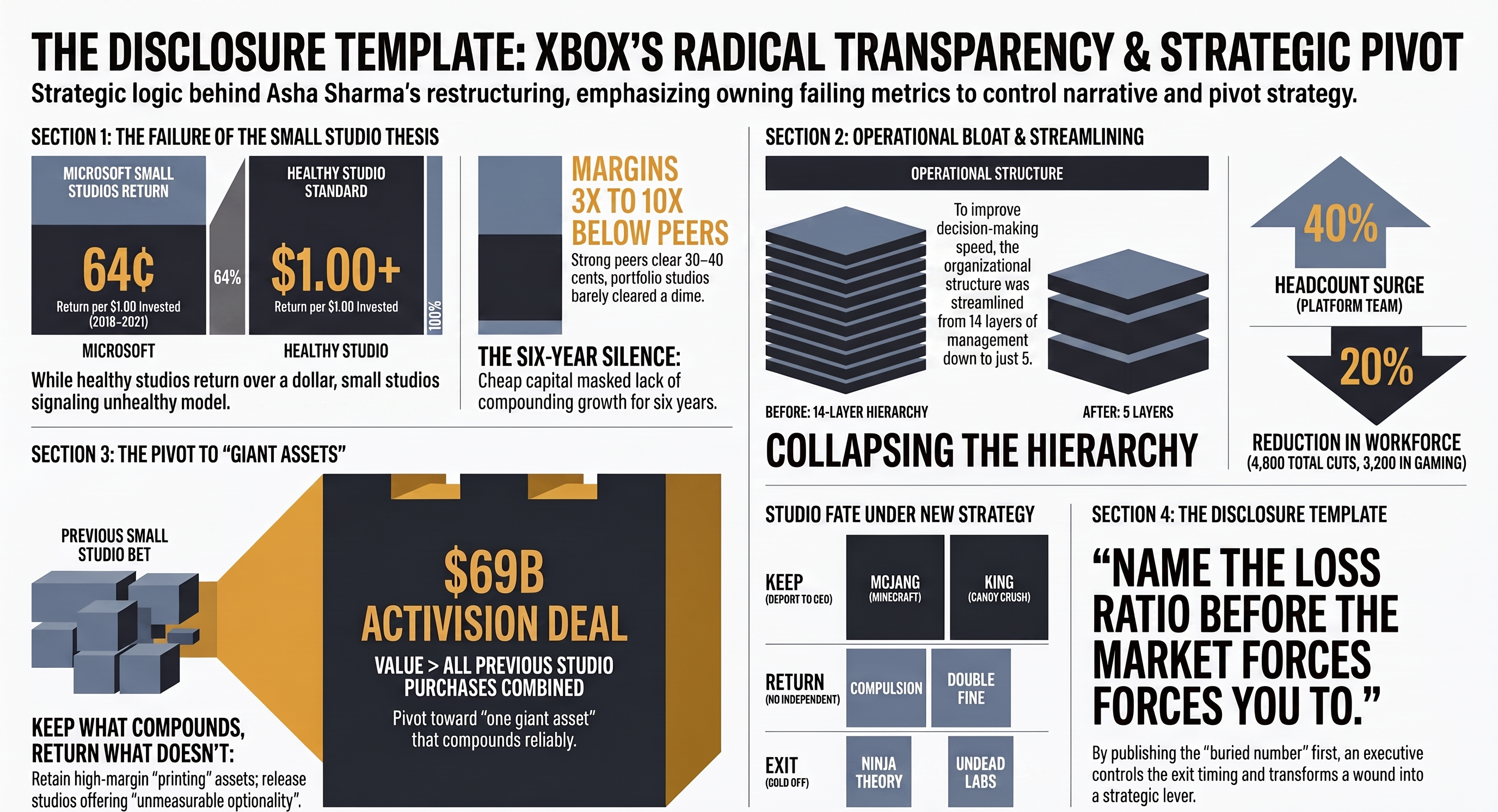
The data Sharma put on the record is a brutal indictment of Microsoft’s mid-market gaming strategy. Between 2018 and 2021, the company poured billions into small studio acquisitions, expecting them to feed the Game Pass ecosystem. The actual return on that cash? 64 cents. For every dollar Microsoft spent, it saw a 36% loss on principal. As a strategic analyst, the nuance here isn't just the loss of principal; it’s the operational decay. While a healthy, high-functioning studio typically returns well over a dollar and clears profit margins of 30 to 40 cents, these acquisitions were barely clearing a dime. Their margins were three to ten times lower than comparable publishers. In her internal memo, Sharma cut through the noise:" Our business today is not healthy. "The previous leadership stayed silent for six years while these numbers soured. That silence wasn't a lack of data; it was a lack of conviction. A healthy bet gets reported early. Six years of quiet tells you the answer came back wrong long ago, and Sharma’s decision to publish the "loss ratio" is a calculated move to ensure the old strategy can never be defended again.
From 14 Layers to 5: Killing the Bureaucracy
Financial hemorrhaging is rarely an isolated incident; it is almost always accompanied by structural bloat. While the studio bets were failing, the Xbox platform team grew 40% larger than it was at the Series X launch, despite having fewer studios to actually manage. The organization had ossified into a hierarchy of 14 layers of decision-makers. Sharma’s response was a surgical strike: cutting 4,800 jobs across the company, with 3,200 of those coming directly from the gaming division—representing a fifth of Xbox’s workforce. She then collapsed the 14 layers of management down to five. Xbox had become a museum of management rather than a factory of play. With 14 layers of gatekeepers, the "flywheel" wasn't just stuck; it was buried under the weight of people whose only job was to watch others work. There was more "running" the business than there was playing the games, and Sharma is clearly done paying for the audience.
The Great Pivot: Owning Assets vs. Feeding the Flywheel
The 2023 Activision deal—a $69 billion behemoth worth more than every previous studio purchase combined—was the final nail in the coffin for the "small studio" thesis. Microsoft has stopped gambling on the hope that many small, non-compounding bets would eventually aggregate into a winner. They are shifting to a "giant asset" strategy: owning the platforms that already print money. Keep what compoundsSharma is aggressively pruning the portfolio to align with this reality. The logic is simple: close the optionality you cannot measure and double down on the assets with proven daily active users (DAUs) and recurring revenue.
Retained: Mojang (Minecraft) and King (Candy Crush) now report directly to the CEO. These are the compounding engines of the business.
Divested/Returned: Studios that failed the 64-cent test are out. Compulsion and Double Fine are being returned to independence. Ninja Theory and Undead Labs are being sold.
The "Disclosure Template" as a Power Move
I call this the " Disclosure Template. " By naming the loss ratio before market forces or activist investors can weaponize it, an executive seizes the number that decides the exit. It is an act of political finality. By putting these four numbers on the record, Sharma has made it impossible for the board to cling to her predecessor’s failed strategy. "Whoever names it first controls the narrative and the timing of the exit. "Naming the wound turns it into a lever. It provides the mandate for the 3,200 job cuts and the divestment of "prestige" studios that don't pay their bills. Sharma has seized control of the clock, turning a strategic retreat into a disciplined reorganization.
Conclusion: What’s Hiding in Your Book?
The era of "zero-rate deals"—where cheap capital allowed for speculative, non-compounding bets—is officially over. Microsoft’s six-year silence was a symptom of an era where you could hide a "dime-margin" business behind the growth of a parent company. That luxury has evaporated. A "disclosure wave" is coming. By next earnings season, boards still sitting on their buried numbers will be the outliers that investors punish. It is time to look at your own book. Find the figure you’d least want printed. Identify the deal from 2019 that never compounded or the segment that barely clears a dime. You already know exactly which one it is. The question isn't whether that figure gets named. It's who names the figure first—you, or the market?