// The money read, in writing
The End of Forever: What the De Beers Fire Sale Reveals About the Future of Scarcity
 Download the one-page infographic
Introduction: The $2.3 Billion Confession
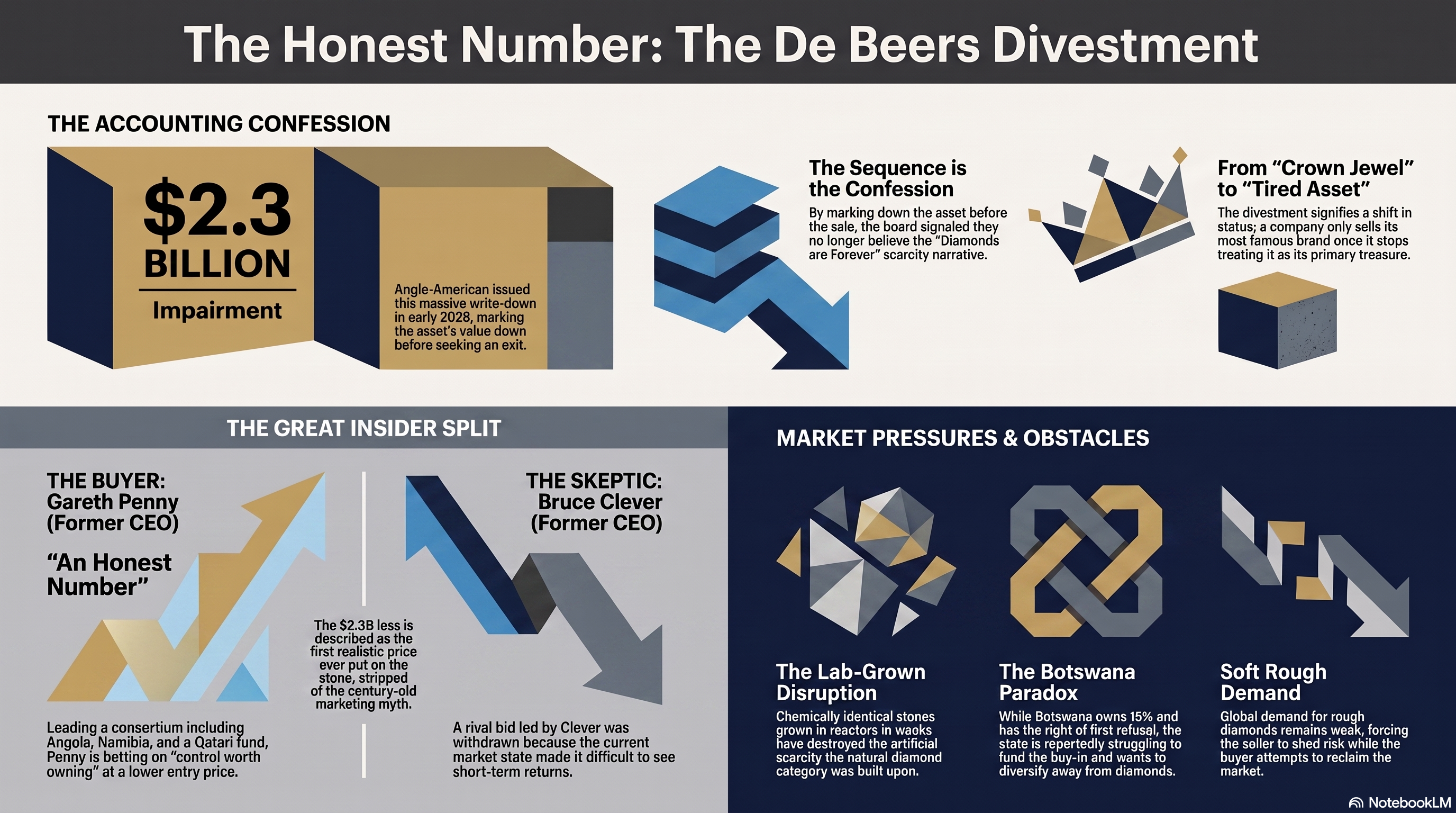
For nearly a century, De Beers operated the most successful marketing machine in human history, convincing a global audience that " A Diamond is Forever. " But in early 2026, the company’s parent, Anglo American, signaled that "forever" had reached a definitive expiration date. Under CEO Duncan Wanblad, the mining giant moved to sell control of the iconic diamond brand, but the real story isn't the sale itself—it is the financial admission that preceded it. Four months before seeking an exit, Anglo American issued a fresh $2.3 billion impairment on De Beers. Critically, this was not a standalone loss; it was a cumulative blow on top of a series of earlier write-downs. In the cold language of corporate boards, a write-down of this magnitude is a confession: the board no longer believes its own narrative. You don't sell a "crown jewel"; you sell an asset you have quietly stopped calling a crown. This wasn't just a corporate merger; it was a fundamental, multi-billion dollar repricing of a global icon.
Takeaway 1: The Sequence is the Secret (Mark Down, Then Move Out)
In high-stakes divestment, the timing of a write-down is never accidental. As the strategic logic goes, the sequence is the confession. By marking the asset down by billions shortly before seeking a buyer, Anglo American’s board established an "honest number" that the seller could no longer ignore and the buyer could no longer dispute. Before finding the door, the company stopped the "crown jewel" rhetoric that had defined the relationship for decades. This tactical markdown allowed the seller to shed the risk and the emotional baggage of the diamond industry's historical scarcity, clearing the decks for a buyer to step in at a valuation that reflects current market realities rather than the synthetic scarcity of the 20th century.
Takeaway 2: When the "Kings of Scarcity" Split the Difference
The divestment has highlighted a dramatic "insider divergence" between the very individuals who once governed the "forever machine. " Two former De Beers chiefs, Gareth Penny and Bruce Cleaver, looked at the same books and reached diametrically opposite conclusions. While Penny led a consortium to acquire the asset, seeing an "entry" in a distressed market, Cleaver’s rival bid pulled out entirely. "With the state of the business and the market, it was hard to see an appropriate return in the short term. " — Bruce CleaverThis split reveals the core tension of the deal: one insider sees a "floor worth owning"—a price so low it represents a safe entry—while the other sees a "return that doesn't clear. " It is a battle of conviction where Penny is effectively betting against his old self, reading value in the same wreckage where others see only a permanent loss.
Takeaway 3: The "Reactor" Problem—Why Scarcity is Evaporating
The primary force eroding the De Beers empire is the rise of lab-grown diamonds. These stones are not "fakes" or mere substitutes; they are chemically identical to natural diamonds. However, instead of being forged over eons in the earth's crust, they are grown in a reactor in a matter of weeks. The impact is transformative. Lab-grown stones are pulling the floor out from under the very concept of scarcity that the industry spent a hundred years building. Because supply can no longer be restricted by a single gatekeeper, the "forever" narrative is being replaced by a technological reality that creates abundance. The scarcity is evaporating because the "reactor" has decoupled value from time and geology.
Takeaway 4: The Botswana Paradox—Power Without a Balance Sheet
The Government of Botswana remains the most volatile variable in this transition. As a sovereign holding a 15% stake and a powerful "preemption right," the state technically has the right of first refusal to increase its control. President Dumaboko has publicly signaled a desire for a larger stake, yet this ambition is trapped in a strategic paradox. While the state wants more control, it is reportedly struggling to fund a larger position and is simultaneously desperate to diversify its economy away from a reliance on diamonds. This is the "hidden" tension: the sovereign holding the preemption right may no longer have the balance sheet—or the long-term strategic desire—to double down on a sunsetting industry. This makes their current position less of a settled move and more of an "opening position in the fight" for the stone.
Takeaway 5: Buying Back "Heresy"
There is a profound irony in the selection of Gareth Penny’s consortium as the preferred bidder—though it is vital to note that a "preferred bidder" status isn't a final deal. Penny, the man who once ran the "forever machine," is now buying back the ground it comes from alongside a Qatari fund and the producing states of Angola and Namibia. Penny is not a "trophy hunter" overpaying for a legacy logo; he is an insider who knows the asset's true value better than anyone. He is seeking to own a distressed asset at a price that he, in his former role, would have likely considered "heresy. " It is a calculated move from selling a global narrative to owning the physical control of a repriced reality.
Conclusion: The First Honest Number
The transition of De Beers marks the definitive end of an era of manufactured scarcity and the beginning of a market-driven reality. Anglo American’s $2.3 billion write-down wasn't an accounting mistake or a simple footnote; it was the first honest number put on a diamond in a century. The natural diamond story isn't just wobbling; it is being fundamentally rewritten. In the end, it took the man who invented forever to finally price it. As the industry shifts from the boardroom to the reactor, one question remains: In a world where technology can manufacture "forever" in a few weeks, what does true rarity actually look like?