// The money read, in writing
The Ghost in the Machine: Why "Chipflation" is the Invisible Ceiling of the AI Era
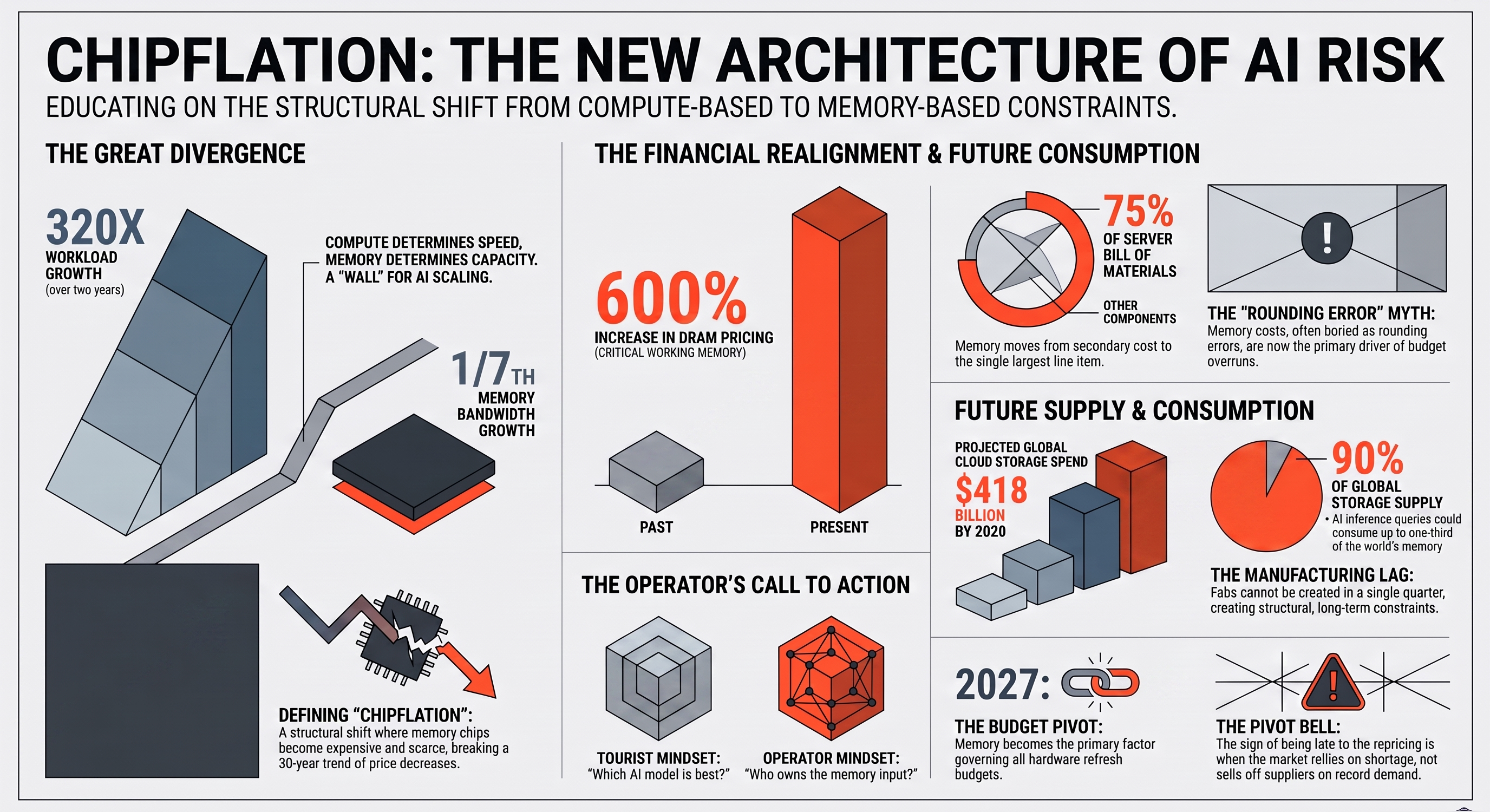 Download the one-page infographic
1. Introduction: The Compute Delusion
The AI trade was repriced this week, and the catalyst didn't come from a processor architecture or a breakthrough in neural networks. It came from a single word: Chipflation . While the market spent the last two years high on compute—obsessing over raw processing horsepower and the faster chips that do the math—the real crisis was quietly brewing in the plumbing. As Shaun Kim of Morgan Stanley recently observed, the industry has hit a structural inflection point. " Chipflation" marks the moment memory chips stop their historical march toward affordability and instead become aggressively expensive and scarce. We have reached a point where the bottleneck has shifted. The market is still pricing the old constraint (processing power), but the real ceiling is being set by the "fuel line" (memory).
2. The "Wall Going Straight Up" (The Bandwidth Gap)
To understand the friction in the current AI trajectory, you have to look at the widening chasm between what these models demand and what the hardware can actually deliver. There is a fundamental disparity in growth rates that renders software efficiency assumptions almost moot. Over a two-year window, memory bandwidth—the literal speed at which data reaches the processing chip—has grown by a mere 1/7th. During that same period, the AI workloads fed into these systems have exploded by 320 times. "One line is a gentle slope. The other is a wall going straight up. "The chips themselves decide how fast a model answers, but memory decides how much it can hold at once. When the "plumbing" cannot keep pace with the "engine," the world’s most advanced GPUs are left starving for data.
3. The Death of a 30-Year Trend
The economics of the data center are undergoing a violent transformation. For three decades, the technology sector operated under a reliable law of gravity: Dynamic Random Access Memory (DRAM) would always get cheaper. That streak is dead. In just one year, the price of DRAM has increased sixfold. This isn’t just a cyclical spike; it is a structural repricing of intelligence itself. The financial impact is staggering: memory now accounts for 3/4 of a server's total bill of materials. The biggest line item in the stack is now the one nobody mentions in a keynote. What was once a secondary budget consideration has become the primary driver of infrastructure costs.
4. The Inference Hunger (Plumbing Eating the Supply)
The narrative often focuses on the massive energy and hardware required to train new models, but the real supply-killer is "inference"—the everyday queries processed after a model is live. The scale of this "inference hunger" is immense. Current projections suggest that everyday AI queries could consume more than one-third of the world’s memory supply by next year and an incredible 9/10 of its total storage. This is why cloud storage spend is projected to hit $418 billion by 2030. It isn't just the famous, frontier models that matter; it is the physical plumbing underneath them that is eating the global supply.
5. The Operator vs. The Tourist
The current market environment separates participants into two camps: those who understand the physical reality of the supply chain and those who do not. "The tourist asks which model wins. The operator asks who owns the input every model waits on. "The Tourist focuses on software valuations and LLM benchmarks. The Operator recognizes that you cannot will a memory fabrication plant (fab) into existence in a single quarter, regardless of how much efficiency your valuation assumes. Scaling AI is governed by the scarcity of the input, and the input is currently hitting a physical wall.
6. The Pricing Lag and the "Pivot Bell"
The market is currently sleepwalking through a lag between hardware reality and equity pricing. The tape already knows, even if the headlines haven’t caught up. Recently, Micron—the company that sells the exact memory this thesis identifies as scarce—fell 3% on news that proved memory is the constraint. Simultaneously, the market sold off Taiwan Semiconductor (TSMC) for raising its capital budget toward $64 billion. When the winners fall on their own "good news," it is a signal that the story hasn’t been fully repriced by the broader market. This creates a looming budget crisis. By 2027, the memory line will stop being a footnote and start governing every refresh budget. If you haven't marked it yet, you are carrying risk the market hasn’t billed you for. Watch for the "pivot bell": the day these suppliers rally on news of a shortage rather than selling off on record demand. If you’re waiting for that bell to ring before you adjust your hardware budget, you’re already too late.
7. Conclusion: The Invoice is Coming
The constraint of the AI era has moved. It is no longer a question of whether we can build a chip to do the math; it is a question of whether we can afford the memory to feed it. As you look at your next hardware refresh, recognize that the "memory line" is no longer a rounding error—it is the governing factor of your scale. The invoice for the AI era is being delivered, and it is slower than the headlines but much higher than the estimates. The critical question for every technologist and investor remains: have you repriced your memory line, or are you still playing the role of the tourist?