// The money read, in writing
Costco Isn’t a Store: The Counter-Intuitive Strategy Behind a $5 Billion Membership Engine
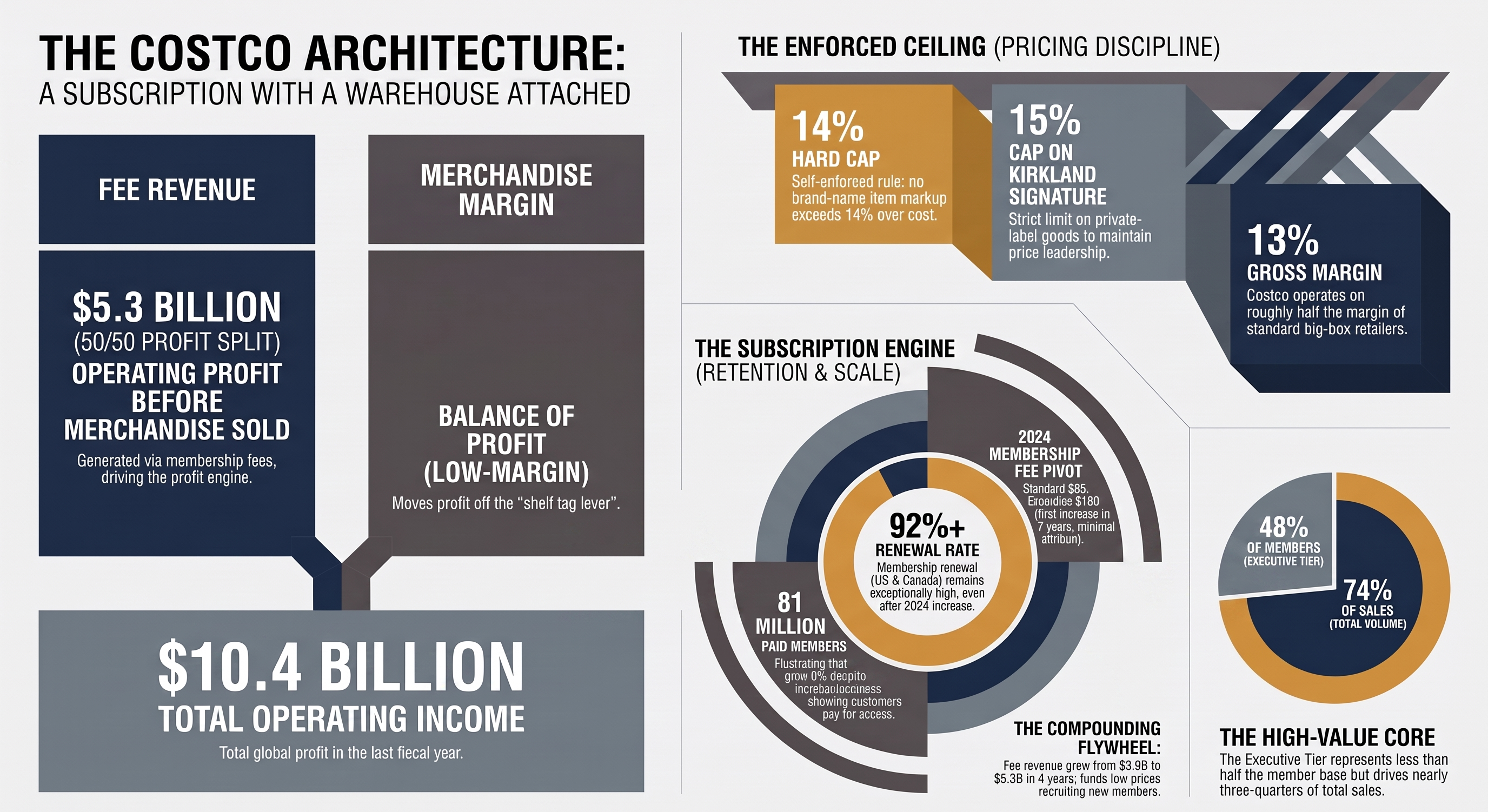 Download the one-page infographic
To analyze Costco as a discount retailer is to commit a fundamental category error. While the casual observer sees a warehouse filled with bulk goods, the strategic analyst sees something far more sophisticated: a high-margin membership annuity protected by a break-even logistics operation. Most retailers spend their lives in a desperate struggle to balance competitive pricing with quarterly profitability. Costco solved this equation forty years ago by removing profit from the sales floor entirely.
The Self-Imposed Profit Ceiling
In the world of capital allocation, growth typically invites margin expansion. Costco, however, operates under a rigid, self-imposed constraint that looks like corporate heresy: no item is marked up more than 14% over cost (15% for Kirkland Signature). This is not merely a "low price" tactic; it is a permanent capital moat. By maintaining a gross margin of under 13% —roughly half the margin carried by a typical big-box competitor—Costco has effectively refused to bank the savings generated by its massive scale. For four decades, the company has deliberately left billions on the table, reinvesting potential margin back into the "shelf tag" to lower the cost of customer acquisition. "A ceiling on their own profit enforced by them on themselves. "This discipline is the engine of their unit economics. By treating the merchandise business as a loss-leader or break-even operation, they ensure that every dollar of scale flows directly to the consumer, making the value proposition virtually impossible to disrupt.
The $5.3 Billion "Fee" Business
The true nature of Costco’s business emerges when you look at the operating income. Last fiscal year, Costco generated approximately $10.4 billion in operating profit. Of that total, $ 5.3 billion arrived before a single item was sold. The membership fees represent pure operating leverage. While the company moved $275 billion in physical goods, that massive effort only accounted for the remaining half of the profit. This is the ultimate "subscription with a warehouse attached. "The Flywheel is Acquisition; The Fee is the Business. In the standard retail deck, the flywheel (volume driving buying power driving lower prices) is designed to expand the bottom line. At Costco, the flywheel is repurposed exclusively for acquisition and retention. The merchandise exists to defend the membership; the membership exists to provide the profit. This is evident in the growth trajectory: fee revenue surged from $3.9 billion to $5.3 billion in just four years , compounding alongside a growing, loyal member base.
Moving the Profit Lever
The central constraint of the retail industry is that the "shelf tag" and the "earnings" are the same lever. If a store wants to increase its profit, it must raise prices or squeeze costs. This creates an inherent tension between being cheap and being profitable. Costco moved its profit off that lever entirely. By decoupling its earnings from the individual product price, it changed the fundamental nature of its inventory:
The Traditional Model: A rotisserie chicken is a "margin question. " The merchant asks, " What is the maximum price the market will bear for this bird? "
The Costco Model: A rotisserie chicken is a "retention question. " The analyst asks, " Does the price of this chicken guarantee the customer renews their membership? "Once the profit lives in the fee, the rotisserie chicken stops being a product and starts being a defense mechanism for a high-margin annuity.
The Ultimate Loyalty Test
In September 2024, Costco executed the cleanest possible test of its model: a price hike. The standard membership rose to $65 and the executive tier to $130, affecting roughly 52 million memberships. Because this revenue is pure profit with no offsetting COGS, it was a high-stakes gamble on customer loyalty. The results confirm the strength of the moat:
Expansion: Paid memberships reached 81 million, a 6% year-over-year increase.
Retention: Renewal rates in the U. S. and Canada held steady at a staggering 92%.
The Heavy User: The Executive Tier now represents 48% of members but accounts for 74% of total sales. This concentration of "heavy users" proves that Costco has successfully captured the most valuable segment of the market—those for whom the membership is not an expense, but a recurring investment in their own household economy.
Reflection: The Two-Column Challenge
The genius of the Costco model isn't just low prices—plenty of retailers have tried and failed to win on price. The genius is the refusal to let the price pay the bills. By moving profit to a line that the customer chooses to renew on purpose, Costco forced itself to spend 40 years defending that renewal through operational excellence. To evaluate the health of your own business or career, perform a " Two-Column" analysis:
Column A (The Earnings): Which of your activities carry your actual profit?
Column B (The Relationship): Which of your activities exist solely to build and defend the relationship? Most organizations never draw this line. They treat every interaction as a margin opportunity, which is why every discount becomes a internal fight with finance and every customer renewal is based on hope rather than a proven value proposition. If your business moved its profit off the "shelf tag" and onto the "relationship," would your customers still choose to renew?