// The money read, in writing
Why Samsung Just Bet $1.8 Billion on the "Raw Material" of the Decade
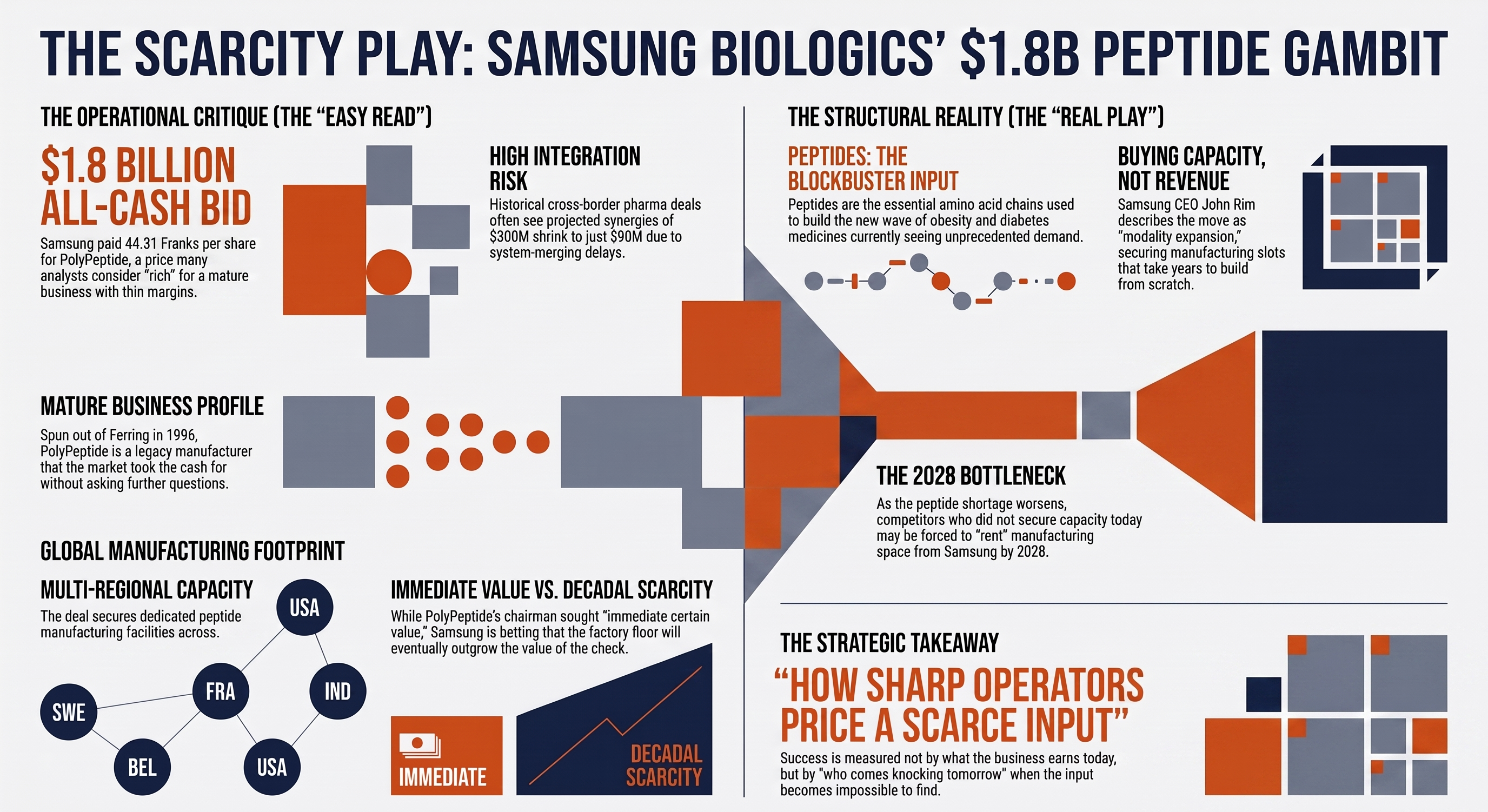 Download the one-page infographic
Samsung Biologics CEO John Rim just signaled the end of the wait-and-see era in the GLP-1 supply chain. By executing an all-cash, $1.8 billion bid for PolyPeptide—a Swiss manufacturer most people have never heard of—Samsung has made the largest biopharma move in South Korea’s history. To the casual observer reading the headlines, the price tag looks reckless: a massive premium for a mature manufacturer with thin margins. But for the strategic analyst, this isn't just an expansion; it is the shrewdest play for scarcity we will see this decade.
It’s Not a Revenue Play, It’s a Scarcity Play
The easy read—the one most headlines took—is that Samsung is an antibody maker simply planting a flag in the EU. Critics will argue that cross-border pharma deals are a graveyard of failed synergies, where modeled gains of $300 million shrink to $90 million while teams spend two years merging IT systems instead of making product. Samsung is paying 44.31 Francs a share for a business spun out of Ferring in 1996, a rich price for a company facing significant integration risks. However, the "deal math" usually skips the question of purpose. Peter Wen, PolyPeptide’s Chairman, took the "immediate certain value" of the cash offer. But Rim is looking at the next ten years. As the analysis of the deal suggests: " One side is buying a decade of scarcity. The other takes cash now rather than betting the factory floor outgrows the check. " These are two rational bets, but Samsung is the one positioning itself to own the bottleneck before the market reprices it beyond reach.
Peptides are the Hidden Engine of the Obesity Drug Wave
This is a calculated "modality expansion. " Samsung is moving aggressively beyond its roots in antibody manufacturing and into peptides—the short amino acid chains that serve as the essential raw material for the blockbuster obesity and diabetes medications currently dominating the market. This is the largest demand wave the pharmaceutical industry has seen in a generation, and manufacturing these peptides at scale is the scarcest input in the world right now. You cannot simply flip a switch to build this capacity; it takes years of construction and rigorous certification. By acquiring PolyPeptide, Samsung circumvents that timeline entirely, gaining an immediate geographical head start with dedicated manufacturing facilities in:
Sweden
Belgium
France
The United States
India
The High Cost of "Buying Time"
The "tell" in this deal is that John Rim didn’t buy a balance sheet; he bought a manufacturing head start. Operationally, the deal looks expensive. The margins are thin, the integration is complex, and 44.31 Francs a share is a steep price for a business as it stands today. Structurally, however, it is a fortress. In an industry defined by 18-month lead times and multi-year construction phases, time is the only thing money usually cannot buy. By paying the premium today, Samsung owns the bottleneck. While competitors are stuck in the "operational read"—worrying about the price of the entry—Samsung has moved to the "structural read," securing the one thing the rest of the industry will be begging for by the time their own factories are finally cleared for production.
How Sharp Operators Price the Future
This acquisition offers a universal lesson in how the sharpest operators price a scarce input. They do not value an asset based on what it earns today; they value it based on who comes knocking tomorrow. Samsung identified the coming peptide shortage before the market could fully prove the price. This is the real decision underneath the premium: Do you wait for the price to be proven, or pay up today to own the asset? Whether the scarce input in your world is a specialized supplier, a senior engineer, or a slot on next year’s roadmap, the cost of waiting almost always exceeds the cost of a premium. If you wait for the "right" price, you have already lost the asset to someone with a longer lens.
Conclusion: The 2028 Prediction
The peptide manufacturing bottleneck will worsen before it gets better. As the obesity drug wave continues to surge, the capacity Samsung has just secured will become the most valuable real estate in pharma. By 2028, competitors who chose to wait for a "fair" price will find themselves at the mercy of Samsung’s pricing. They won't be rivals; they will be tenants, renting the capacity they were too timid to buy in 2024. Ultimately, the question isn't whether $1.8 billion is too much for PolyPeptide today. The question is whether it is actually too little for what this business becomes when everyone else needs it and can no longer get in.