// The money read, in writing
The $1 Empire: What Coca-Cola’s "Worst" Deal Teaches Us About Modern Scale
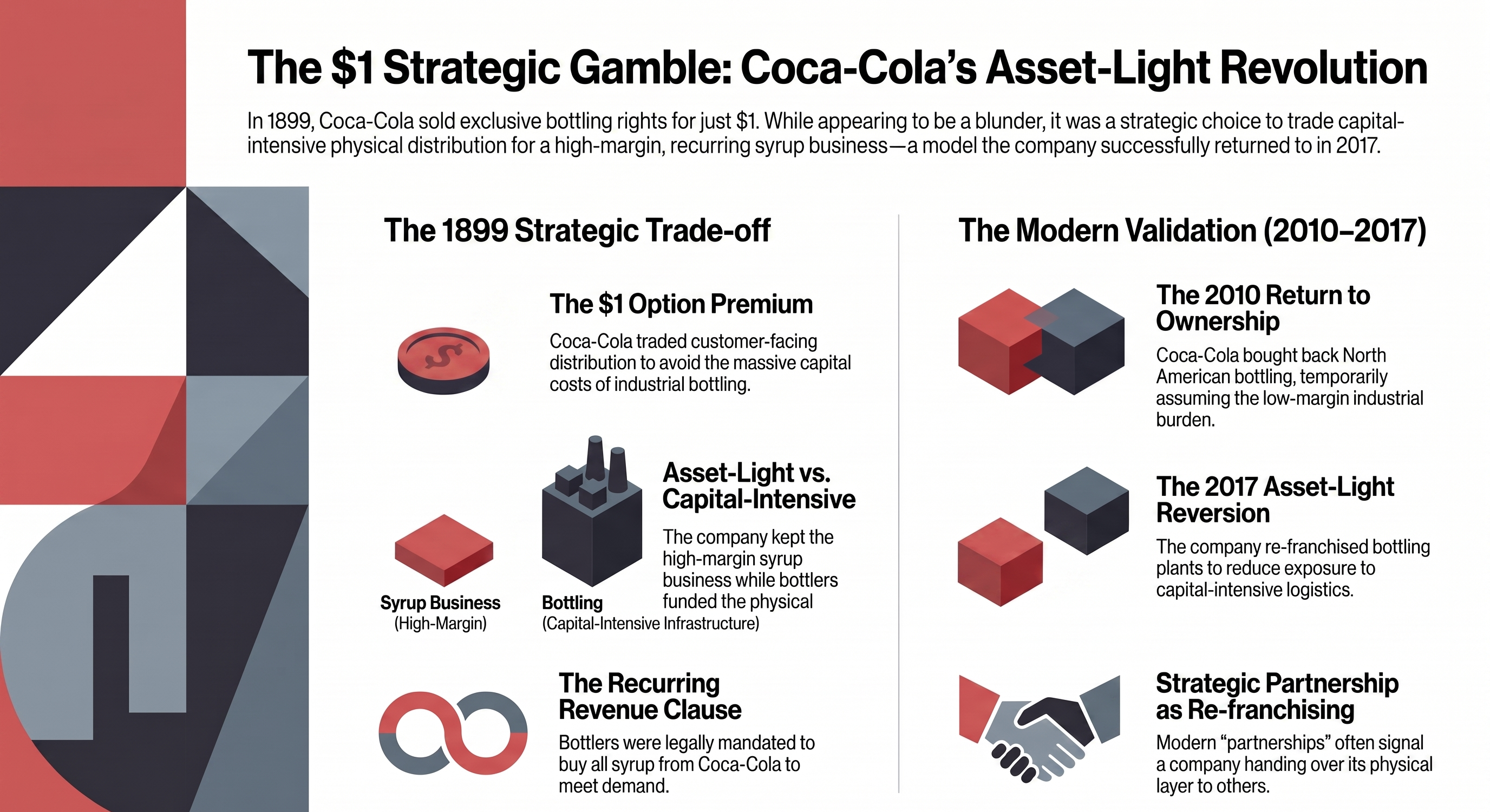 Download the one-page infographic
1. Introduction: The Billion-Dollar Blunder that Wasn't
In 1899, Asa Candler, the architect of the Coca-Cola Company, performed an act that remains a case study in structural risk management: he sold the exclusive bottling rights for nearly the entire United States for exactly one dollar. To the uninitiated, this appears to be the ultimate historical gaffe—voluntarily handing away the customer-facing half of a burgeoning empire. However, a systems-level analysis reveals this was not a lapse in judgment, but a deliberate refusal of a structural trap. At the time, bottling was an unproven distribution model; the "soda fountain" was the established frontier. When two lawyers from Chattanooga entered his office, Candler wasn't negotiating a partnership. He was declining an obligation. By offloading the physical layer of the business for a nominal dollar, Candler ensured that the explosion of Coca-Cola’s reach would be financed entirely by the capital of others.
2. The "Malpractice" of Giving Away the Customer
On a standard deal sheet, Candler’s agreement looks like professional malpractice. He surrendered the customer-facing half of a global brand and committed to a syrup price fixed in perpetuity—a move that, in an inflationary environment, could have been a death sentence. By doing so, he effectively bifurcated the company into two distinct layers:
The Hidden Layer: High-margin syrup production and brand stewardship.
The Customer-Facing Layer: Low-margin bottling, distribution, and local logistics. The conventional wisdom of "owning the customer" suggests that Candler committed a strategic error by losing control of the retail interaction. Yet, the systemic reality was that he was partitioning the business to isolate the brand from the "exposure to low-margin capital" that defines the industrial bottling process.
3. Selling the Liability, Keeping the Recurring Line
The genius of the 1899 deal lies in the recognition that bottling is not a beverage business—it is an industrial one. It is a world of glass plants, specialized machinery, and grueling delivery routes in every town in America. Candler recognized that these were not assets to be coveted, but liabilities to be managed.
The Capital Requirement: The physical infrastructure and "heavy" assets required to manufacture, store, and transport bottles.
The Recurring Line: The essential, high-margin concentrate that the bottling network is legally obligated to purchase in perpetuity to meet demand. "He sold the capital requirement and kept the recurring line. "By shedding the "physical layer," Candler avoided the burden of owning the means of distribution, focusing the company’s resources on the high-margin, scalable syrup business.
4. Off-Balance Sheet Growth: The Hidden Power of Sub-Franchising
The Coca-Cola bottling network was never a top-down corporate design; it was a viral expansion fueled by third-party capital. The original lawyers sub-franchised the rights to anyone willing to fund a local plant. This resulted in national distribution financed entirely off somebody else’s books. The choice was structural, not a matter of luck. Most founders prioritize keeping the markup and choose to eat the buildout costs. Candler flipped the script. What he gave up was the markup on the bottled liquid; what he successfully refused was the obligation to fund the buildout. In the binary of Markup vs. Obligation , Candler understood that the capital expenditure avoided was worth far more than the incremental margin surrendered.
5. The Century-Long Validation: From 2010 to 2016
The validity of Candler’s 1899 logic was proven through the lens of a modern failure. In 2010, the Coca-Cola Company attempted to "unwind" history by buying back its North American bottling operations. For six years, the company owned the trucks and the plants, carrying the exact industrial burden that the original contract had spared it. The experiment was a clear failure of scale. In February 2016, the company announced it would "re-franchise" the entire North American network. Scale tested owning distribution for six years and chose to return to where it started. The stated rationale—reducing exposure to low-margin, capital-intensive bottling—was an admission that Candler’s original "asset light" model was the superior system. Even with 100 years of data, the company concluded it was better to earn the same by owning less.
6. The "Option Premium" Framework
Viewed through a systems lens, the $1 price tag was not a "price" in the traditional sense. It was an option premium paid to ensure the company would never have to own a truck. Owning distribution often feels like "control," but in a high-scale environment, that control frequently prices like a liability. Key Takeaway: The asset you refuse to buy is the only one that can never be written down on your balance sheet, and it is the only one that can never stop you pricing the thing you kept. By refusing to own the physical infrastructure, the syrup business remained agile. The partners absorbed the risks of the industrial buildout, while the parent company maintained the pricing power over the one thing it truly owned: the recipe.
7. Conclusion: The Future of "Strategic Partnerships"
The history of the Coca-Cola bottling deal serves as a blueprint for the current wave of "asset-light" restructuring. Today, the next wave of divestitures won't always announce itself as such. Instead, it will arrive under the guise of "strategic partnerships. "As a professional analyst or investor, you must watch the language in corporate filings. When a company describes handing over its physical layer to a partner, they are not just "collaborating"—they are re-franchising. They are shedding the low-margin capital requirements in a bid to return to the recurring-line model that Candler perfected in 1899. In your own business or career, which half are you currently financing that someone else should be?