// The money read, in writing
The Ledger vs. The Headline: Why Google’s "Loss" of Jeff Dean is Actually a Masterclass in Accounting
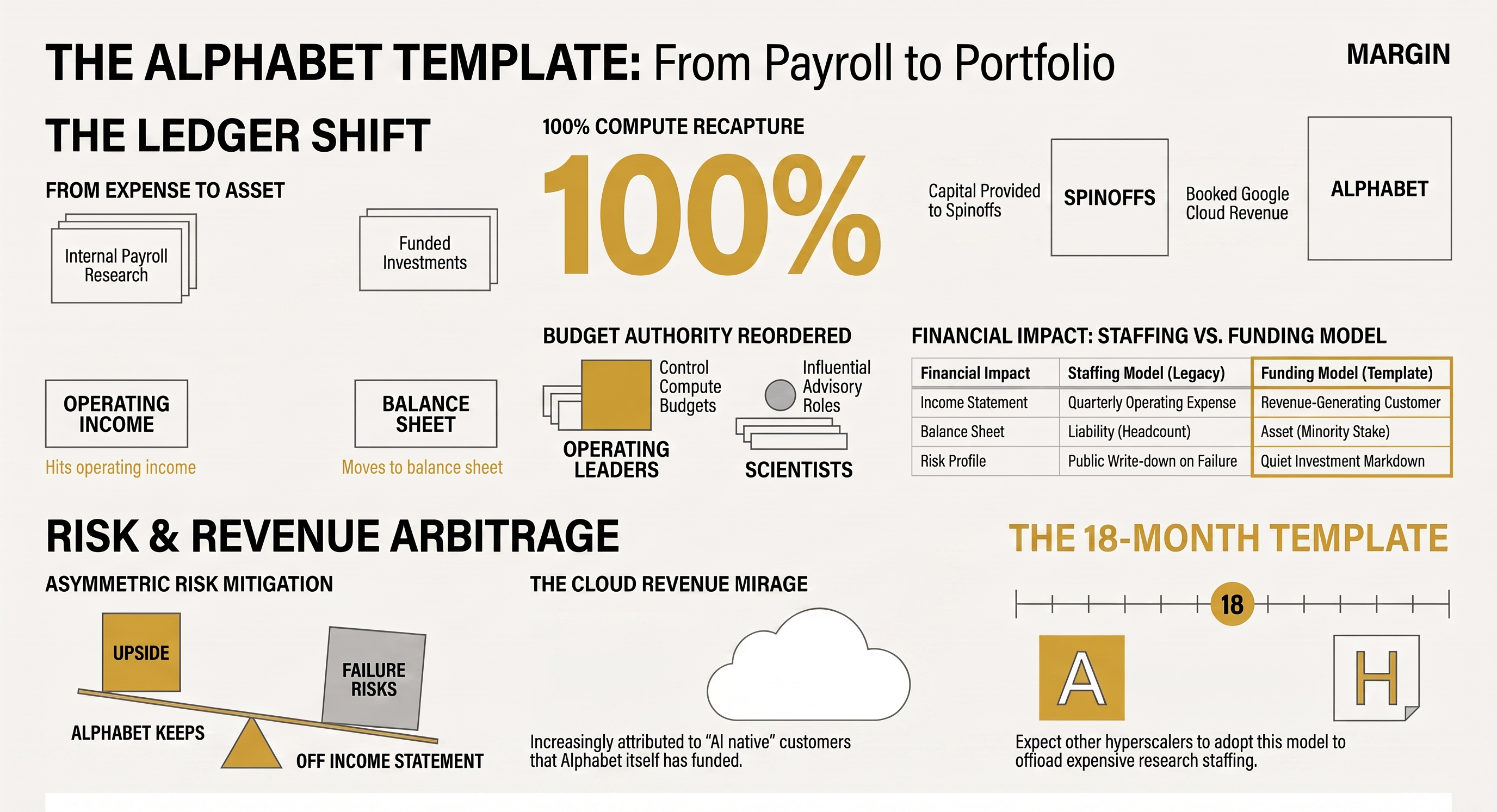 Download the one-page infographic
The recent departure of Jeff Dean—Alphabet’s "founding technical mind" and a fixture at the company since 1999—is being framed by the press as a brain drain. After 27 years, the man who essentially built the backbone of Google’s engineering culture is walking out the door. But if you look past the sentimental headlines, you’ll find "the piece nobody circled": Discovery Loop. Instead of fighting a bidding war to keep its most valuable researcher on the payroll, Alphabet did something far more clinical. It wrote Dean a check to co-found a new venture, Discovery Loop, and immediately signed him as a major cloud customer. This isn't a story about talent loss; it is a sophisticated corporate restructuring of how frontier research is funded and accounted for. While the narrative says "departure," the ledger says Alphabet just moved its most expensive research relationship off the income statement and got paid on the way out.
The OpEx Alibi: Moving the Goalposts to the Balance Sheet
The fundamental shift here is one of categorization. When a researcher of Dean’s caliber is on the internal payroll, his work—and the staggering costs of the compute and headcount supporting it—is an operating expense (OpEx). This expense hits operating income every single quarter, creating a drag on earnings that management must defend to an increasingly cost-conscious Wall Street. By funding Dean’s venture as an outside entity, Alphabet transforms a recurring liability into a strategic asset. "On payroll, that research is an expense. It hits operating income every quarter and every quarter somebody has to defend it. As an investment, it moves to the balance sheet. It stops reducing earnings. "By shifting the relationship to the balance sheet as a minority investment, Alphabet cleans up its income statement while maintaining a significant stake in the eventual output.
The Build vs. Fund Math: Engineering a Circular Economy
This restructuring creates a highly favorable "infinite loop" of revenue. In the traditional "build" model, Google pays for the research and the servers. In the "fund" model, Alphabet provides the capital to the lab, and the lab immediately hands that capital back to Google Cloud to purchase compute power. The irony is sharp: the "loss" of a senior researcher results in a booked increase in Cloud revenue. Alphabet isn't just offloading a salary; it is financing the creation of a guaranteed, high-spend customer for its own infrastructure.
Externalizing the Downside: The De-Risking of Frontier Failure
Frontier AI research is a high-variance bet. By moving this work outside the corporate walls, Alphabet has engineered a way to manage the "downside" of potential failure with surgical precision. If a massive internal project fails to produce a product, it results in a visible write-down and a difficult conversation with shareholders. However, if a funded startup fails, it is merely a minority stake that can be quietly marked down over time. Crucially, the revenue generated by that startup’s compute usage remains safely booked on Alphabet's ledgers. "Alphabet kept the upside and moved the downside off its own income statement. "
The Operator Era: Why "Owning the Compute" is the New Power
The restructuring of the research bench is mirrored by a cold-blooded shift in the internal hierarchy. The recent moves involving Demis Hassabis and Koray Kavukcuoglu signal that the era of the "research-king" is over, replaced by the era of the operator. Demis Hassabis has been moved into "influence seats"—Chair of DeepMind and Chief Scientist of Alphabet. These are prestigious titles, but they are roles that do not sign budgets. Meanwhile, Koray Kavukcuoglu, reporting directly to CEO Sundar Pichai, now runs the unit. In the current AI arms race, Kavukcuoglu "owns the compute. " By placing spending authority in the hands of an operator rather than a pure researcher, Alphabet has signaled that AI is no longer a laboratory experiment; it is a resource-management problem.
The Templatization of Research: The "Smoking Gun" for Investors
This is not a one-off exit; it is a template for how hyperscalers will handle high-cost research moving forward. Why carry the headcount risk when you can fund the lab and keep the compute revenue? On Alphabet’s next earnings call, ignore the flowery language about "innovation culture" and look for the smoking gun—an inverse relationship between two key metrics:
Headcount: Is AI research headcount described as flat or shrinking?
" AI Native" Revenue: Is Cloud revenue growth being specifically attributed to " AI native customers"? If these move in opposite directions, the "templatization" is confirmed. Expect at least one other hyperscaler to fund a lab it used to staff within the next 18 months.
Conclusion: Carrying a Counterparty You Haven’t Repriced
The "ledger" reveals a reality that should unsettle anyone currently negotiating with a major cloud provider. The provider you signed with in early 2024 is a different counterparty than the one that exists today. They are no longer just a utility; they are increasingly the primary financier of the very labs and startups that may be looking to disrupt your business. You are likely carrying a counterparty you haven't repriced. Your vendor is now an investor in your potential competition, using your contract revenue to fund the next wave of "departing" talent. Before you renew your next cloud contract, ask yourself: do you know who actually owns a piece of your vendor’s other customers?