// The money read, in writing
The Walmart Machine: Why Sam Walton’s "Reckless" Gamble Rewrote the Rules of Retail
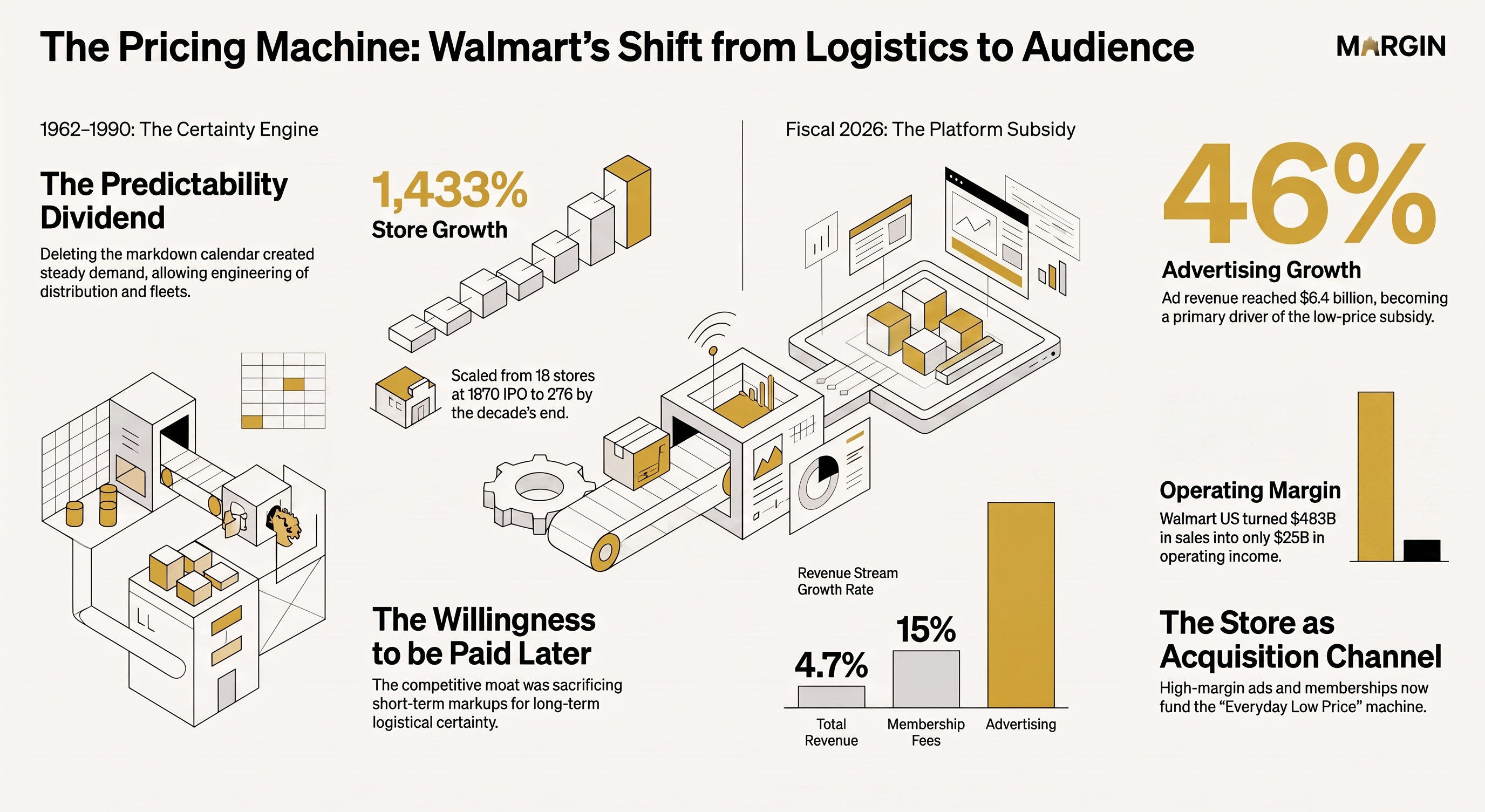 Download the one-page infographic
1. The Hook: A Retail Revolution in Rogers, Arkansas
In 1962, in the small town of Rogers, Arkansas, Sam Walton made a decision that looked, on paper, like business suicide. He abolished the sale. No weekend events, no glossy circulars, no seasonal markdowns—just one permanent, unchanging price. Traditional retail was a high-stakes game of "manufacturing" demand through the markdown cycle: pricing high, then using circulars to drive Saturday crowds. Walton "deleted the calendar. " This wasn't a choice made from a position of market dominance; it was a design forced by constraint. As a rural operator, Walton couldn't buy at the favorable terms the big chains enjoyed, and he couldn't afford the expensive flyers that filled his competitors' stores. Instead of fighting a battle he couldn't win, he designed around his limits, choosing to build an infrastructure of certainty rather than a machine for promotional swings.
2. Takeaway 1: The Promise Must Precede the Machine
There is a pervasive myth that Walmart’s low prices were the inevitable result of its massive scale. In reality, the causality runs in the opposite direction: the promise of the " Everyday Low Price" was the cause of the volume, not the result of it. Walton made the commitment to the consumer in Rogers long before he had the network or the logistics to fund it. He understood that to fundamentally change the economics of retail, he had to first change the consumer’s expectation. By the time the competition realized he wasn't just having a "bad week" with his pricing, he was already engineering the machine to fulfill that promise. As the logic of the ledger shows, a pricing promise is a commitment to a machine you haven't built yet.
3. Takeaway 2: The "Predictability Dividend"
By keeping prices static, Walton unlocked what we can call the " Predictability Dividend. " While rivals treated consumer demand like unpredictable weather—swinging wildly based on the latest promotion—Walton created a number that never moved. This was not a marketing tactic; it was a forecasting instrument. Steady demand is the only input a business can truly engineer against. Because demand stopped swinging, Walmart could optimize its logistics with surgical precision. They didn't need to maintain massive inventory buffers to handle "swinging" demand; instead, they could size truck routes to something that held still. This allowed Walton to cross-dock his own fleet and build distribution centers that functioned as high-velocity conduits rather than stagnant warehouses. This engineering excellence, backed by a private satellite link by 1983 that put every store on the same numbers the same day, allowed the company to scale at a staggering rate. The machine grew from just 18 stores at its 1970 initial public offering to 276 by the end of that decade.
4. Takeaway 3: The Moat of Delayed Gratification
The "honest objection" to Walmart's dominance is that it was simply a matter of scale. But scale was available to giants like Kmart and Sears much earlier and in far greater volume. The differentiator was that neither of those rivals was willing to abandon the markdown cycle and the short-term hits of adrenaline it provided. The true competitive moat was not the low price itself, but the willingness to be paid later . Walton surrendered short-term quarterly gains for 30 years to buy 60 years of pricing power. He recognized that no rival could match his price without first building the same infrastructure of certainty underneath it—an opportunity cost his competitors were unwilling to put on the ledger.
5. Takeaway 4: The New Subsidy (The 2026 Pivot)
Today, the Walmart machine is undergoing its most significant evolution since 1962. Fiscal 2026 data reveals a critical strategic "tell" in the numbers: while total revenue hit a massive $713 billion, operating income grew by only 1.6% compared to sales growth of 4.7%. This delta is the signature of "grocery economics. " Even with 60 years of accumulated advantage, Walmart US turned $483 billion in sales into just $25 billion in operating income—roughly 5 cents on the dollar. The core business of selling products on shelves is becoming less profitable on its own, which has forced a pivot in how the " Everyday Low Price" is funded. The subsidy has moved from the shelf to higher-margin income streams:
Advertising: Grew 46% to $6.4 billion.
Membership Fees: Increased by 15%.
E-commerce: Reached its first period of profitability. The physical store has transitioned into an "acquisition channel" for these high-margin streams. Operational excellence is still doing the heavy lifting, but it is now serving a different master: the audience standing in front of the machine.
6. Summary: The Evolution of the Machine
Sam Walton spent three decades building a machine that prioritized long-term pricing power over immediate profit, paying for it one surrendered quarter at a time. His successors are now leveraging that audience to subsidize the very prices that brought them into the store in the first place. For the modern strategist, the lesson is clear: watch the gross margin rate against the advertising line. That’s your tell for how the subsidy is shifting. As the financial engine of retail evolves, we must ask: If the shelf price is no longer the primary profit driver, what is the "store" actually selling?