// The money read, in writing
The Weight Loss Pill That Isn’t for Everyone (Yet): Why Eli Lilly’s UK Strategy is a Masterclass in Market Anchoring
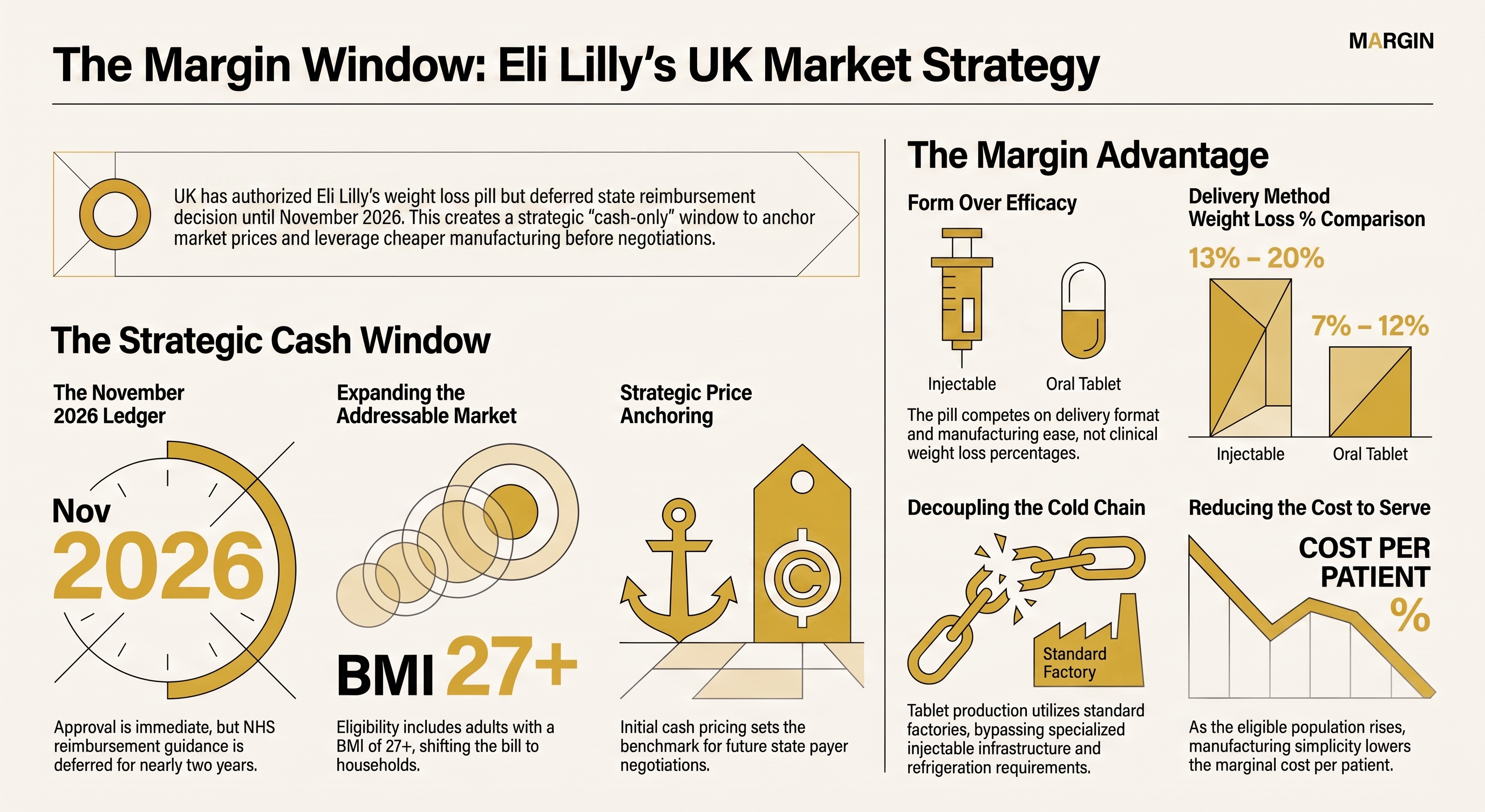 Download the one-page infographic
1. Introduction: The Approval That Wasn’t
The headlines out of the United Kingdom suggest a clinical revolution: the authorization of Orforglipron (branded as Foundo), the first once-daily oral GLP-1 receptor agonist to hit the European market. But to understand the true impact of this move, one must ignore the medical milestone and look at the schedule. The British regulator has cleared the drug, but the British state has declined to pay for it—at least for now. This creates a fascinating strategic paradox. While the press celebrates a new tool in the fight against obesity, the business reality is more nuanced. As the saying goes: Read the calendar, not the headline. The real story isn't about clinical efficacy; it’s about a company winning a specific window of time before the primary buyer ever walks into the room.
2. The 100-Day Cash Window: Strategy Over Science
In the UK pharmaceutical landscape, authorization and reimbursement are two separate hurdles. By clearing the Medicines and Healthcare products Regulatory Agency (MHRA), Eli Lilly has secured a "100-day window" where Foundo can be legally sold, yet the cost-effectiveness body that dictates National Health Service (NHS) coverage won’t issue its guidance until November 2026. This 18-month gap is not a bureaucratic oversight; it is a tactical masterstroke. For Lilly, this is a gross margin decision, not a clinical one. By separating these two milestones, Lilly avoids the immediate pricing pressures of a state monopsony while establishing an immediate presence in the private sector. As the strategic logic dictates: " Approval and reimbursement are two different doors and Lilly chose the cheaper one first. "
3. Form Over Function: Why Tablets Win Even When They Lose
If you judge Foundo purely on a clinical spreadsheet, it looks like a step backward. The data shows:
Orforglipron (Foundo) Tablet: 7% to 12% weight loss at low doses; 11.2% at the high dose.
Existing Injectables (Mounjaro/Wegovy): 13% to 20% weight loss. By the numbers, the pill loses. But Eli Lilly CEO David Ricks has been consistent: the pill’s advantage is not the result, it’s the form. Lilly is no longer competing solely on biological potency; they are competing on the "cost to serve. "Injectables require a "cold chain"—a complex, temperature-controlled logistics network—and specialized manufacturing capacity that is notoriously difficult to scale. Foundo, however, is produced in tablet factories. It moves from the boutique world of biologics into the mass-market world of consumer goods. In the words of the strategy: " Lilly competes on how the drug is made, not on how much weight it takes off. "
4. Expanding the Pool: Targeting the "Impatient" Buyer
The eligibility criteria for Foundo—adults with a BMI of 30+, or 27+ with a weight-related condition—is less about medical necessity and more about market expansion. By lowering the threshold, Lilly isn't just fighting for market share; they are enlarging the total addressable pool of patients at the exact moment the state has refused to foot the bill. This turns the MHRA approval into a marketing " Seal of Approval" for a private cash-pay tier. This isn't for the marginal patient waiting for an NHS script; it’s for the affluent consumer. "A cash channel does not price to the median household. It prices to whoever will not wait. "By validating the drug's safety and efficacy for a broader group, Lilly hands a demand curve to a private channel, shifting the financial burden from the government's ledger to the household's credit card.
5. The Anchor Effect: Negotiating With a Ghost
The most sophisticated part of this strategy is the " Anchor Effect. " By operating in a private cash window for 18 months before state reimbursement begins, Lilly is essentially negotiating with a ghost. The price established in the private market today becomes the baseline for the state’s negotiations in 2026. When the cost-effectiveness body finally sits down to talk, they won’t be starting from a blank page; they will be negotiating against a market price that has already been "baked in" to the culture and the economy. Lilly is effectively setting the value of the market before the primary buyer—the state—is even in the room.
6. Conclusion: The Ledger Opens in 2026
For those managing healthcare budgets, the old assumptions are now obsolete. Your medical trend projections were likely built on a population that could not easily access this class of drug due to supply chain bottlenecks or injection hesitancy. Those spreadsheets are now a relic of the past. The exposure to these costs won't arrive as a formal claim on a government ledger; it arrives as an expectation you have not budgeted for. As we look toward November 2026, the true intent of this strategy will be revealed. If the eventual state guidance is highly restrictive, it will prove that the private cash window wasn't a stopgap—it was the destination. We are entering an era where pharmaceutical "access" is a two-tiered system: one for those who wait for the state, and one for those who pay for the form. The headline says a country approved a pill; the reality is that a company just redefined the price of the market.